SAP Salary After 2-3 Years of Experience in India
Learn how much SAP professionals with 2–3 years of experience can earn in India. Discover salary ranges, high-paying SAP modules, industries hiring, and tips to increase your earning potential.
Introduction
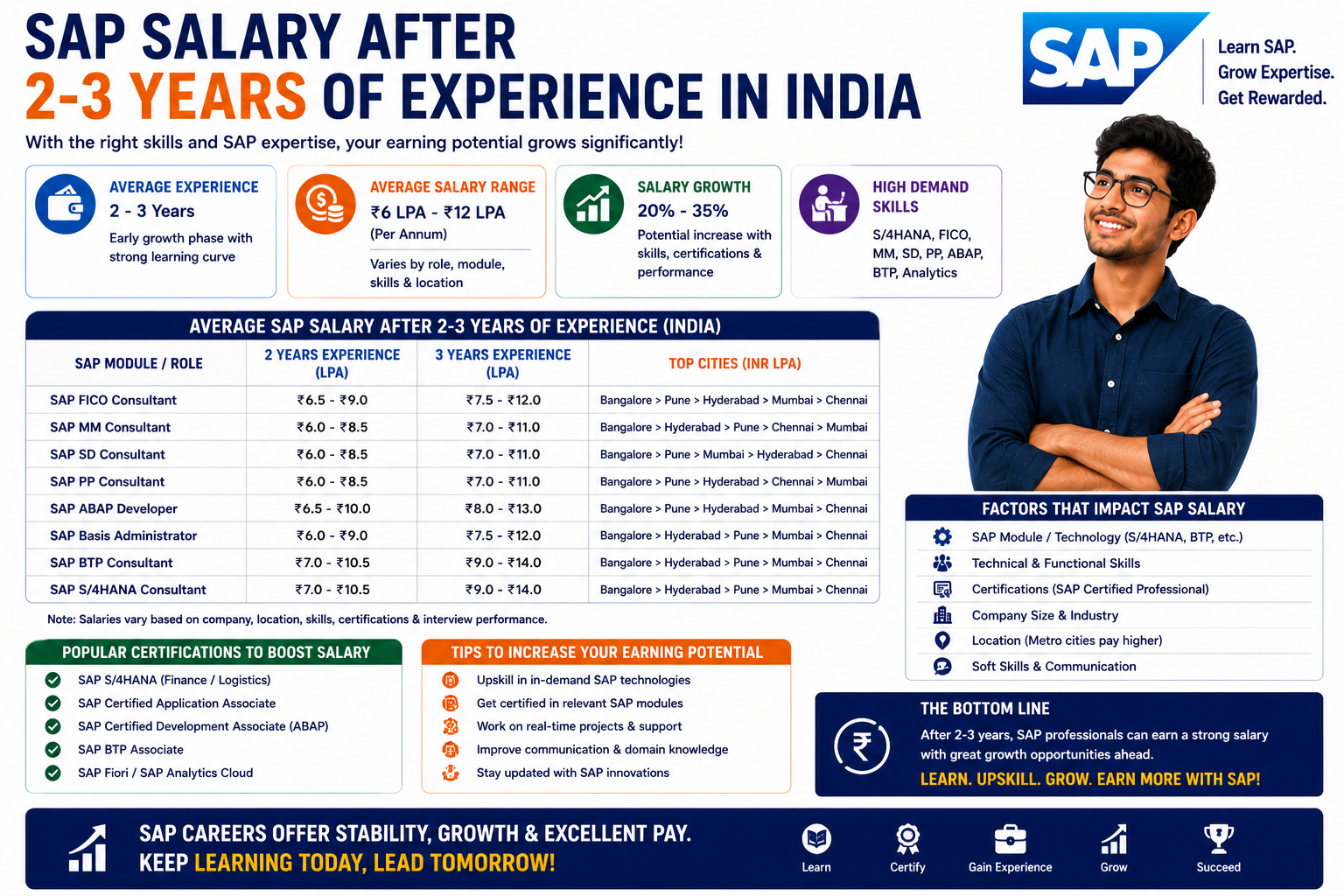
SAP professionals continue to be among the most sought-after IT and business consultants in India. After gaining two to three years of practical experience, many professionals begin seeing significant salary growth as they move beyond entry-level responsibilities and take on more complex business processes, client interactions, and implementation tasks.
A common question among SAP professionals is:
"How much can I earn after 2–3 years of SAP experience?"
"Which SAP modules offer the highest salary growth?"
The answer depends on your SAP specialization, technical skills, certifications, project experience, industry, and employer. This guide explains the average SAP salary after two to three years of experience, factors that influence earnings, and practical tips to maximize your career growth.
Why Do SAP Salaries Increase After 2–3 Years?
The first few years in an SAP career are focused on building technical expertise and understanding business processes. Once professionals gain hands-on experience, they become more valuable because they can independently solve business problems and contribute to implementation or support projects.
Employers value professionals who can:
- Configure SAP modules
- Handle client requirements
- Resolve business issues
- Support implementation projects
- Work independently
- Collaborate with cross-functional teams
- Deliver business value
This increased responsibility is one of the main reasons salaries grow after gaining experience.
Average SAP Salary After 2–3 Years in India
The table below provides a general estimate of salary ranges in India. Actual salaries vary depending on the company, city, SAP module, and individual skills.
| Experience | Typical Annual Salary (Approx.) |
|---|---|
| Fresher (0–1 Year) | ₹3.5 LPA – ₹6 LPA |
| 2 Years | ₹6 LPA – ₹10 LPA |
| 3 Years | ₹8 LPA – ₹14 LPA |
| 5+ Years | ₹12 LPA – ₹22+ LPA |
Note: These are indicative market ranges. Professionals working in high-demand SAP modules, consulting firms, or global implementation projects may earn higher compensation.
Factors That Influence SAP Salary
Not every SAP professional with the same experience earns the same salary.
Your earning potential depends on:
- SAP module specialization
- SAP S/4HANA knowledge
- Implementation project experience
- Support vs consulting role
- Industry domain expertise
- Location
- Certifications
- Communication skills
- Problem-solving ability
Professionals who continuously upgrade their skills generally experience faster salary growth.
Highest Paying SAP Modules
Some SAP specializations tend to offer stronger salary growth because of higher market demand.
Popular high-paying SAP modules include:
- SAP S/4HANA
- SAP FICO
- SAP MM
- SAP SD
- SAP SuccessFactors
- SAP BTP
- SAP ABAP on HANA
- SAP EWM
- SAP Ariba
- SAP IBP
Choosing a module should depend on your interests and background rather than salary alone.
Salary by Job Role
Different SAP roles come with different responsibilities and compensation levels.
| SAP Role | Typical Salary After 2–3 Years (Approx.) |
|---|---|
| SAP Support Consultant | ₹6 LPA – ₹9 LPA |
| SAP Functional Consultant | ₹7 LPA – ₹12 LPA |
| SAP Technical Consultant | ₹7 LPA – ₹13 LPA |
| SAP Implementation Consultant | ₹8 LPA – ₹14 LPA |
| SAP BTP Consultant | ₹8 LPA – ₹15 LPA |
Actual salaries vary depending on project complexity and employer.
Industries Hiring Experienced SAP Professionals
SAP professionals with 2–3 years of experience are in demand across multiple industries.
Major hiring sectors include:
- Information Technology
- Manufacturing
- Banking and Financial Services
- Healthcare
- Retail
- Automotive
- Pharmaceuticals
- Oil and Gas
- Logistics
- Consulting
As more organizations adopt SAP S/4HANA and cloud solutions, opportunities continue to grow.
How to Increase Your SAP Salary Faster
If your goal is to maximize salary growth, focus on building practical expertise.
Recommended strategies include:
- Learn SAP S/4HANA.
- Gain implementation project experience.
- Earn relevant SAP certifications.
- Improve communication skills.
- Learn integration concepts.
- Work on real-world business scenarios.
- Stay updated with new SAP technologies.
- Build expertise in a niche SAP module.
Continuous learning often leads to better career opportunities and higher-paying roles.
Career Progression After 2–3 Years
With consistent performance and learning, professionals can move into higher-level positions such as:
- Senior SAP Consultant
- SAP Functional Lead
- SAP Technical Consultant
- SAP Solution Consultant
- SAP Project Coordinator
- SAP Business Analyst
These roles often bring increased responsibilities, leadership opportunities, and higher salaries.
Common Mistakes That Slow Salary Growth
Many professionals unintentionally limit their earning potential.
Avoid these common mistakes:
- Remaining in the same role without learning new skills.
- Ignoring SAP S/4HANA and cloud technologies.
- Avoiding implementation projects.
- Not improving communication skills.
- Relying only on experience without continuous learning.
- Delaying certification or professional development.
Keeping your skills current is essential in the rapidly evolving SAP ecosystem.
Salary Growth Roadmap
| Career Stage | Primary Focus | Expected Outcome |
|---|---|---|
| 0–1 Year | Learn SAP fundamentals and business processes | Build foundational knowledge |
| 2–3 Years | Gain implementation/support experience and specialize | Significant salary growth |
| 4–6 Years | Lead projects and develop niche expertise | Senior consultant opportunities |
| 7+ Years | Solution architecture, leadership, and consulting | High-paying leadership roles |
Frequently Asked Questions (FAQs)
Q1. How much can an SAP consultant earn after 2 years in India?
Many SAP professionals with around two years of experience earn approximately ₹6 LPA to ₹10 LPA, depending on their SAP module, company, and practical experience.
Q2. Does SAP S/4HANA increase salary potential?
Yes. Professionals with SAP S/4HANA expertise are often preferred for modernization and implementation projects, which can improve career opportunities.
Q3. Which SAP module pays the highest after 3 years?
High-demand modules such as SAP BTP, SAP S/4HANA, SAP SuccessFactors, SAP EWM, and specialized consulting roles often offer strong salary potential.
Q4. Can certifications improve SAP salary?
Yes. Certifications, combined with practical project experience and strong business process knowledge, can strengthen your profile and support salary growth.
Q5. Is SAP still a good career choice in India?
Yes. SAP continues to be widely adopted across industries, creating strong demand for skilled consultants in both functional and technical domains.
Conclusion
After gaining two to three years of experience, SAP professionals in India often see meaningful salary growth as they take on greater responsibilities and contribute more effectively to business and technology projects. While salary depends on multiple factors—including specialization, experience, certifications, and employer—continuous learning remains the biggest driver of long-term success.
If you focus on developing practical SAP skills, understanding business processes, gaining implementation experience, and staying updated with technologies such as SAP S/4HANA and SAP BTP, you'll be well positioned for higher-paying opportunities and sustained career growth in the SAP ecosystem.
Get Training Quote for Free
Related Blogs

Top Interview Questions for Java Backend Developers
This blog covers top Java backend interview questions with clear answers, focusing on Spring Boot, REST APIs, Hibernate, security, and performance to help freshers and professionals prepare confidently.

What You Will Learn in a Professional MySQL Course – Curriculum Explained
In today’s data-driven world, databases play a critical role in almost every application, from small websites to large enterprise systems. Among all database technologies, MySQL continues to be one of the most widely used and trusted solutions across industries. If you are planning to build a career in database management, web development, or data-related roles, enrolling in professional mysql courses can be a smart and future-proof decision. This blog explains in detail what you will learn in a professional MySQL course, how the curriculum is structured, and why choosing the best mysql course can make a real difference in your career growth.

How Can You Get Ready for a Data Science Interview After Finishing a Course?
Preparing for a data science interview is an important step after completing a data science course. While training helps you learn key concepts, interviews require you to demonstrate practical knowledge, problem-solving ability, and clear communication. This blog explains how reviewing core data science concepts, practicing real-world projects, strengthening programming skills, and preparing common interview questions can help candidates succeed. It also highlights the importance of building a strong portfolio, improving communication skills, and staying updated with industry trends to increase your chances of starting a successful career in data science.

Java Courses: The Smart Way to Build a Strong Programming Career
This blog explains why Java remains a top programming language, highlights the benefits of Java courses and online training, and shows how certification and hands-on learning can boost career growth.