Popular
How Much Experience Do You Need for 40-60k Per Month SAP Salary?
Akram
July 2, 2026
5 min read
Want to earn ₹40,000–₹60,000 per month as an SAP professional? Discover how much experience you need, the skills employers expect, salary progression, and practical steps to reach this career milestone.
Introduction
One of the biggest motivations for learning SAP is the opportunity to earn a competitive salary. Many fresh graduates and working professionals entering the SAP ecosystem often ask whether earning ₹40,000 to ₹60,000 per month is realistic and how long it typically takes to reach that income level.
Common questions include:
"Can a fresher earn ₹50,000 per month in SAP?"
"How many years of experience do I need to reach a ₹40K–₹60K monthly salary?"
The answer depends on several factors, including your SAP module, practical project experience, certifications, industry, employer, and communication skills. While some professionals achieve this salary within their first year, others may take longer depending on their career path. This guide explains what employers look for and how you can reach this salary range.
Is ₹40K–₹60K Per Month a Good SAP Salary?
Yes. A monthly salary of ₹40,000 to ₹60,000 (approximately ₹4.8–₹7.2 LPA) is considered a solid early-career milestone for many SAP professionals in India.
This salary range is commonly seen in roles such as:
- SAP Associate Consultant
- SAP Functional Consultant
- SAP Technical Consultant
- SAP Support Consultant
- SAP Analyst
- SAP Application Consultant
Actual salaries vary depending on your city, company, SAP module, and project experience.
How Much Experience Is Typically Required?
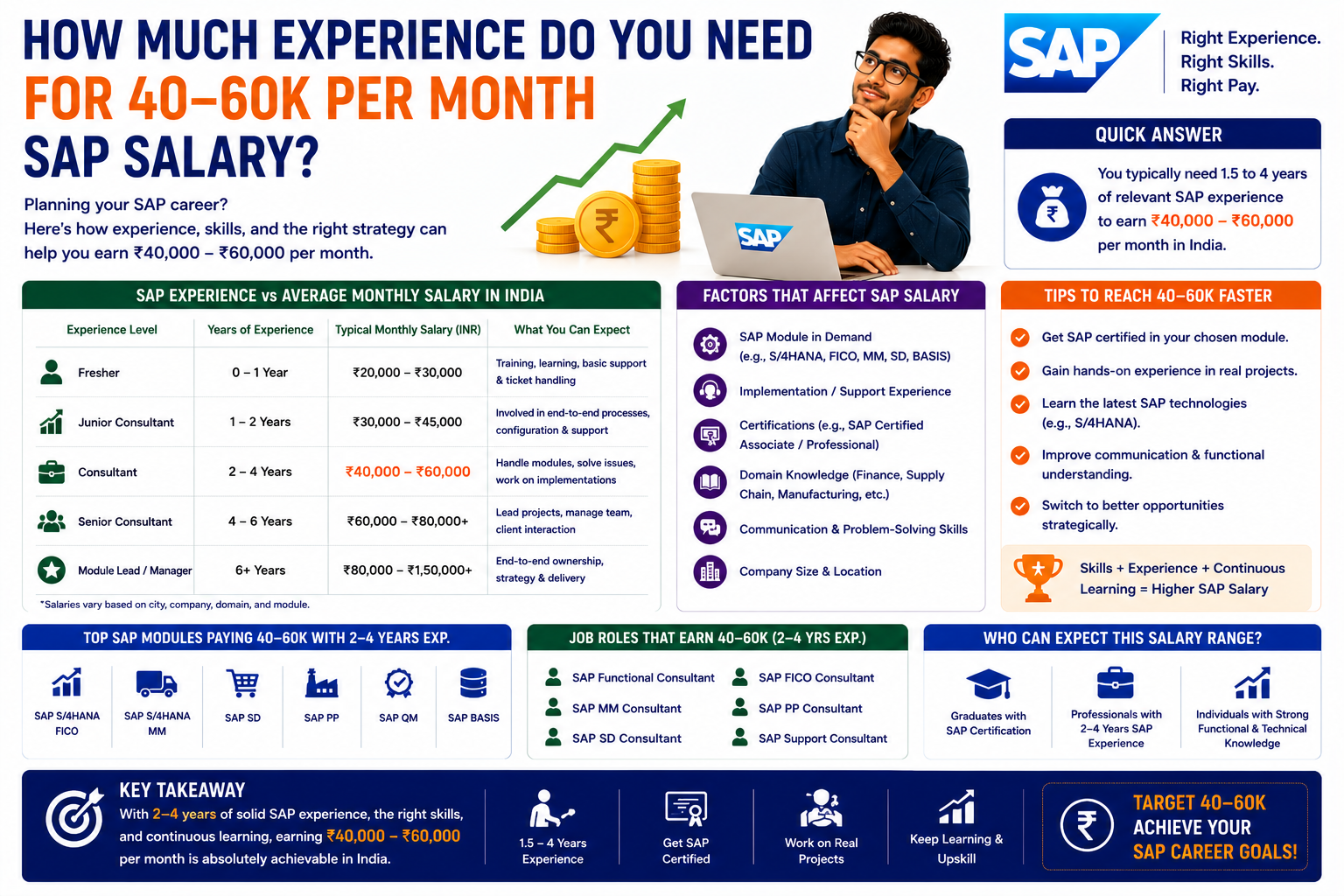
For many SAP professionals, reaching a ₹40K–₹60K monthly salary usually requires 0 to 2 years of relevant SAP experience.
A general progression looks like this:
| Experience | Approximate Monthly Salary |
|---|---|
| Fresher (0–6 Months) | ₹25,000 – ₹40,000 |
| 6 Months – 1 Year | ₹35,000 – ₹50,000 |
| 1–2 Years | ₹40,000 – ₹60,000 |
| 2–4 Years | ₹60,000 – ₹90,000 |
| 5+ Years | ₹1 Lakh+ (depending on role and expertise) |
These figures are approximate and can vary significantly based on skills and employer.
Factors That Influence Your Salary
Several factors determine how quickly you reach this salary range.
SAP Module
Some SAP modules may have stronger market demand depending on industry needs.
Popular modules include:
Demand changes over time, so continuous learning is important.
Practical Project Experience
Employers value candidates who can demonstrate real-world SAP knowledge.
Experience with:
- Implementations
- Support projects
- Testing
- SAP S/4HANA
- Business process mapping
can improve both employability and salary prospects.
Communication Skills
SAP consultants frequently interact with business users, managers, and clients.
Strong communication skills help you:
- Gather requirements.
- Explain solutions clearly.
- Conduct user training.
- Collaborate with project teams.
Professionals with good communication often progress more quickly.
SAP S/4HANA Knowledge
Organizations continue migrating to SAP S/4HANA.
Candidates familiar with:
- SAP S/4HANA navigation
- Modern business processes
- Fiori applications
- Cloud technologies
are often more competitive in the job market.
Skills Employers Expect
To earn ₹40K–₹60K per month, employers generally expect you to have:
- Strong knowledge of one SAP module.
- Understanding of business processes.
- Practical SAP system experience.
- Basic troubleshooting skills.
- Documentation abilities.
- Analytical thinking.
- Communication skills.
- Willingness to learn continuously.
Technical knowledge alone is rarely enough; business understanding is equally important.
Which Industries Offer These Salaries?
Many industries hire SAP professionals within this salary range.
Common sectors include:
- IT Services
- Manufacturing
- Retail
- Banking
- Healthcare
- Pharmaceuticals
- Logistics
- Automobile
- Consulting
- FMCG
Large enterprises and consulting firms often provide faster career progression.
Can Freshers Earn ₹40K–₹60K Per Month?
Yes, some freshers do, but it depends on several factors.
Fresh graduates may reach this salary if they have:
- High-quality SAP training.
- Strong interview performance.
- Practical project exposure.
- Knowledge of SAP S/4HANA.
- Good communication skills.
- Relevant internships or domain knowledge.
Not every fresher starts at this level, but it's an achievable target for well-prepared candidates.
How to Reach ₹40K–₹60K Faster
You can improve your chances by following a structured learning plan.
1. Master One SAP Module
Develop deep expertise instead of learning multiple modules superficially.
2. Practice Real Business Scenarios
Work on case studies involving:
- Procurement
- Finance
- Sales
- Inventory
- Payroll
Understanding business processes is essential.
3. Learn SAP S/4HANA
Modern SAP projects increasingly use SAP S/4HANA.
Learning the latest platform enhances your profile.
4. Build Interview Confidence
Prepare for:
- Technical interviews
- Functional scenarios
- HR discussions
- Business process questions
Confident candidates often receive better offers.
5. Continue Learning
Keep upgrading your skills with:
- SAP cloud solutions
- Analytics
- Business process improvements
- Industry trends
Continuous learning supports long-term salary growth.
Common Mistakes That Delay Salary Growth
Many professionals slow their career progression by:
- Focusing only on theory.
- Ignoring practical experience.
- Learning multiple modules without mastering one.
- Neglecting communication skills.
- Avoiding interview preparation.
- Not staying updated with SAP S/4HANA.
Avoiding these mistakes can accelerate your career.
Frequently Asked Questions (FAQs)
Q1. Is ₹40K–₹60K per month achievable in SAP?
Yes. Many SAP professionals reach this salary range within their first two years by combining strong technical knowledge with practical experience and good communication skills.
Q2. Which SAP modules offer better salary growth?
Modules such as SAP FICO, MM, SD, SuccessFactors, ABAP, BTP, and SAP Analytics Cloud often provide strong career opportunities, although demand varies by industry and market trends.
Q3. Do SAP certifications guarantee a ₹50K monthly salary?
No. Certifications can strengthen your profile, but employers also evaluate practical skills, project experience, and problem-solving abilities.
Q4. Can freshers earn ₹50K per month?
Some freshers receive offers within this range, especially if they have quality training, practical exposure, and perform well during interviews. However, starting salaries differ between companies.
Q5. What is the fastest way to increase my SAP salary?
Focus on mastering one SAP module, gain practical project experience, improve communication skills, learn SAP S/4HANA, and continue upgrading your knowledge as technology evolves.
Conclusion
Earning ₹40,000–₹60,000 per month as an SAP professional is a realistic goal for many candidates, especially within the first two years of their career. Your success depends on much more than completing a training course—it requires practical experience, business process knowledge, interview preparation, and continuous learning.
By specializing in one SAP module, gaining hands-on exposure, understanding SAP S/4HANA, and developing strong communication skills, you can position yourself for better job opportunities and faster salary growth. With consistent effort and the right career strategy, this salary milestone can be an important stepping stone toward a successful long-term SAP consulting career.
SAP Salary
SAP Career
SAP Jobs
SAP Consultant
SAP Experience
SAP Training
SAP S/4HANA
SAP Fresher
SAP Salary India
ERP Career


