Popular
What Skills Besides SAP Will Help Me Get Hired?
Akram
July 1, 2026
5 min read
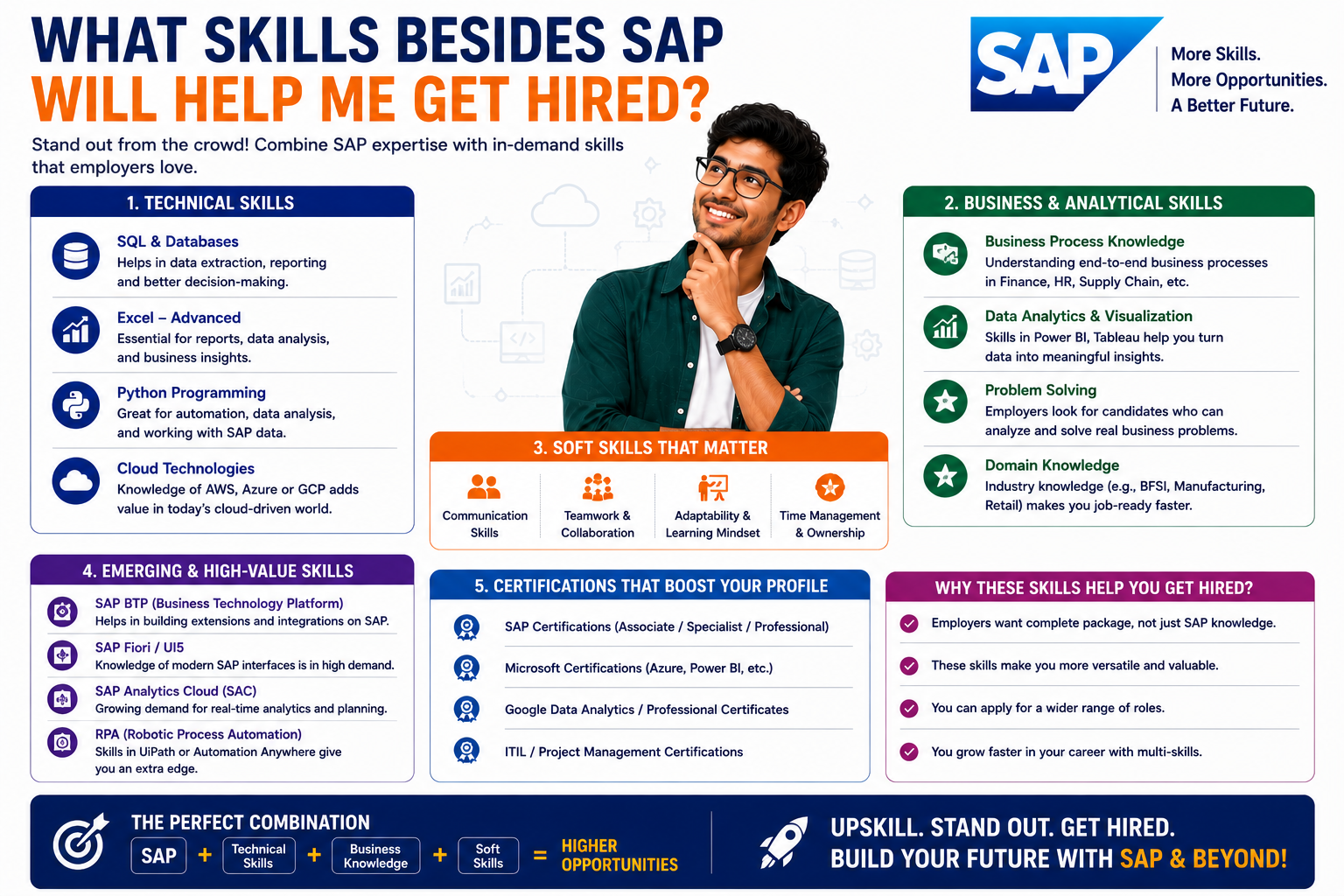
Learn the most valuable skills beyond SAP that employers expect from freshers and experienced professionals. Discover how communication, business knowledge, Excel, SQL, and analytical thinking can help you secure an SAP job.
Introduction
Learning SAP is an excellent first step toward building a successful career in enterprise technology. However, employers rarely hire candidates based on SAP knowledge alone. Whether you're a fresher or an experienced professional, companies look for individuals who can solve business problems, communicate effectively, and work collaboratively within project teams.
Many job seekers ask:
"Is learning SAP enough to get a job?"
"What additional skills do recruiters expect from SAP professionals?"
The truth is that combining SAP expertise with business knowledge, technical skills, and strong communication makes you a far more competitive candidate. This guide explores the most valuable skills that can help you stand out and increase your chances of getting hired.
Why Employers Look Beyond SAP Skills
SAP is a business application used across finance, procurement, sales, manufacturing, human resources, and supply chain operations. Because of this, SAP professionals regularly interact with business users, managers, developers, and consultants.
Recruiters therefore look for candidates who can:
- Understand business requirements
- Communicate clearly
- Analyze problems
- Work in teams
- Learn new technologies
- Adapt to changing business needs
These complementary skills make SAP professionals more productive and valuable.
1. Business Process Knowledge
One of the most important skills is understanding how businesses operate.
Learn concepts such as:
- Procure-to-Pay (P2P)
- Order-to-Cash (O2C)
- Record-to-Report (R2R)
- Hire-to-Retire (H2R)
- Inventory Management
- Financial Accounting
Understanding business workflows allows you to explain not only how SAP works, but why companies use it.
2. Communication Skills
Excellent communication is essential for every SAP consultant.
You'll frequently need to:
- Gather client requirements
- Explain SAP solutions
- Conduct meetings
- Prepare documentation
- Support end users
- Present project updates
Good communication builds trust with clients and project teams.
3. Microsoft Excel
Excel remains one of the most commonly used tools alongside SAP.
Useful Excel skills include:
- Pivot Tables
- VLOOKUP/XLOOKUP
- INDEX & MATCH
- Conditional Formatting
- Data Validation
- Charts and Dashboards
- Basic Macros
Many organizations use Excel for reporting, reconciliation, and data analysis.
4. SQL Basics
While every SAP role doesn't require SQL, understanding databases is a valuable advantage.
Learning SQL helps you:
- Retrieve business data
- Understand database structures
- Analyze reports
- Validate SAP information
- Support troubleshooting
Basic SQL knowledge is especially useful for consultants working with analytics or reporting.
5. Analytical and Problem-Solving Skills
SAP consultants solve business challenges every day.
Employers value candidates who can:
- Identify issues
- Analyze root causes
- Suggest practical solutions
- Improve business processes
- Think logically
Strong analytical thinking often distinguishes high-performing consultants.
6. Understanding SAP S/4HANA
Modern organizations are increasingly adopting SAP S/4HANA.
Learning the basics of:
- SAP S/4HANA
- SAP Fiori
- Cloud ERP
- Business process changes
can significantly improve your employability.
7. Documentation Skills
SAP projects require extensive documentation.
You should know how to prepare:
- Functional specifications
- Business process documents
- Test cases
- User manuals
- Training documents
- Meeting notes
Clear documentation improves collaboration across project teams.
8. Teamwork and Collaboration
SAP implementation projects involve multiple departments.
You'll often work with:
- Functional consultants
- Technical consultants
- Developers
- Business users
- Project managers
- Testing teams
Being a collaborative team member is highly valued by employers.
9. Interview and Presentation Skills
Even highly skilled candidates can lose opportunities if they struggle during interviews.
Prepare to:
- Explain SAP concepts confidently
- Discuss projects clearly
- Answer business scenario questions
- Present your strengths professionally
Practice through mock interviews to improve confidence.
10. Continuous Learning Mindset
SAP technology evolves rapidly with innovations such as:
- SAP S/4HANA
- SAP Business Technology Platform (BTP)
- SAP Fiori
- SAP SuccessFactors
- SAP Analytics Cloud
- Artificial Intelligence
Employers prefer candidates who actively update their skills and embrace continuous learning.
Skills Employers Value the Most
| Skill | Why It Matters |
|---|---|
| Business Process Knowledge | Understands real business operations |
| Communication Skills | Improves client interaction |
| Microsoft Excel | Supports reporting and analysis |
| SQL Basics | Helps with data retrieval and validation |
| Analytical Thinking | Solves business problems effectively |
| SAP S/4HANA Knowledge | Matches modern enterprise requirements |
| Documentation Skills | Supports implementation projects |
| Teamwork | Enables successful project delivery |
| Presentation Skills | Improves stakeholder communication |
| Continuous Learning | Keeps skills relevant in the SAP ecosystem |
Skills Roadmap for SAP Freshers
If you're starting your SAP career, follow this roadmap:
- Learn ERP and SAP fundamentals.
- Choose an SAP specialization.
- Understand business processes.
- Improve Microsoft Excel skills.
- Learn basic SQL.
- Study SAP S/4HANA concepts.
- Build communication and presentation skills.
- Complete practical SAP projects.
- Prepare for interviews.
- Continue learning new SAP technologies.
Following this roadmap helps you become a well-rounded SAP professional.
Common Mistakes to Avoid
Avoid these mistakes when preparing for SAP jobs:
- Focusing only on SAP transaction codes.
- Ignoring business process understanding.
- Neglecting soft skills.
- Avoiding Excel and SQL.
- Not practicing interviews.
- Assuming certification alone guarantees employment.
Employers look for complete professionals—not just software users.
Frequently Asked Questions (FAQs)
Q1. Is SAP knowledge alone enough to get hired?
No. Most employers also evaluate communication skills, business process knowledge, analytical thinking, and practical experience.
Q2. Is Excel important for SAP professionals?
Yes. Excel is widely used for reporting, reconciliation, analysis, and handling business data alongside SAP.
Q3. Should I learn SQL with SAP?
Basic SQL is beneficial, especially for reporting, analytics, and understanding how business data is stored and retrieved.
Q4. Are communication skills important in SAP consulting?
Absolutely. SAP consultants regularly interact with clients, business users, and project teams, making communication one of the most valuable skills.
Q5. What is the best way to improve my chances of getting hired?
Develop strong SAP fundamentals, understand business processes, build practical project experience, improve soft skills, and prepare thoroughly for interviews.
Conclusion
SAP expertise is a valuable foundation, but employers seek professionals who can combine technical knowledge with business understanding, communication, and problem-solving abilities. Skills such as Microsoft Excel, SQL, documentation, teamwork, and analytical thinking complement your SAP knowledge and make you more effective in real-world projects.
If you invest in both technical and professional development, you'll not only improve your chances of landing your first SAP job but also build a strong foundation for long-term career growth in the SAP ecosystem.
SAP Skills
SAP Career
SAP Jobs
SAP Freshers
Business Process
Excel
SQL
Communication Skills
SAP Interview
SAP Consultant


