Popular
SAP MM Course: What Will I Learn and What Jobs Can I Get?
Akram
July 2, 2026
5 min read
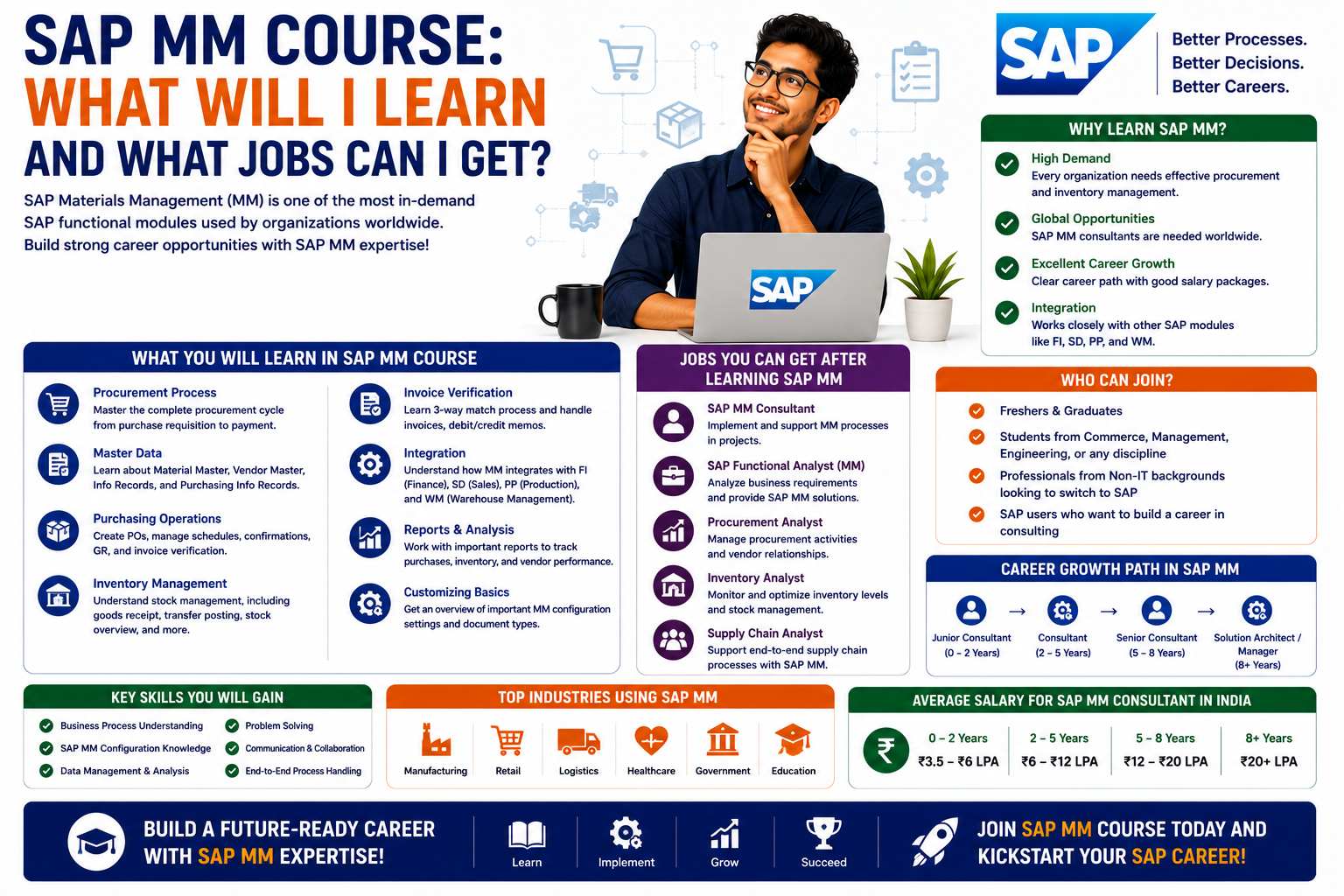
Thinking about learning SAP MM? Explore what you'll study in an SAP MM course, the practical skills you'll develop, career opportunities, salary expectations, and why SAP Materials Management remains one of the most in-demand SAP modules.
Introduction
Supply chain and procurement play a vital role in every successful business. From purchasing raw materials to managing inventory and vendor relationships, companies rely on efficient processes to keep operations running smoothly. SAP Materials Management (SAP MM) is one of the most widely used SAP modules for managing procurement and inventory across industries.
Many students and professionals considering SAP training often ask:
"What will I actually learn in an SAP MM course?"
"What kind of jobs can I get after learning SAP MM?"
The answer is that SAP MM training goes beyond learning software. It teaches you how businesses manage purchasing, inventory, warehouse operations, and vendor relationships using SAP ERP and SAP S/4HANA. This guide explains what you'll learn, the practical skills you'll gain, career opportunities, salary expectations, and why SAP MM is an excellent career choice.
What Is SAP MM?
SAP MM (Materials Management) is a functional module within SAP ERP that helps organizations manage procurement, inventory, material planning, vendor management, and warehouse operations.
It supports the complete procurement lifecycle, ensuring that materials are available when needed while minimizing costs and improving operational efficiency.
SAP MM integrates with other SAP modules such as:
This integration allows organizations to streamline end-to-end business processes.
What Will You Learn in an SAP MM Course?
A comprehensive SAP MM course covers both business concepts and practical SAP configuration.
1. SAP MM Fundamentals
You'll begin by understanding the basics of SAP ERP and the role of Materials Management in business operations.
Topics include:
- Introduction to SAP ERP
- SAP S/4HANA overview
- SAP navigation
- Organizational structure
- Enterprise procurement process
- Material lifecycle
This foundation helps beginners understand how SAP MM fits into an organization's supply chain.
2. Organizational Structure in SAP MM
Understanding organizational elements is essential before configuring SAP MM.
You'll learn about:
- Client
- Company Code
- Plant
- Storage Location
- Purchasing Organization
- Purchasing Group
These structures define how procurement activities are managed within SAP.
3. Master Data Management
Master data forms the backbone of SAP MM.
You'll learn how to manage:
- Material Master
- Vendor Master
- Purchasing Information Records
- Source Lists
- Quota Arrangements
Accurate master data ensures smooth procurement and inventory operations.
4. Procurement Process
Procurement is one of the most important topics in [SAP MM.
You'll learn how organizations manage:
- Purchase Requisitions
- Requests for Quotation (RFQ)
- Quotations
- Purchase Orders
- Contracts
- Scheduling Agreements
You'll also understand the complete Procure-to-Pay (P2P) process used in real businesses.
5. Inventory Management
Inventory management ensures that materials are available without excessive stock.
Topics include:
- Goods Receipt
- Goods Issue
- Stock Transfer
- Physical Inventory
- Stock Overview
- Inventory Valuation
You'll learn how SAP tracks materials throughout the supply chain.
6. Invoice Verification
SAP MM integrates closely with finance.
You'll understand:
- Invoice Verification
- Three-Way Matching
- Invoice Posting
- Vendor Payments
- Procurement Accounting
This ensures accurate financial and procurement records.
7. Material Requirement Planning (MRP)
MRP helps organizations maintain the right inventory levels.
You'll learn:
- Demand Planning
- Procurement Planning
- Material Planning
- Stock Availability
- Reorder Planning
MRP is especially important in manufacturing and production environments.
Practical Skills You Will Gain
After completing an SAP MM course, you'll be able to:
- Create and manage purchase orders.
- Maintain material and vendor master data.
- Perform goods receipt and goods issue transactions.
- Manage inventory efficiently.
- Process procurement documents.
- Support invoice verification.
- Understand end-to-end procurement processes.
- Work with SAP MM reports and analytics.
These practical skills make you job-ready for SAP MM roles.
Who Should Learn SAP MM?
SAP MM is suitable for:
- Fresh Graduates
- Supply Chain Professionals
- Procurement Executives
- Purchase Officers
- Warehouse Managers
- Inventory Controllers
- Logistics Professionals
- Mechanical Engineers
- MBA Operations Graduates
- ERP Professionals
Even candidates without prior SAP experience can learn SAP MM with proper training.
Career Opportunities After SAP MM Training
Completing an SAP MM course opens the door to various career opportunities.
Common job roles include:
- SAP MM Consultant
- SAP MM Support Consultant
- SAP Procurement Consultant
- SAP Functional Consultant
- Materials Management Executive
- Inventory Analyst
- Purchase Executive
- Supply Chain Analyst
- SAP S/4HANA MM Consultant
- ERP Consultant
Many organizations also hire freshers as SAP Associate Consultants or Graduate Trainees.
Industries Hiring SAP MM Professionals
SAP MM professionals are in demand across multiple sectors, including:
- Manufacturing
- Automobile
- Retail
- Healthcare
- Pharmaceuticals
- FMCG
- Logistics
- Oil and Gas
- Construction
- E-commerce
Since procurement and inventory are essential for every business, SAP MM professionals enjoy broad career opportunities.
Average SAP MM Salary in India
SAP MM offers competitive salaries that grow with experience.
| Experience | Approximate Salary |
|---|---|
| Fresher | ₹3.5 LPA – ₹6 LPA |
| 1–3 Years | ₹6 LPA – ₹10 LPA |
| 3–5 Years | ₹10 LPA – ₹15 LPA |
| 5–8 Years | ₹15 LPA – ₹22 LPA |
| 8+ Years | ₹22 LPA and above |
Actual salaries depend on project experience, certifications, employer, and location.
Tips to Build a Successful SAP MM Career
To maximize your career opportunities:
- Understand procurement business processes.
- Practice real-time SAP MM scenarios.
- Learn SAP S/4HANA MM concepts.
- Improve communication skills.
- Gain hands-on project experience.
- Stay updated with new SAP technologies.
- Prepare thoroughly for SAP MM interviews.
Continuous learning and practical exposure are key to long-term success.
Frequently Asked Questions (FAQs)
Q1. Is SAP MM easy to learn?
Yes. SAP MM is beginner-friendly, especially for candidates with an interest in procurement, inventory, logistics, or supply chain management.
Q2. Can freshers get jobs after completing an SAP MM course?
Yes. Many companies hire freshers for trainee, support consultant, and associate consultant roles after they complete SAP MM training and demonstrate practical knowledge.
Q3. Is coding required for SAP MM?
No. SAP MM is a functional module, so programming knowledge is generally not required.
Q4. Which industries hire SAP MM consultants?
Manufacturing, retail, healthcare, logistics, automobile, pharmaceuticals, FMCG, and many other industries actively recruit SAP MM professionals.
Q5. Is SAP MM a good career choice in 2026?
Absolutely. As organizations continue adopting SAP S/4HANA and modern supply chain solutions, the demand for skilled SAP MM consultants remains strong in India and globally.
Conclusion
SAP MM is an excellent career choice for professionals interested in procurement, inventory management, logistics, and supply chain operations. A well-structured SAP MM course not only teaches you how to use SAP software but also helps you understand real-world business processes that organizations rely on every day.
With growing demand for SAP S/4HANA professionals, strong salary potential, and opportunities across multiple industries, learning SAP MM can open the door to a stable and rewarding career. By combining practical training, project experience, and continuous learning, you can confidently build a successful future as an SAP MM consultant.
SAP MM
SAP Materials Management
SAP MM Course
SAP MM Jobs
SAP MM Career
SAP MM Consultant
SAP Training
SAP S/4HANA
ERP
Supply Chain


