Popular
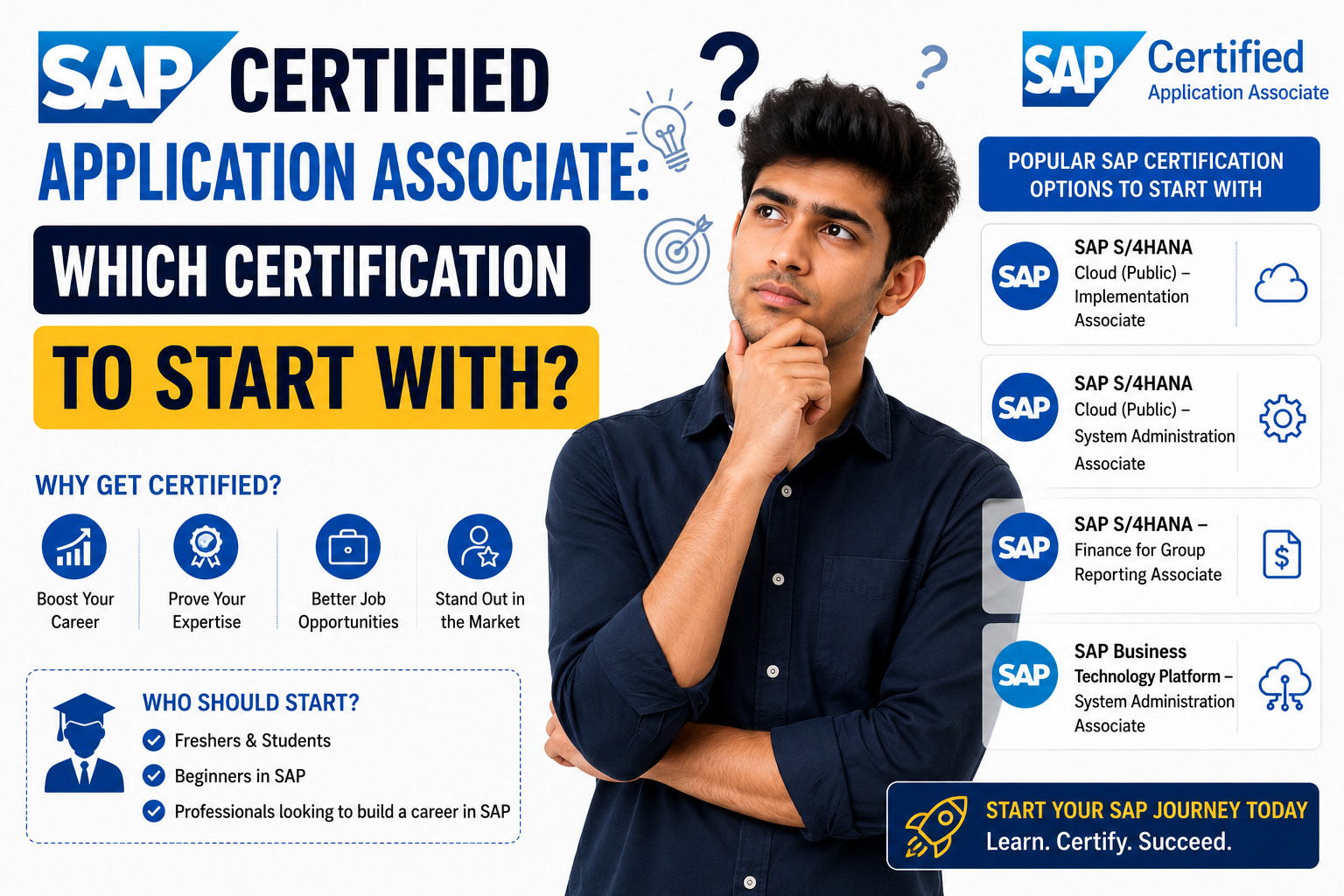
SAP Certified Application Associate: Which Certification to Start With?
Akram
June 30, 2026
5 min read
Learn which SAP Certified Application Associate certification is best for beginners. Compare popular SAP certifications, career opportunities, and tips to choose the right path.
Introduction
If you're planning to build a career in SAP, you've probably come across the SAP Certified Application Associate certification. It is one of the most recognized entry-level SAP certifications and is designed to validate your knowledge of specific SAP modules and business processes.
However, with multiple certification paths available, beginners often wonder: "Which SAP Certified Application Associate certification should I start with?" The answer depends on your educational background, career goals, and the SAP module you want to specialize in. In this guide, we'll explore the most popular certification options and help you choose the right starting point.
What Is SAP Certified Application Associate?
The SAP Certified Application Associate credential validates foundational knowledge of SAP solutions and the ability to apply core business processes in a specific functional or technical module.
It is suitable for:
- Fresh graduates
- Working professionals
- Career changers
- ERP beginners
- Consultants looking to validate their skills
This certification demonstrates that you understand SAP concepts and are prepared for entry-level implementation or support roles.
Popular SAP Certified Application Associate Certifications
Some of the most popular certifications include:
SAP S/4HANA Financial Accounting (SAP FICO)
Ideal for finance and accounting professionals.
You'll learn:
- Financial Accounting
- General Ledger
- Accounts Payable
- Accounts Receivable
- Asset Accounting
- Financial Reporting
Best For: B.Com, M.Com, MBA Finance, Accountants, Finance Professionals.
SAP S/4HANA Sourcing and Procurement (SAP MM)
Designed for professionals interested in procurement and supply chain management.
Key topics include:
- Purchasing
- Vendor Management
- Inventory Management
- Material Master
- Procurement Processes
Best For: Supply Chain Professionals, Operations Graduates, Procurement Executives.
SAP S/4HANA Sales (SAP SD)
Focuses on sales and customer order management.
Topics covered include:
- Sales Orders
- Pricing
- Billing
- Shipping
- Customer Management
Best For: Sales Professionals, MBA Marketing Graduates, Business Analysts.
SAP S/4HANA Asset Management
Suitable for professionals working in maintenance and asset management.
Topics include:
- Equipment Management
- Preventive Maintenance
- Work Orders
- Asset Performance
SAP SuccessFactors
A cloud-based certification for HR professionals.
Modules include:
- Employee Central
- Recruiting
- Performance Management
- Learning Management
Best For: HR Graduates and Human Resource Professionals.
How to Choose the Right Certification
Choose your SAP certification based on your educational background and career aspirations.
| Educational Background | Recommended Certification |
|---|---|
| B.Com, M.Com, MBA Finance | SAP S/4HANA Financial Accounting |
| BBA, MBA Operations | SAP S/4HANA Sourcing and Procurement |
| MBA Marketing | SAP S/4HANA Sales |
| HR Graduates | SAP SuccessFactors |
| IT Graduates | SAP Technical Certifications or SAP S/4HANA |
Selecting the right certification increases your chances of building a successful SAP career.
Benefits of SAP Certified Application Associate
Earning this certification can help you:
- Validate your SAP knowledge
- Improve your resume
- Increase interview opportunities
- Build confidence in SAP concepts
- Support long-term career growth
- Enhance professional credibility
When combined with practical experience, certification becomes even more valuable.
Career Opportunities
After completing an SAP Certified Application Associate certification, you can pursue roles such as:
- SAP Associate Consultant
- SAP Functional Consultant
- SAP Support Consultant
- ERP Analyst
- Business Analyst
- SAP Implementation Consultant
- SAP Technical Consultant
Organizations across manufacturing, banking, retail, healthcare, logistics, and IT services actively recruit SAP-certified professionals.
Tips Before Taking the Certification Exam
Improve your chances of success by:
- Learning SAP fundamentals thoroughly.
- Practicing with real-world business scenarios.
- Completing hands-on training.
- Reviewing official SAP learning resources.
- Taking mock tests.
- Understanding business processes instead of memorizing answers.
Consistent practice and practical knowledge are key to passing the certification exam.
Frequently Asked Questions (FAQs)
Q1. Which SAP Certified Application Associate certification is best for beginners?
The best certification depends on your background. SAP FICO, SAP MM, SAP SD, SAP SuccessFactors, and SAP S/4HANA certifications are popular starting points.
Q2. Is SAP Certified Application Associate difficult?
It is beginner-friendly if you have completed proper SAP training and understand the business processes covered in your chosen module.
Q3. Is certification enough to get a job?
Certification strengthens your profile, but employers also value practical experience, project work, and interview performance.
Q4. How long should I prepare for the certification?
Preparation time varies, but most candidates spend several weeks studying course material, practicing scenarios, and taking mock exams after completing training.
Q5. Is SAP certification worth it?
Yes. It validates your knowledge, enhances your credibility, and can improve your career opportunities when combined with practical skills.
Conclusion
The SAP Certified Application Associate certification is an excellent starting point for anyone looking to build a career in ERP and enterprise technology. Choosing the right certification depends on your educational background, career interests, and the industry you want to work in.
Whether you select SAP FICO, SAP MM, SAP SD, SAP SuccessFactors, or another specialization, combining certification with hands-on training and real-world projects will help you stand out in the competitive SAP job market and build a successful long-term career.
SAP Certified Application Associate
SAP Certification
SAP S/4HANA Certification
SAP FICO Certification
SAP MM Certification
SAP SD Certification
SAP Training
SAP Career
SAP Consultant
SAP ERP


