How to Migrate Your Data to Collibra Safely
Learn how to migrate your data to Collibra safely with this step-by-step guide. Discover migration best practices, common challenges, implementation tips, and strategies for successful enterprise data governance.
Introduction
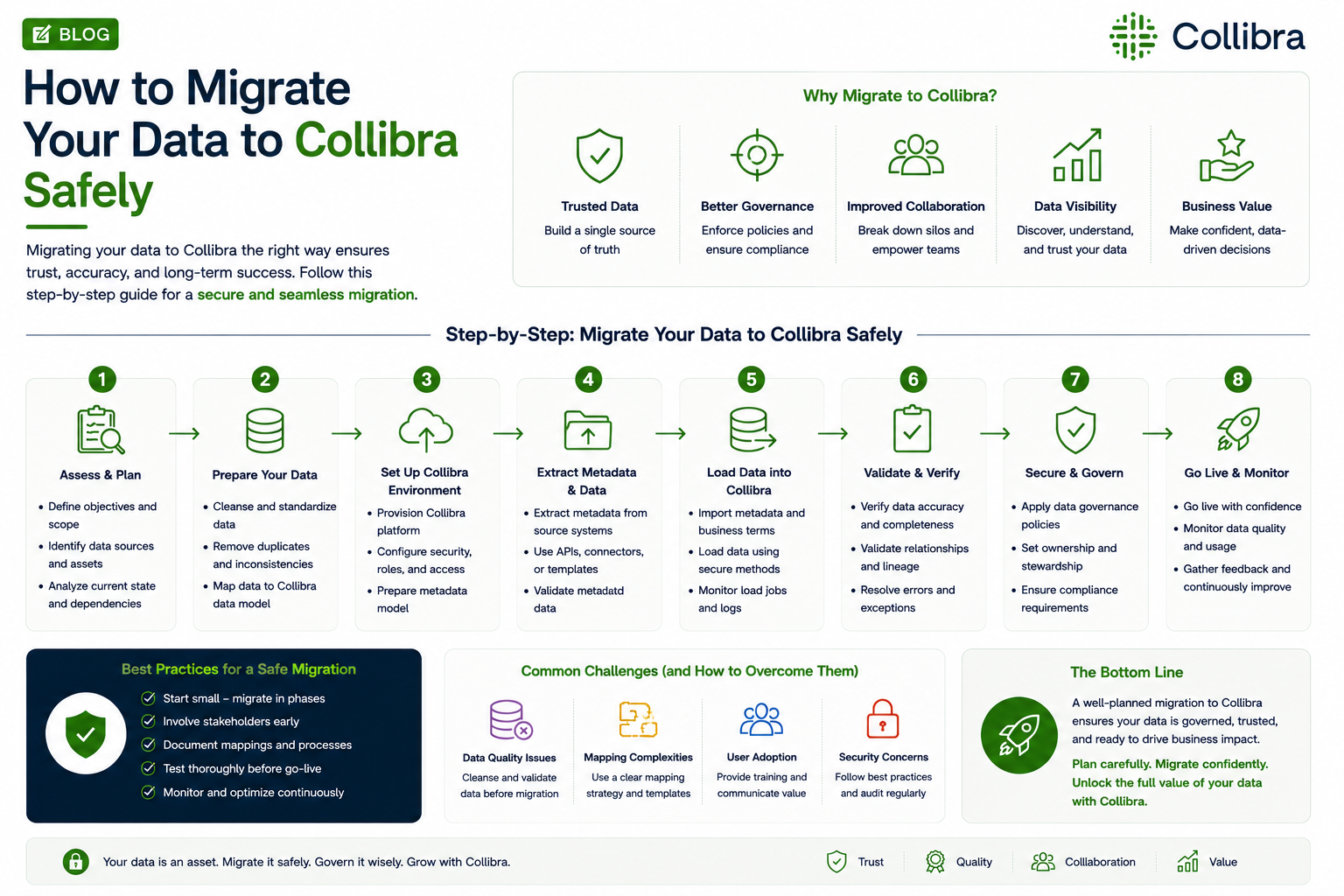
Migrating data to a new governance platform is a critical step for organizations looking to improve data quality, compliance, and visibility. Collibra provides a centralized platform for managing metadata, business glossaries, data catalogs, and governance workflows, making it a popular choice for enterprise data governance.
However, a successful migration requires careful planning and execution. Poorly managed migrations can lead to incomplete metadata, inconsistent governance policies, and business disruptions. In this guide, you'll learn how to migrate your data to Collibra safely, the key stages involved, common challenges, and best practices for a smooth transition.
Why Migrate to Collibra?
Organizations migrate to Collibra to create a trusted and well-governed data environment. Instead of relying on spreadsheets or disconnected governance tools, Collibra centralizes metadata and governance processes in one platform.
Key benefits include:
- Centralized metadata management
- Enterprise data catalog
- Improved data discovery
- Better regulatory compliance
- Standardized business glossary
- Automated governance workflows
- Enhanced collaboration between business and IT teams
Step 1: Assess Your Current Data Environment
Before starting the migration, evaluate your existing data landscape.
Identify:
- Current data sources
- Metadata repositories
- Existing governance tools
- Data quality issues
- Business glossary definitions
- Data owners and stewards
This assessment helps determine what should be migrated and what needs to be cleaned up beforehand.
Step 2: Define Migration Goals
Establish clear objectives before moving data into Collibra.
Examples include:
- Improve metadata quality
- Create a centralized data catalog
- Standardize business definitions
- Strengthen compliance
- Enhance data lineage visibility
- Improve governance processes
Well-defined goals help keep the migration focused and measurable.
Step 3: Clean and Prepare Your Metadata
Migrating poor-quality metadata into Collibra can reduce the value of the platform.
Before migration:
- Remove duplicate entries
- Correct inconsistent naming
- Update outdated information
- Validate business definitions
- Assign data owners
- Review governance policies
Clean metadata leads to a more effective implementation.
Step 4: Connect Data Sources
Collibra integrates with a wide range of enterprise systems.
Common data sources include:
- Relational databases
- Cloud storage platforms
- Data warehouses
- ETL and integration tools
- Business intelligence platforms
- Enterprise applications
Verify that all required connections are configured and tested before importing metadata.
Step 5: Import and Validate Metadata
Once your environment is ready, import metadata into Collibra and verify that all assets have been transferred correctly.
Check:
- Asset relationships
- Business glossary terms
- Data lineage
- Ownership assignments
- Classifications
- Metadata completeness
Validation helps identify issues before users begin working with the platform.
Step 6: Train Users and Launch
A successful migration is not complete until users understand how to use the platform.
Provide training for:
- Data Stewards
- Business Users
- Data Governance Teams
- Administrators
- IT Teams
User adoption is essential for maximizing the value of your Collibra investment.
Common Migration Challenges
Organizations may encounter challenges such as:
- Poor metadata quality
- Inconsistent business terminology
- Missing data ownership
- Complex integrations
- Resistance to change
- Lack of governance processes
Addressing these issues early helps ensure a smoother migration.
Best Practices for a Safe Migration
To reduce risks during migration:
- Start with a pilot project.
- Clean metadata before importing.
- Involve business and IT stakeholders.
- Test integrations thoroughly.
- Validate migrated assets.
- Train end users before go-live.
- Continuously monitor governance processes after deployment.
Following these best practices improves both migration success and long-term platform adoption.
Career Opportunities with Collibra
As more organizations adopt enterprise data governance, professionals with Collibra experience continue to be in demand.
Popular roles include:
- Data Governance Analyst
- Data Steward
- Collibra Developer
- Metadata Analyst
- Data Governance Consultant
- Data Quality Analyst
- Data Architect
Practical migration experience can also strengthen your profile for implementation and consulting roles.
Frequently Asked Questions (FAQs)
Q1. What should be migrated to Collibra?
Organizations typically migrate metadata, business glossary terms, governance policies, ownership information, and data catalog assets rather than operational business data.
Q2. How long does a Collibra migration take?
Migration timelines vary depending on the number of data sources, metadata volume, and implementation complexity. Most projects are completed over several weeks to a few months.
Q3. Do I need to clean metadata before migration?
Yes. Cleaning metadata helps eliminate duplicates, improve consistency, and increase the overall effectiveness of your Collibra implementation.
Q4. Can Collibra integrate with existing enterprise systems?
Yes. Collibra supports integrations with databases, cloud platforms, ETL tools, business intelligence solutions, and other enterprise applications.
Q5. Why is user training important after migration?
Training ensures users understand governance processes, platform features, and best practices, leading to higher adoption and better long-term value.
Conclusion
Migrating to Collibra is more than simply transferring metadata—it is an opportunity to strengthen your organization's entire data governance strategy. By assessing your current environment, cleaning metadata, planning carefully, validating imported assets, and training users, you can achieve a safe and successful migration.
Whether you're implementing Collibra for the first time or modernizing an existing governance framework, following a structured migration approach will help your organization build trusted, compliant, and well-managed data assets for the future.
Contact us to know more about upcoming batches and get a free career counseling session.
[Click Here to Join in Edubrights | Collibra Course
WhatsApp: +91-9498046428 / +91-9498055428 | EduBrights Software Training Institue | Chennai.

Get Training Quote for Free
Related Blogs
Master Your Future with the Best.NET Courses: A Complete Guide by Edubrights
In today’s rapidly evolving technology landscape, choosing the right skill can significantly shape your career path. This blog provides a complete guide to mastering .NET courses, one of the most in-demand technologies backed by Microsoft. It covers everything from understanding the fundamentals of .NET training to exploring advanced topics like ASP.NET, C#, cloud integration, and database management. The blog also highlights the benefits of enrolling in a .NET developer course, including career opportunities, certification value, and industry demand. Additionally, it explains why Edubrights stands out as a trusted training provider with expert trainers, hands-on projects, and career support. Whether you are a beginner or a professional, this guide helps you choose the right .NET certification course and build a successful future in software development.
Why PHP Courses Are Still the Smartest Choice for Aspiring Developers in 2026
This blog provides a complete introduction to PHP courses and their importance in today’s web development industry. It explains why PHP remains a relevant and in-demand programming language in 2026, what learners can expect from a structured PHP course, and the advantages of online PHP training. The article also highlights career opportunities, essential skills, and tips to succeed as a PHP developer. With a focus on practical learning and industry-relevant training, Edubrights helps students gain real-world experience and build a strong foundation in web development. Whether you are a beginner or a professional, this guide will help you choose the right PHP course and start your journey in the tech field.
Master Your Future with the Best.NET Courses: A Complete Guide by Edubrights
This blog provides a complete guide to choosing the right .NET course and building a successful career in software development. It explains what .NET courses are, what you will learn, and the benefits of enrolling in a .NET certification course. The article also highlights career opportunities, industry demand, and the importance of structured .NET training. With insights into Edubrights’ expert-led programs, learners can understand how to gain practical skills, work on real-time projects, and become job-ready. Whether you are a beginner or a working professional, this guide helps you take the right step toward becoming a successful .NET developer.

Looking for the Flask Course in Chennai? Here’s Why Edubrights is Your Top Choice!
This blog provides a complete guide for learners who are searching for the best Flask course in Chennai. It explains what Flask is, why it is an essential Python framework for web development, and how it helps build scalable web applications. The article highlights the growing demand for Flask developers in Chennai’s IT industry and the importance of choosing the right training institute. It also covers the key features of Flask courses, including hands-on projects, real-time training, and career opportunities after completing a Flask training course in Chennai. Additionally, the blog showcases why Edubrights stands out as a top choice by offering industry-oriented curriculum, expert trainers, flexible learning options, and placement support. Overall, this blog is designed to help beginners, students, and professionals make an informed decision about enrolling in Flask courses and building a successful career in web development.