Popular
Free SAP Learning Resources for Beginners in India
Akram
July 1, 2026
5 min read
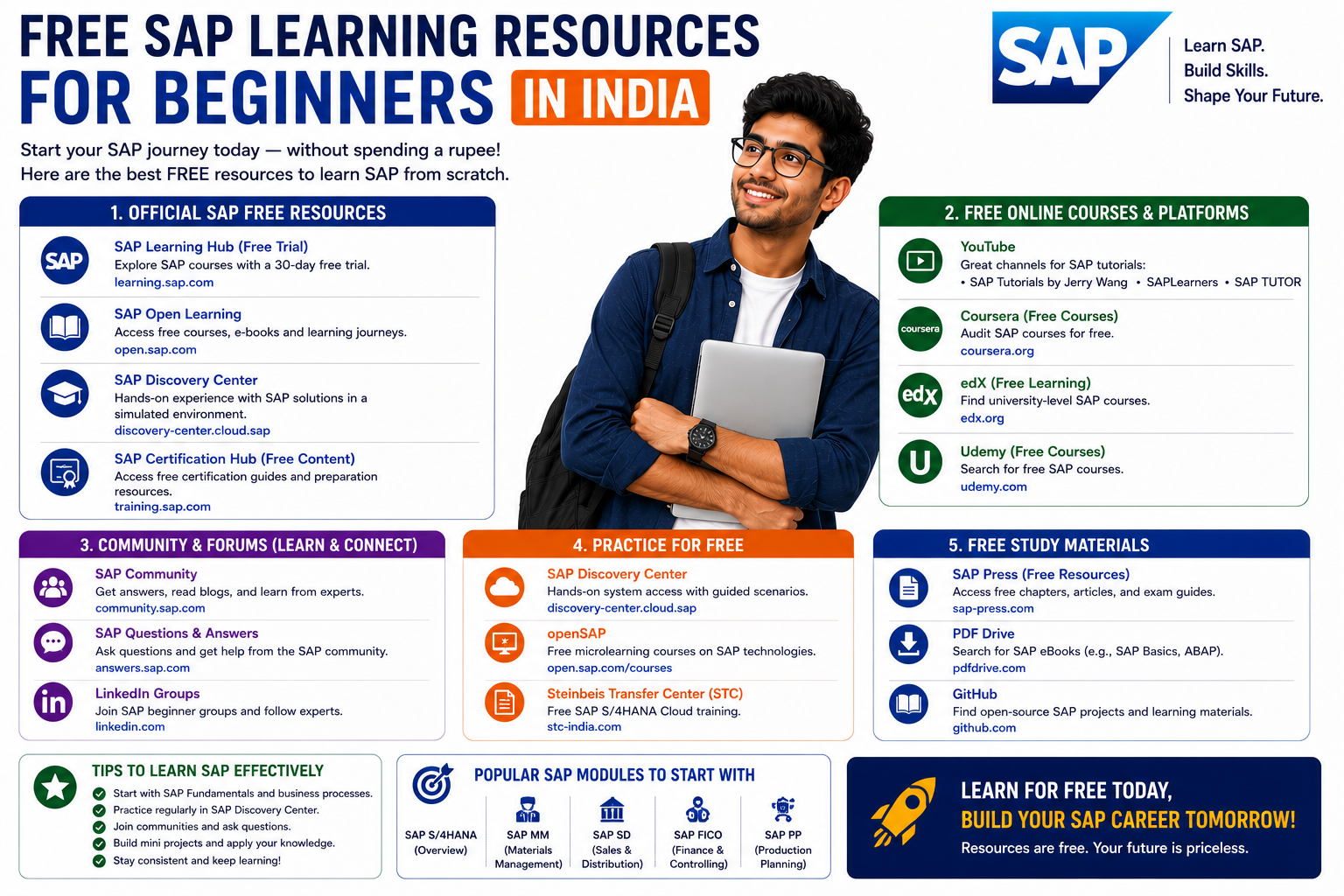
Looking for free SAP learning resources? Explore the best websites, YouTube channels, documentation, and learning platforms that help beginners in India start their SAP journey.
Introduction
SAP is one of the world's leading Enterprise Resource Planning (ERP) platforms, helping businesses manage finance, supply chains, sales, procurement, manufacturing, and human resources. Because SAP skills are highly valued across industries, many students and professionals in India want to begin learning SAP but are unsure where to start.
One of the most common questions is:
"Can I learn SAP for free?"
"What are the best free SAP learning resources for beginners in India?"
The answer is yes. While becoming job-ready usually requires structured training and hands-on practice, there are many free resources that can help you understand SAP fundamentals, business processes, and basic navigation before investing in a professional course. This guide explores the best free SAP learning resources available for beginners.
Why Start with Free SAP Resources?
Free learning resources allow beginners to explore SAP before committing to paid training.
Benefits include:
- Understanding ERP basics
- Exploring different SAP modules
- Learning SAP terminology
- Building confidence
- Identifying your area of interest
- Preparing for professional training
They are especially useful for students and career changers who want to understand SAP before making an investment.
Best Free SAP Learning Resources
Several trusted platforms provide quality SAP learning materials.
Some of the best options include:
- SAP Learning Hub (Free Learning Journeys)
- SAP Community
- SAP Developers Portal
- OpenSAP course archives
- YouTube educational channels
- Technical blogs
- Official SAP documentation
Using multiple resources gives you a broader understanding of the SAP ecosystem.
Learn SAP Through YouTube
YouTube offers thousands of beginner-friendly SAP tutorials.
You can find videos covering:
When choosing a channel, look for updated content that explains both SAP screens and business processes.
Read Official SAP Documentation
SAP provides extensive documentation for learners and professionals.
Documentation helps you understand:
- SAP terminology
- Product features
- Business scenarios
- Configuration concepts
- Best practices
- Cloud technologies
Although technical at times, official documentation is one of the most reliable learning resources.
Join SAP Communities
Learning becomes easier when you interact with other SAP professionals.
Community platforms allow you to:
- Ask questions
- Read expert discussions
- Learn from implementation scenarios
- Stay updated on SAP innovations
- Explore career advice
Participating in SAP communities also helps you build professional connections.
Learn Business Processes Alongside SAP
One mistake beginners often make is focusing only on SAP screens.
Instead, learn how businesses actually operate.
Important business processes include:
- Procure-to-Pay (P2P)
- Order-to-Cash (O2C)
- Record-to-Report (R2R)
- Hire-to-Retire (H2R)
- Inventory Management
- Financial Accounting
Understanding these processes makes SAP concepts much easier to learn.
Practice with Case Studies
Even without access to a live SAP system, you can improve your practical understanding.
Practice by:
- Reading business case studies
- Mapping business workflows
- Solving process-based scenarios
- Watching implementation demonstrations
- Creating process diagrams
This develops the analytical thinking expected from SAP consultants.
Free Learning vs Paid SAP Training
| Free Learning Resources | Professional SAP Training |
|---|---|
| Learn SAP fundamentals | Structured curriculum |
| No cost | Paid investment |
| Flexible learning | Trainer guidance |
| Limited practical exposure | Live SAP practice |
| Self-paced | Real-time projects |
| Good starting point | Job-ready preparation |
| Limited placement support | Placement assistance and interview preparation |
Free resources are excellent for exploration, while professional training is usually necessary for becoming job-ready.
Recommended Learning Roadmap
If you're starting from scratch, follow this roadmap:
- Learn ERP fundamentals.
- Understand what SAP is and how businesses use it.
- Explore different SAP modules.
- Watch beginner tutorials.
- Read SAP documentation.
- Learn business processes.
- Choose a specialization such as SAP FICO, MM, SD, or HCM.
- Join a structured training program.
- Work on live projects.
- Prepare for SAP interviews.
This approach helps you progress from beginner to job-ready professional.
Common Mistakes Beginners Should Avoid
Avoid these common mistakes:
- Jumping directly into advanced SAP topics.
- Learning multiple SAP modules simultaneously.
- Ignoring business process knowledge.
- Depending only on YouTube videos.
- Avoiding practical exercises.
- Expecting free resources alone to secure a job.
Balanced learning with practical exposure delivers the best results.
Is Free SAP Learning Enough to Get a Job?
Free resources are excellent for building a foundation, but most employers expect more than theoretical knowledge.
To become job-ready, you should also develop:
- Practical SAP skills
- Project experience
- Business process understanding
- Interview preparation
- Professional communication skills
Structured training and hands-on practice significantly improve employability.
Frequently Asked Questions (FAQs)
Q1. Can I learn SAP completely free?
You can learn SAP fundamentals using free resources, but professional training and practical experience are usually recommended for job preparation.
Q2. Which SAP module should beginners start with?
The best module depends on your educational background and career goals. Popular choices include SAP FICO, SAP MM, SAP SD, and SAP HCM.
Q3. Are free SAP tutorials enough for interviews?
Free tutorials help build knowledge, but interview success usually requires practical understanding, projects, and business process knowledge.
Q4. Can I practice SAP without a live system?
Yes. You can learn business processes, study case studies, watch demonstrations, and understand implementation scenarios before gaining access to a live SAP environment.
Q5. Should I use free resources before joining a paid SAP course?
Yes. Exploring free resources helps you understand SAP basics and choose the right specialization before investing in professional training.
Conclusion
Free SAP learning resources provide an excellent starting point for beginners in India who want to explore enterprise technology without making an immediate financial investment. By combining official documentation, educational videos, community discussions, and business process learning, you can build a strong foundation in SAP concepts.
However, if your goal is to secure an SAP job, free learning should be viewed as the first step rather than the final destination. Structured training, practical projects, certification preparation, and interview practice will help transform your foundational knowledge into real-world SAP skills that employers value.
Free SAP Learning
SAP Beginner
SAP Tutorials
SAP Training
SAP Career
SAP S/4HANA
SAP Learning Resources
SAP Jobs
SAP Certification
Learn SAP


