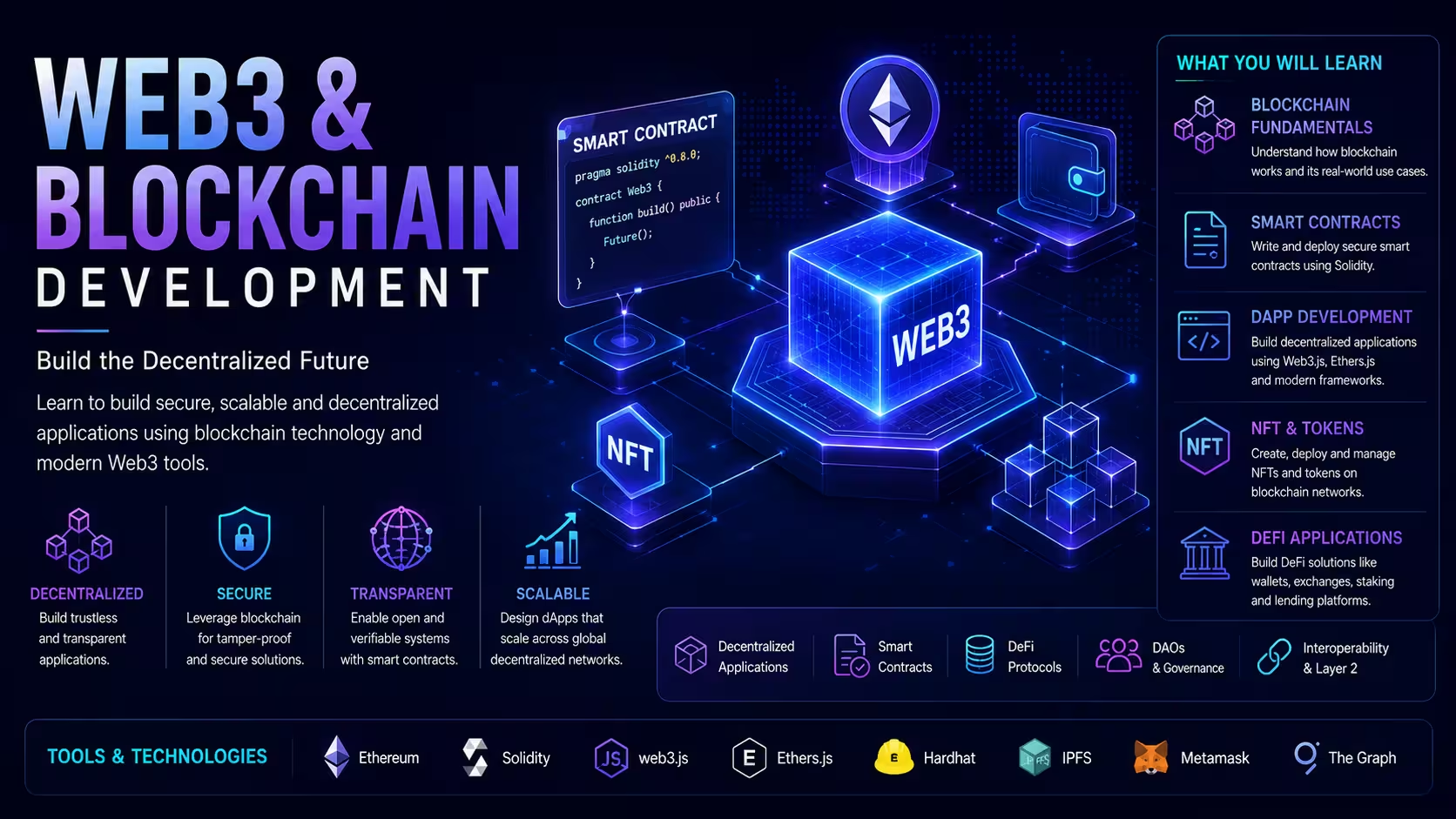
Course Objectives
1. How will I master decentralized infrastructure?
You will dismantle Blockchain Architecture from the ground up. This module moves past surface-level definitions to explore cryptographic hashing, public/private key pairs, and consensus mechanics (Proof of Work and Proof of Stake). You will gain a deep, operational understanding of how immutable public ledgers process transactions securely without a central authority.
2. What engineering skills will I use to write automated digital agreements?
You will achieve mastery in Advanced Solidity Engineering. You will learn to construct production-ready smart contracts for the Ethereum Virtual Machine (EVM). The curriculum focuses heavily on writing gas-optimized code, managing complex inheritance structures, programming mapping arrays, and implementing strict role-based access control.
3. How do I protect smart contracts from devastating exploits and hacks?
You will specialize in Smart Contract Auditing and Security Controls. You will look at real-world decentralized finance (DeFi) hacks to identify critical vulnerabilities. You will learn to detect and patch reentrancy bugs, integer overflows, front-running opportunities, and flash loan vulnerabilities using industry-standard debugging frameworks.
4. How are modern web interfaces connected directly to the blockchain?
You will build fully functional Web3 dApp Frontends. You will link responsive client-side web applications directly to decentralized networks using JavaScript and TypeScript libraries like Ethers.js and Web3.js. This ensures your applications can securely handle cryptographic wallet authentication via MetaMask and listen to live on-chain events.
Popular Techniques Covered in This Course
Blockchain Consensus & Peer-to-Peer Architecture
Solidity Smart Contract Development
Hardhat and Foundry Testing Environments
ERC-20, ERC-721, and ERC-1155 Token Standards
Web3.js and Ethers.js Client Integration
Cryptographic Wallet Routing & Metamask Auth
Decentralized Media Storage via IPFS
Smart Contract Vulnerability Auditing
Layer-2 Scaling Platforms & Cross-Chain Bridges
DAO Governance Architecture & Voting Logic
Get Hands-on Knowledge about Real-Time Projects
Project 1
1. Decentralized Finance (DeFi) Yield Farming & Liquidity Protocol
We provide an institutional course completion certificate from EduBrights documenting your advanced smart contract scripts, local environment testing arrays, and completed dApp portfolio. Vendor-specific global certificates must be cleared via independent proctored testing bodies.
Project 2
2. Web3 Escrow Crowdfunding Platform
Build a decentralized funding platform where creators can pitch campaigns with hard block-time deadlines. Write the Solidity logic to securely custody donor contributions, releasing capital to the creator only if target metrics are hit, or initiating automated refunds if the campaign fails.
Project 3
3. Dynamic NFT Marketplace with IPFS Integration
Design a fully functional NFT ecosystem. Code an ERC-721 contract, host the structural metadata securely on IPFS using unique content identifiers, and write a separate marketplace engine that automatically handles active bidding, sales, and secondary creator royalties.
Project 4
4. On-Chain DAO Governance Token & Voting Infrastructure
Construct a corporate governance architecture. You will create an ERC-20 governance asset that registers user voting weights, write a proposal engine that tracks cryptographic signatures, and implement code that automatically triggers system upgrades when a quorum is cleared.
Project 5
5. Multi-Signature Corporate Treasury Vault
Develop a highly secure corporate asset vault contract that requires approval from a specified threshold of independent cryptographic keys (e.g., 3 out of 5 executives) before any outbound transaction can clear the blockchain, complete with an interactive frontend tracking pending approval states.
Key Features
Edubrights offers WEB3 & BLOCKCHAIN DEVELOPMENT Training in virtual mode with expert trainers. Here are the key features,
40 Hours Course Duration
100% Job Oriented Training
Industry Expert Faculties
Free Demo Class Available
Completed 500+ Batches
Certification Guidance
Curriculum
Module 1: Blockchain Fundamentals
- Blockchain concepts: distributed ledger, consensus, and immutability
- Public vs private blockchains: Ethereum, Polygon, and Hyperledger
- Cryptography basics: hash functions, digital signatures, and wallets
- Blockchain transaction lifecycle: creation, propagation, and confirmation
Module 2: Ethereum and the EVM
- Ethereum architecture: accounts, transactions, and the EVM
- Gas: understanding transaction fees and gas optimisation
- Ethereum testnets: Sepolia and Goerli for development and testing
- Setting up MetaMask and connecting to Ethereum networks
Module 3: Solidity Smart Contract Development
- Solidity fundamentals: data types, functions, and control flow
- Smart contract structure: pragma, contract, state variables, and events
- Access control: modifiers, ownership, and role-based patterns
- Common patterns: factory contracts, proxy patterns, and upgradability
Module 4: DeFi and Token Standards
- ERC-20 token standard: fungible token implementation
- ERC-721 and ERC-1155: NFT standards and digital asset management
- DeFi concepts: DEXs, liquidity pools, yield farming, and lending protocols
- Interacting with existing DeFi protocols: Uniswap and Aave
Module 5: Web3 Frontend Development
- Web3.js and Ethers.js: connecting frontends to Ethereum
- Connecting wallet providers: MetaMask and WalletConnect integration
- Reading contract state and listening to events from the frontend
- React with Wagmi and RainbowKit for modern Web3 UX
Module 6: Smart Contract Testing and Security
- Hardhat testing framework: writing and running contract tests
- Foundry: fast Solidity testing with fuzzing and invariant testing
- Common smart contract vulnerabilities: reentrancy, overflow, and access control
- Slither and MythX for automated smart contract security analysis
Module 7: IPFS, Oracles, and Layer 2
- IPFS: decentralised file storage for NFT metadata and assets
- Chainlink oracles: bringing real-world data on-chain
- Layer 2 solutions: Polygon, Arbitrum, Optimism, and zkSync overview
- Cross-chain bridges and multi-chain deployment strategies
Module 8: Capstone Project and Assessment
- ERC-20 token and DeFi staking contract development and testing
- NFT minting contract with IPFS metadata and React frontend
- Smart contract security audit and Layer 2 deployment exercise
- Final assessment and course certification
Receive Training From Our Skilled and Effective Trainers
Experience in the Industry Gain expertise from blockchain developers who have built DeFi protocols, NFT platforms, DAO governance systems, and Web3 applications on Ethereum and EVM-compatible chains.
Backgrounds at the Top Our Web3 trainers have worked at blockchain startups, DeFi protocols, and enterprise blockchain projects delivering smart contract systems and decentralised applications at scale.
Clear & Effective Teaching Blockchain fundamentals, Ethereum, Solidity, ERC token standards, DeFi concepts, Web3 frontend development, smart contract security, IPFS, Chainlink, and Layer 2 are taught with real dApp development examples.
Hands-On Learning Focus Students write and deploy Solidity smart contracts, build Web3 React frontends, test contracts with Hardhat and Foundry, audit for security vulnerabilities, and deploy to Layer 2 networks through structured labs.
Up-to-Date Knowledge Trainers keep content current with the latest Ethereum upgrades, EIP developments, emerging DeFi primitives, zkEVM rollup technology, and evolving Web3 development tooling and best practices.
About Our Course Certification*
Our institution offers a recognized WEB3 & BLOCKCHAIN DEVELOPMENT certification that validates your ability to design and prototype professional user interfaces efficiently. This certification enhances your design portfolio and prepares you for collaborative projects in real-world environments. Gain practical skills through hands-on training and assessments.

Course FAQs
1. What is Web3 and how does it change the current internet?
Web3 represents the decentralized evolution of the internet built on top of secure blockchain networks. In the current Web2 landscape, data, hosting infrastructure, and digital identities are heavily controlled by centralized technology companies. Web3 shifts this paradigm by using cryptographic validation, allowing users to own and interact with their data and assets peer-to-peer without relying on a middleman.
2. Do I need an advanced mathematical background to become a blockchain developer?
No. While the underlying protocols of blockchain rely heavily on advanced cryptography and mathematics, modern developer tools abstract these layers entirely. If you possess a solid understanding of fundamental programming concepts—such as variables, functions, arrays, and conditional loops—you are fully capable of mastering Web3 engineering.
3. Which programming languages are prioritized in this training program?
The primary backend language of this course is Solidity, which is the universally adopted standard for programming smart contracts on Ethereum-compatible networks. On the frontend, you will utilize standard JavaScript or TypeScript paired with specialized Web3 libraries to establish a clean communications pipe with your deployed contracts.
4. Why should I choose EduBrights for Web3 training in Chennai?
We eliminate theoretical slide presentations to focus exclusively on production-grade engineering. At EduBrights, you write code inside active sandbox environments from day one. You will deploy live smart contracts to public test networks, manage actual cryptographic wallet signatures, and build multi-tier decentralized applications that match current FinTech industry standards.
5. What exactly is a smart contract?
A smart contract is a self-executing program stored directly on a blockchain ledger. It automatically executes and enforces the terms of an agreement or operation when predefined parameters are met. Because it runs on a decentralized network, a smart contract operates exactly as coded, removing any risk of human manipulation, downtime, or third-party interference.
6. What are "Gas Fees" and why must developers optimize for them?
Gas refers to the computational energy required to execute an operation or complete a transaction on a blockchain network. Every line of code written inside a smart contract costs a micro-fraction of cryptocurrency to run. This course places a massive emphasis on gas optimization design patterns, teaching you how to write highly efficient code that reduces operational costs for end-users.
7. What is the operational difference between ERC-20 and ERC-721 tokens?
ERC-20 is the technical blueprint standard used to create fungible tokens, meaning every token minted is identical, fractional, and entirely interchangeable, much like standard digital currencies. ERC-721 is the standard for Non-Fungible Tokens (NFTs), where each token contains unique, individual metadata attributes that cannot be exchanged on a 1-to-1 basis.
8. What are Hardhat and Foundry?
Hardhat and Foundry are professional, command-line development frameworks used by global engineering teams to build, test, and deploy smart contracts. They simulate local, high-speed blockchain environments on your computer, allowing you to run automated test scripts, monitor code execution logs, and eliminate bugs before deploying to a live network.
9. How do decentralized applications store large media assets like videos or high-res images?
Storing heavy files directly on a blockchain ledger is incredibly expensive. Web3 developers solve this by utilizing decentralized storage networks like IPFS (InterPlanetary File System). The media file is uploaded to IPFS, which generates an unchangeable cryptographic hash. This lightweight hash is then saved inside the smart contract, linking the token directly to the asset securely.
10. What is a Reentrancy Attack and how do we prevent it?
A reentrancy attack is a critical smart contract vulnerability where an exploit contract calls a withdrawal function repeatedly before the target contract can update its internal balance ledger, completely draining its liquidity pools. You will learn to neutralize this vulnerability by implementing the Checks-Effects-Interactions programming pattern and utilizing OpenZeppelin reentrancy guards.
11. What are Layer-2 Scaling Solutions?
Layer-2 platforms, such as Polygon and Arbitrum, are secondary networks built directly on top of a Layer-1 blockchain like Ethereum. They process thousands of complex data transactions off-chain instantly for fractions of a cent and then bundle them back to the main network securely, resolving standard network congestion and high transaction fee bottlenecks.
12. Can a smart contract look up real-world information like stock prices or sports scores?
Blockchains are intentionally isolated environments to maintain absolute security, meaning they cannot natively fetch external web data. To bridge this gap, developers integrate decentralized Oracles like Chainlink. You will learn how to configure oracle data feeds safely to ingest validated, real-world data directly into your smart contract logic.
Get Training Quote for Free
Testimonials
Hear What Our Students Say
"Transform your life through Education, hear it from our Alumni"

8 LPA
Rahul
Student
Data Scientist
"Transform your life through Education, hear it from our Alumni"

8 LPA
Siddharth
NIELSON IQ
Data Analyst
"Transform your life through Education, hear it from our Alumni"

6 LPA
Fathima
Student
Software Engineer