Course Objectives
1. What will you learn in the Fiori Administration course?
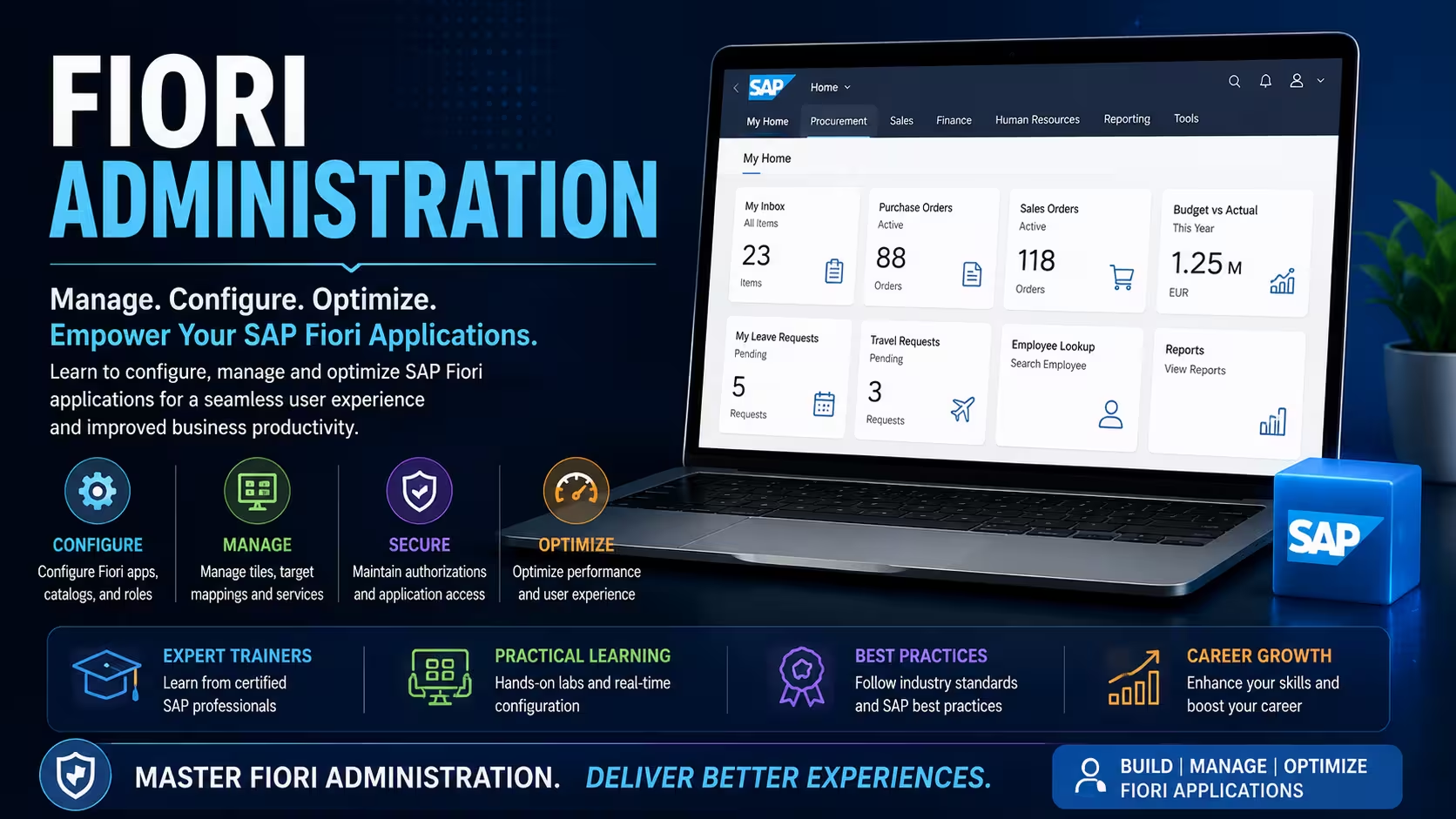
You will learn how to install, configure, manage, and maintain the SAP Fiori landscape. The course covers Fiori Launchpad administration, SAP Gateway configuration, system integration, role management, security, performance monitoring, and troubleshooting.
2. How does this course prepare you for real-world SAP Fiori administration projects?
The course provides hands-on experience in configuring SAP Fiori Launchpad, managing catalogs and groups, assigning user roles, monitoring system performance, handling transport requests, and resolving common SAP Fiori administration issues.
3. What practical skills will you develop during the training?
You will gain expertise in SAP Fiori administration, SAP Gateway configuration, Launchpad management, role-based authorization, system monitoring, Fiori app activation, transport management, security configuration, and performance optimization.
4. How will real-time projects improve your SAP Fiori Administration skills?
You will work on enterprise SAP projects involving Fiori app deployment, Launchpad configuration, user authorization management, SAP Gateway administration, system monitoring, and production support activities.
5. What career opportunities can you pursue after learning Fiori Administration?
This course prepares you for roles such as SAP Fiori Administrator, SAP Basis Consultant, SAP System Administrator, SAP Technical Consultant, SAP Support Engineer, SAP Security Administrator, SAP Fiori Support Consultant, and SAP Technology Consultant.
Popular Techniques Covered in This Course
SAP Fiori Architecture and Landscape
SAP Gateway Configuration and Administration
SAP Fiori Launchpad Configuration
Fiori Catalogs, Groups, and Spaces Management
SAP Fiori App Activation and Deployment
User Roles and Authorization Management
Transport Management and System Configuration
SAP Fiori Security Administration
Performance Monitoring and Troubleshooting
SAP Fiori System Maintenance and Support
Get Hands-on Knowledge about Real-Time Projects
Project 1
Project 1: SAP Fiori Launchpad Configuration
Configure and customize the SAP Fiori Launchpad by creating catalogs, groups, spaces, pages, and assigning applications to different business users.
Project 2
Project 2: Enterprise User Role Management
Implement role-based authorization, assign business catalogs, manage user access, and configure SAP security roles for enterprise users.
Project 3
Project 3: SAP Gateway Administration
Configure SAP Gateway services, activate OData services, monitor system performance, and troubleshoot connectivity issues.
Project 4
Project 4: SAP Fiori Application Deployment
Deploy and activate standard and custom SAP Fiori applications across development, quality assurance, and production environments.
Project 5
Project 5: SAP Fiori Performance Optimization
Monitor application performance, optimize response time, resolve configuration issues, and improve system availability for enterprise users.
Key Features
Edubrights offers Fiori Administration Training in virtual mode with expert trainers. Here are the key features,
40 Hours Course Duration
100% Job Oriented Training
Industry Expert Faculties
Free Demo Class Available
Completed 500+ Batches
Certification Guidance
Curriculum
Module 1: Introduction to Fiori Administration
- Overview of Fiori Launchpad administration
- Fiori system landscape: Front-end and back-end servers
- Fiori administration roles and responsibilities
- SAP Gateway and OData service infrastructure
- Fiori administration tools overview
Module 2: Fiori Launchpad Configuration
- Site manager and page configuration
- Spaces and pages concept (Fiori 3)
- Tile catalog and group management
- Business role configuration
- Launchpad plugin management
Module 3: SAP Gateway Administration
- SAP Gateway system configuration
- Backend system connection (RFC)
- OData service activation and configuration
- Gateway error log analysis
- Gateway performance monitoring
Module 4: Fiori Authorization and Roles
- Business catalog concept
- Business role creation and assignment
- Integration with PFCG role management
- Authorization objects for Fiori apps
- Fiori app authorization troubleshooting
Module 5: Fiori App Deployment
- App deployment from ABAP repository
- BSP application management
- SAP UI Add-on deployment
- Transport management for Fiori apps
- Fiori app lifecycle management
Module 6: Fiori Launchpad on BTP
- SAP Launchpad Service on BTP
- HTML5 app deployment
- Managed Approuter configuration
- Custom domain setup
- BTP subaccount configuration for Fiori
Module 7: Performance and Caching
- Fiori cache configuration
- CDN integration for Fiori
- SAPUI5 library caching
- Back-end performance tuning for OData
- Fiori client performance monitoring
Module 8: Fiori Mobile Administration
- SAP Fiori Client mobile app
- Mobile Device Management (MDM) integration
- Push notifications configuration
- Offline Fiori app management
- Mobile security policies
Module 9: Fiori Monitoring and Troubleshooting
- Application log monitoring
- OData service error analysis
- Launchpad loading issues
- Gateway trace analysis
- End-user support for Fiori issues
Module 10: Fiori System Updates
- SAP UI Add-on upgrade process
- SAPUI5 version management
- Fiori app content updates
- Regression testing after updates
- Transport strategy for Fiori content
Module 11: Fiori Key User Tools
- SAPUI5 flexibility key user adaption
- Custom fields and logic with key user tools
- In-app extensibility
- Custom tile creation
- Business variant management
Module 12: Real-Time Projects and Case Studies
- Fiori launchpad rollout for S/4HANA
- Fiori authorization model design
- End-to-end Fiori administration project
- Certification and interview preparation
Receive Training From Our Skilled and Effective Trainers
Experience in the Industry Gain knowledge from experts with hands-on Fiori Administration experience in S/4HANA and BTP Fiori launchpad management.
Backgrounds at the Top Prominent corporations such as HCL, TCS, Accenture, and SAP Labs employ our Fiori Administration trainers.
Clear & Effective Teaching Excellent communication and real-world examples simplify complex Fiori system configuration and authorization management.
Hands-On Learning Focus Students apply skills using live SAP Fiori and Gateway systems with real launchpad deployment and troubleshooting projects.
Up-to-Date Knowledge Trainers stay current with latest SAP Fiori releases, BTP Launchpad Service, and modern Fiori governance best practices.
Professional SAP Fiori Administration Certification
The Professional SAP Fiori Administration Certification validates your expertise in administering and supporting SAP Fiori environments.

Course FAQs
1. What is SAP ABAP and what is it used for?
SAP ABAP (Advanced Business Application Programming) is SAP's programming language for developing and extending business applications. ABAP is used to create reports, interfaces, forms, enhancements, database programs, APIs, and custom business logic within SAP systems.
2. What are the fundamental concepts of SAP ABAP programming?
ABAP fundamentals include data types, variables, constants, operators, control statements, loops, strings, structures, internal tables, work areas, field symbols, data references, modularization, and exception handling. These concepts form the foundation for developing ABAP applications.
3. What are the different data types available in ABAP?
ABAP provides elementary data types such as C, N, D, T, I, INT8, P, F, and STRING, along with complex types such as structures and internal tables. Developers can also define custom types using the ABAP Dictionary or local type declarations.
4. What are internal tables in SAP ABAP?
Internal tables are dynamic runtime data structures used to store and process collections of records in ABAP programs. They are commonly used for retrieving database data, performing calculations, sorting records, filtering data, and preparing output.
5. What are the different types of internal tables in ABAP?
The primary internal table types are standard tables, sorted tables, and hashed tables. Each provides different access and performance characteristics depending on how records are searched, inserted, modified, and processed.
6. What is the difference between standard, sorted, and hashed internal tables?
Standard tables are optimized for index-based access, sorted tables maintain their data according to a defined key, and hashed tables provide efficient key-based access using a hash algorithm. Selecting the appropriate table type is important for ABAP application performance.
7. What are field symbols in SAP ABAP?
Field symbols are dynamically assigned memory areas that provide direct access to existing data objects. They are frequently used when processing internal tables and dynamic data because they can reduce unnecessary copying of data.
8. What are data references in ABAP?
Data references are reference variables that point to dynamically created or existing data objects. They are useful for dynamic programming, generic programming, object-oriented development, and handling dynamically generated data structures.
9. What is modularization in SAP ABAP?
Modularization divides large ABAP programs into reusable logical components. ABAP supports modularization through subroutines, function modules, methods, and other reusable programming constructs, helping improve maintainability and code organization.
10. What are function modules in SAP ABAP?
Function modules are reusable procedures managed in the SAP system's Function Builder. They can contain importing, exporting, changing, and table parameters and can be designed as RFC-enabled modules for communication between SAP systems or external applications.
11. What is Object-Oriented ABAP?
Object-Oriented ABAP, commonly called ABAP Objects, provides object-oriented programming capabilities such as classes, objects, methods, attributes, inheritance, interfaces, polymorphism, encapsulation, events, and exception classes.
12. What is the difference between a class and an object in ABAP?
A class defines the attributes and behavior of an application component, while an object is a runtime instance of that class. ABAP Objects uses classes as templates from which objects are created.
13. What are inheritance and polymorphism in ABAP?
Inheritance allows a subclass to reuse or extend functionality from a superclass. Polymorphism allows different classes to implement common interfaces or methods differently, supporting flexible, reusable, and extensible application designs.
14. What are interfaces in Object-Oriented ABAP?
Interfaces define a common contract containing methods, attributes, and other components that implementing classes must provide. Interfaces help create loosely coupled, reusable, and maintainable ABAP applications.
15. What is the ABAP Dictionary?
The ABAP Dictionary, or DDIC, is the central metadata repository used to define data structures and database-related objects in SAP. It contains objects such as tables, data elements, domains, structures, table types, views, search helps, and lock objects.
16. What is the difference between a domain and a data element?
A domain defines the technical characteristics of a field, such as data type, length, and possible value range. A data element provides the semantic definition of a field and can contain field labels and documentation while referring to a domain.
17. What are transparent tables in SAP?
Transparent tables are database tables whose structure in the SAP Dictionary corresponds directly to a physical database table. They are commonly used to persist business application data.
18. What are structures and table types in ABAP Dictionary?
A structure defines a collection of fields without necessarily representing a database table. A table type defines the technical characteristics of an internal table, including its row type, table category, and key.
19. What are lock objects in SAP ABAP?
Lock objects are used to prevent conflicting simultaneous updates to business data. SAP generates enqueue and dequeue function modules from lock-object definitions, allowing applications to establish and release logical locks.
20. What is Open SQL in SAP ABAP?
Open SQL is SAP's database-independent SQL interface used by ABAP programs to access application data. It supports operations such as SELECT, INSERT, UPDATE, MODIFY, and DELETE.
21. What is the difference between Open SQL and Native SQL?
Open SQL provides a database-independent interface managed by the ABAP runtime, whereas Native SQL allows database-specific SQL statements. Open SQL is generally preferred for application development because it supports database independence and SAP's database abstraction.
22. What are joins in ABAP SQL?
Joins combine data from multiple database tables based on related fields. ABAP SQL supports operations such as inner joins and outer joins, allowing developers to retrieve related data efficiently in a single database operation.
23. What is FOR ALL ENTRIES in ABAP?
FOR ALL ENTRIES allows an ABAP SQL query to retrieve records based on values contained in an internal table. Developers must ensure that the driving internal table is not empty and should carefully consider duplicate values and query performance.
24. How can database performance be optimized in ABAP?
ABAP database performance can be improved by reducing unnecessary database calls, selecting only required fields, using appropriate joins, avoiding database access inside loops, applying suitable filters, using effective indexes, and analyzing expensive SQL statements with SAP performance tools.
25. What is ALV in SAP ABAP?
ALV, or ABAP List Viewer, is a framework for displaying structured business data in interactive reports. It supports functions such as sorting, filtering, aggregation, layouts, totals, subtotals, grouping, and exporting report data.
26. What is the difference between classical reports and ALV reports?
Classical reports generally generate formatted list output using traditional ABAP statements. ALV provides a standardized interactive reporting framework with features such as filtering, sorting, totals, layouts, grouping, and user-specific display options.
27. What are Smart Forms in SAP ABAP?
Smart Forms are SAP's form-development technology used to generate business documents such as invoices, purchase orders, delivery documents, labels, and other printed or PDF-based outputs. ABAP programs can call Smart Forms and pass application data to them.
28. What are Adobe Forms in SAP?
Adobe Forms are used to create sophisticated print and interactive forms using Adobe technology integrated with SAP. They support structured layouts, tables, graphics, dynamic content, digital signatures, and PDF output.
29. What are BAPIs in SAP ABAP?
BAPIs, or Business Application Programming Interfaces, are standardized interfaces provided by SAP business objects. They allow applications to access and execute business processes and data using stable business-level APIs.
30. What is RFC in SAP ABAP?
RFC, or Remote Function Call, enables a function module to be executed remotely between SAP systems or between SAP and external systems. RFC can be used for distributed application processing, remote data access, and system integration.
31. What are IDocs in SAP?
An IDoc, or Intermediate Document, is a standard SAP data format used for exchanging business information between SAP systems and external systems. ABAP developers work with IDoc structures, segments, message types, process codes, partner profiles, and inbound or outbound processing.
32. What is the difference between inbound and outbound IDocs?
An outbound IDoc carries data from an SAP system to another system, while an inbound IDoc transfers data into an SAP system. ABAP developers may implement, monitor, troubleshoot, and reprocess IDocs in both scenarios.
33. What are enhancements in SAP ABAP?
Enhancements allow developers to extend standard SAP functionality without directly modifying SAP standard source code. Enhancement techniques include enhancement points, enhancement sections, BAdIs, customer exits, user exits, implicit enhancements, and explicit enhancements.
34. What are BAdIs in SAP ABAP?
BAdIs, or Business Add-Ins, are enhancement technologies based on object-oriented concepts. They allow custom implementations to be plugged into predefined enhancement points in SAP applications and support more flexible extension scenarios.
35. What are user exits and customer exits?
User exits and customer exits are traditional SAP enhancement techniques that provide predefined locations for adding custom business logic. Developers identify the relevant exit and implement customer-specific functionality without changing SAP standard code directly.
36. What is debugging in SAP ABAP?
ABAP debugging is used to examine program execution and identify logical, runtime, and data-processing problems. Developers can use breakpoints, watchpoints, the call stack, variable inspection, conditional breakpoints, and step-by-step execution to troubleshoot programs.
37. What are breakpoints and watchpoints in ABAP debugging?
Breakpoints pause program execution at a specified statement or location. Watchpoints pause execution when the value of a monitored variable or expression changes or meets a defined debugging condition.
38. What tools are used for ABAP performance analysis?
SAP provides several performance analysis tools, including ST05 SQL Trace, SAT ABAP Runtime Analysis, ST12 Performance Trace, and ATC. These tools help developers identify expensive database operations, runtime bottlenecks, inefficient code, and quality issues.
39. What is ST05 SQL Trace?
ST05 is the SQL Trace tool used to analyze database access performed by SAP applications. It helps developers identify expensive SQL statements, excessive database calls, execution times, database records processed, and access patterns that may affect application performance.
40. What is ABAP Runtime Analysis or SAT?
SAT is used to analyze the runtime behavior of ABAP programs. It provides information about execution times, processing blocks, method calls, database interactions, internal table operations, and other runtime characteristics that help developers identify performance bottlenecks.
41. What are CDS Views in SAP S/4HANA?
Core Data Services, or CDS, provide a modern data-modeling approach for defining semantically rich data models close to the database. CDS Views support associations, annotations, calculated fields, authorization concepts, analytical scenarios, and other capabilities used extensively in SAP S/4HANA development.
42. What are CDS annotations in SAP ABAP?
CDS annotations provide metadata that controls or describes aspects of CDS entities. They can be used for semantic definitions, user interface behavior, analytics, authorization, search, service exposure, and data consumption.
43. What are associations in CDS Views?
Associations define relationships between CDS entities and allow related data models to be navigated and reused. They help create semantically structured data models while reducing unnecessary duplication of join definitions.
44. What is AMDP in SAP ABAP?
ABAP Managed Database Procedures, or AMDP, allow developers to implement database procedures using SQLScript that execute directly on SAP HANA. AMDP can be useful for data-intensive processing that benefits from database-level execution and code pushdown.
45. What is OData and how is it used in SAP development?
OData is a web-based protocol used to expose and consume structured business data through HTTP-based services. In SAP environments, ABAP developers can use OData to make backend business data and operations available to SAP Fiori applications, mobile applications, and external consumers.
46. What is the ABAP RESTful Application Programming Model (RAP)?
RAP is SAP's modern programming model for building transactional and service-based applications using ABAP. It provides concepts such as business objects, behavior definitions, behavior implementations, service definitions, service bindings, validations, determinations, and actions.
47. What is SAP S/4HANA ABAP development?
S/4HANA ABAP development focuses on modern, HANA-optimized application development. It includes modern ABAP syntax, CDS-based data models, optimized Open SQL, AMDP where appropriate, OData services, RAP, released APIs, and development practices aligned with SAP's clean-core strategy.
48. What is Clean Core in SAP ABAP development?
Clean Core is an SAP development approach that minimizes modifications and tightly coupled customizations in the SAP standard system. Developers are encouraged to use released APIs, extension points, CDS-based models, RAP, side-by-side extensions, and other upgrade-safe extensibility mechanisms.
49. What is ATC in SAP ABAP?
ABAP Test Cockpit (ATC) is a static code analysis framework used to identify programming errors, performance problems, security issues, obsolete statements, syntax concerns, and other quality issues. It helps organizations maintain consistent, secure, and maintainable ABAP code.
50. What is the difference between classical ABAP development and modern S/4HANA ABAP development?
Classical ABAP development commonly involves traditional reports, procedural programming, function modules, classical enhancements, Dynpro applications, and direct database-oriented development. Modern S/4HANA development emphasizes object-oriented ABAP, CDS Views, optimized Open SQL, OData, RAP, released APIs, cloud-ready extensions, performance optimization, and clean-core principles.
Get Training Quote for Free
Testimonials
Hear What our Students say
"Transform your life through Education, hear it from our Alumni"

8 LPA
Rahul
Student
Data Scientist
"Transform your life through Education, hear it from our Alumni"

6 LPA
Fathima
Student
Software Engineer
"Transform your life through Education, hear it from our Alumni"

8 LPA
Siddharth
NIELSON IQ
Data Analyst