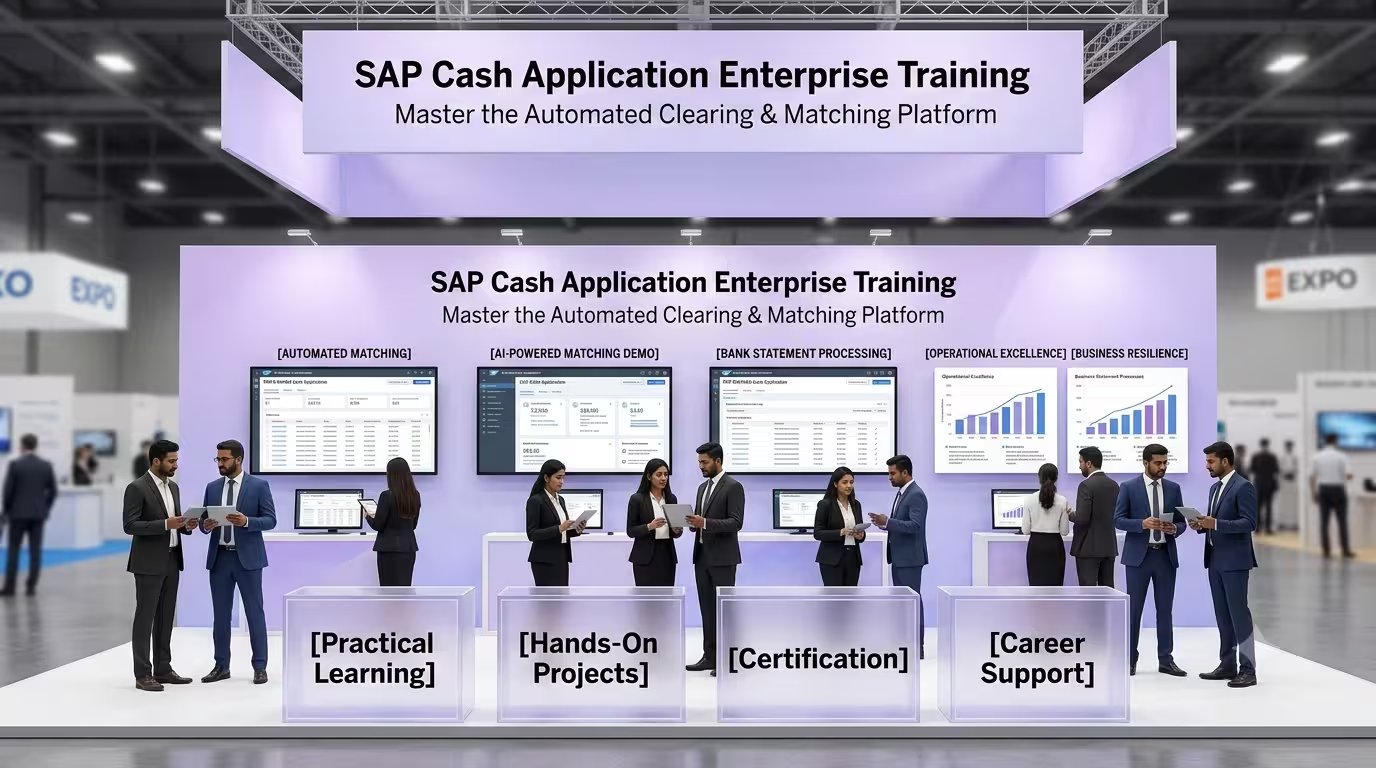
Course Objectives
1. What will I learn by taking the SAP Cash Application course in Bangalore?
You'll build a solid understanding of the core concepts, terminology, and fundamentals of SAP Cash Application, giving you a strong foundation to build on.
2. What hands-on skills will I gain from the SAP Cash Application training?
You'll get hands-on experience with industry-relevant SAP Cash Application tools and workflows through guided exercises, so you learn by doing rather than just reading theory.
3. How does the SAP Cash Application course prepare me for real-world work?
The SAP Cash Application course is designed around how SAP Cash Application is actually applied to solve real-world problems in professional settings, not just textbook scenarios.
4. What practical, job-ready skills will I build during SAP Cash Application training in Bangalore?
You'll develop the practical skills needed to confidently work with SAP Cash Application on the job, so you're ready to contribute from day one in a SAP Cash Application role.
5. Will I work on real projects during the SAP Cash Application course?
Yes, the SAP Cash Application course includes real-time projects and case studies that reinforce concepts through practice, giving you portfolio-ready work by the end.
6. How does the SAP Cash Application course help with certification and job interviews?
The SAP Cash Application course is structured to help you prepare for relevant certifications and interviews, covering the concepts and terminology employers and exam boards expect.
Popular Techniques Covered in This Course
SAP Cash Application Fundamentals
Accounts Receivable Management
Payment Processing
Invoice Matching
Cash Flow Monitoring
Bank Statement Processing
Financial Reconciliation
Exception Handling
SAP S/4HANA Finance Integration
Financial Process Automation
Get Hands-on Knowledge about Real-Time Projects
Project 1
Project 1: Automated Customer Payment Matching
Build a solution that automatically matches customer payments with open invoices and reduces manual effort.
Project 2
Project 2: Bank Statement Reconciliation Process
Create an automated reconciliation system that processes bank statements and updates financial records accurately.
Project 3
Project 3: Accounts Receivable Automation
Develop a workflow that improves receivable management and speeds up payment allocation.
Project 4
Project 4: Customer Payment Analytics Dashboard
Design a dashboard that tracks incoming payments, outstanding balances, and collection performance
Project 5
Project 5: Cash Flow Monitoring Solution
Implement a reporting system that provides real-time visibility into cash collections and payment trends.
Key Features
Edubrights offers SAP BW ( business application) in virtual mode with expert trainers. Here are the key features,
40 Hours Course Duration
100% Job Oriented Training
Industry Expert Faculties
Free Demo Class Available
Completed 500+ Batches
Certification Guidance
Curriculum
Module 1: Introduction to SAP Cash Application
- Overview of SAP Cash Application
- Cash application use cases: AR automation, payment matching
- SAP Cash Application architecture on BTP
- Integration with SAP S/4HANA FI-AR
- Cash application implementation methodology
Module 2: Cash Application Architecture
- Machine learning engine for payment matching
- Integration middleware configuration
- Bank statement and payment file ingestion
- Remittance advice processing
- Matching confidence score model
Module 3: Payment Ingestion
- Bank statement formats: MT940, BAI2, CAMT.053
- Electronic remittance advice (ERA)
- Email-based remittance capture
- Portal payment data ingestion
- Manual payment entry fallback
Module 4: AI-Driven Payment Matching
- Machine learning model training
- Pattern recognition for payment matching
- Confidence score thresholds
- Automatic vs. semi-automatic posting
- Model retraining and improvement
Module 5: Remittance Advice Processing
- Remittance document parsing
- Invoice number extraction
- Partial payment handling
- Deduction identification
- Unstructured remittance processing
Module 6: Exception Handling
- Low-confidence match review
- Unmatched payment queue
- Short payment and deduction management
- Dispute creation from unmatched payments
- Escalation workflow for exceptions
Module 7: Posting to FI-AR
- Automatic clearing of open items
- Partial clearing and residual items
- Payment on account posting
- Currency difference handling
- Posting confirmation and reversal
Module 8: Deduction Management
- Deduction reason code classification
- Valid vs. invalid deduction determination
- Deduction workflow routing
- Credit memo creation for valid deductions
- Deduction analytics and reporting
Module 9: Cash Application Analytics
- Match rate dashboards
- Straight-through processing (STP) rate
- Exception volume analysis
- Processing time reports
- ROI measurement for automation
Module 10: Integration with Collections
- FSCM Collections Management integration
- Cash application status in collections
- Reducing DSO with automation
- Customer account reconciliation
- Credit release after payment application
Module 11: Cash Application in S/4HANA
- Embedded Cash Application in S/4HANA
- Fiori apps for payment matching
- Real-time AR clearing
- Bank communication management integration
Module 12: Real-Time Projects and Case Studies
- High-volume AR automation implementation
- Retail customer payment matching
- End-to-end Cash Application deployment
- Certification and interview preparation
Receive Training From Our Skilled and Effective Trainers
Experience in the Industry Gain expertise from SAP Cash Application professionals training in Bangalore who have applied their skills on live projects across corporate, product, and consulting environments, bringing practical, real-world context into every SAP Cash Application session.
Backgrounds at the Top Our SAP Cash Application trainers in Bangalore bring hands-on industry experience, having worked on real SAP Cash Application projects for organizations across various industries before moving into training.
Clear & Effective Teaching Core SAP Cash Application concepts, tools, and workflows are explained using real project examples and practical scenarios, so you understand not just the theory but how SAP Cash Application is actually used on the job.
Hands-On Learning Focus Students get structured, hands-on practice with SAP Cash Application through guided exercises, mini-projects, and lab work designed to build practical, job-ready skills.
Up-to-Date Knowledge Trainers keep the SAP Cash Application curriculum current with the latest tools, versions, and industry best practices, so what you learn stays relevant to how SAP Cash Application is used today in Bangalore and beyond.
About Our Course Certification*
The SAP Cash Application Professional Certification validates your skills in payment processing, invoice matching, cash application automation, and accounts receivable management. It demonstrates your ability to improve financial operations through automated payment reconciliation and cash management processes. This certification can help you build a career in SAP Finance, accounts receivable, and financial automation.

Course FAQs
1. What is SAP Cash Application?
SAP Cash Application is a solution that helps automate the process of matching incoming customer payments with outstanding invoices and open receivables. It supports faster payment processing, reconciliation, and accounts receivable operations.
2. How does SAP Cash Application support Accounts Receivable?
SAP Cash Application helps automate payment allocation and clearing activities within Accounts Receivable. It can reduce manual matching effort and improve the visibility of outstanding customer balances.
3. What is the architecture of SAP Cash Application?
SAP Cash Application uses components for payment-data ingestion, intelligent matching, exception handling, and integration with financial systems. The course covers SAP Cash Application architecture on SAP BTP and its integration with SAP S/4HANA FI-AR.
4. How does SAP Cash Application integrate with SAP S/4HANA FI-AR?
SAP Cash Application integrates with SAP S/4HANA Financial Accounting and Accounts Receivable processes to support payment matching and clearing. Matching results can be transferred for appropriate accounting and receivables processing.
5. What is payment ingestion in SAP Cash Application?
Payment ingestion is the process of receiving payment information from sources such as bank statements, remittance files, emails, and payment portals. The course covers multiple payment-ingestion mechanisms and formats.
6. Which bank statement formats are used in SAP Cash Application?
Common formats covered include MT940, BAI2, and CAMT.053. These formats provide structured bank transaction information that can be processed for payment matching and reconciliation.
7. What is MT940 in SAP Cash Application?
MT940 is a standardized electronic bank statement format used to exchange account transaction information. SAP Cash Application can use bank statement information in supported formats as an input for payment processing and matching.
8. What is BAI2?
BAI2 is a bank reporting and transaction data format used by financial institutions to provide structured account information. It can be used as an input format for payment and bank statement processing.
9. What is CAMT.053?
CAMT.053 is an ISO 20022-based bank statement message format. It provides structured account statement information that can be used in automated payment processing environments.
10. What is Electronic Remittance Advice (ERA)?
Electronic Remittance Advice provides payment details explaining which invoices or receivables a customer payment relates to. SAP Cash Application can process remittance information to improve automated invoice matching.
11. How does SAP Cash Application process email-based remittances?
Email-based remittance processing can capture payment-related information from customer remittance communications. The extracted information can then be used as an input for invoice and payment matching.
12. What is portal payment data ingestion?
Portal payment ingestion involves receiving payment information from customer or payment portals. This data can be incorporated into the cash application process for automated matching and reconciliation.
13. What is AI-driven payment matching?
AI-driven payment matching uses machine learning and pattern-recognition techniques to identify relationships between incoming payments and open invoices. SAP Cash Application can use historical patterns and matching information to improve automated payment allocation.
14. What is a machine learning engine in SAP Cash Application?
The machine learning engine supports intelligent identification of potential payment-to-invoice matches. It can analyze available payment and receivable information to generate matching recommendations.
15. What is a matching confidence score?
A matching confidence score indicates how strongly the system believes that a proposed payment-to-invoice match is correct. Organizations can use confidence thresholds to determine whether matches should be automatically processed or reviewed.
16. What are confidence score thresholds?
Confidence score thresholds define levels at which payment matches can be treated differently. High-confidence matches may be suitable for automation, while lower-confidence results can be routed for manual review.
17. What is automatic payment matching?
Automatic payment matching identifies and links incoming customer payments with corresponding open invoices without requiring manual intervention for every transaction. It can improve processing speed and straight-through processing rates.
18. What is semi-automatic payment matching?
Semi-automatic matching provides system-generated matching recommendations that require user confirmation before posting or clearing. It is useful when the available payment information does not provide enough confidence for full automation.
19. What is machine learning model training in SAP Cash Application?
Machine learning model training involves using relevant historical payment and matching information to improve the system's ability to identify future matches. The course covers model training, retraining, and improvement concepts.
20. How does model retraining improve payment matching?
Model retraining can incorporate additional matching outcomes and changing payment patterns into the learning process. This can help improve matching accuracy as more relevant data becomes available.
21. What is remittance advice processing?
Remittance advice processing involves interpreting payment-related documents or information to determine which invoices and amounts a customer intended to pay. It can help provide additional information for automated matching.
22. How is invoice number extraction used in cash application?
Invoice number extraction identifies invoice references from payment or remittance information. The extracted invoice numbers can be compared against open receivables to improve matching accuracy.
23. How does SAP Cash Application handle partial payments?
Partial payment processing allows a payment to be associated with an invoice even when the received amount does not fully settle the outstanding balance. The remaining balance can continue to be managed according to the organization's receivables process.
24. What is deduction identification?
Deduction identification determines whether a difference between the payment amount and invoice amount represents a deduction. The system can help classify and route these differences for appropriate follow-up.
25. What is unstructured remittance processing?
Unstructured remittance processing deals with payment information that does not follow a fixed structured format. Intelligent extraction and parsing techniques can help identify useful information from such remittance content.
26. What is exception handling in SAP Cash Application?
Exception handling manages payments that cannot be confidently matched or processed automatically. The course covers low-confidence matches, unmatched payment queues, short payments, deductions, disputes, and escalation workflows.
27. What is an unmatched payment queue?
An unmatched payment queue contains incoming payments for which the system has not identified a suitable invoice or receivable match. Finance users can review these items and resolve them using additional information.
28. What is a low-confidence match?
A low-confidence match is a proposed payment-to-invoice relationship that does not meet the required confidence threshold. Such matches can be routed to users for verification instead of being automatically posted.
29. How are short payments handled?
Short payments occur when a customer pays less than the amount expected on an invoice. SAP Cash Application can identify the difference and route it for deduction management, dispute processing, or other configured business actions.
30. What is dispute creation from unmatched payments?
When an unmatched or short payment represents a customer dispute, a dispute process can be initiated for investigation and resolution. This helps connect payment exceptions with downstream receivables management.
31. What is automatic clearing of open items?
Automatic clearing applies incoming payments against corresponding open receivable items when the matching conditions are satisfied. It reduces manual clearing activities in Accounts Receivable.
32. What is partial clearing?
Partial clearing occurs when a payment is applied against an open item without completely settling the original receivable. The remaining balance stays open for subsequent processing.
33. What are residual items?
Residual-item processing creates a new open item for the remaining amount after a payment is applied. This provides a way to represent the outstanding balance separately within the receivables process.
34. What is payment-on-account posting?
Payment-on-account posting records a customer payment when the system cannot yet determine the specific invoice or open item to which it belongs. The payment can subsequently be allocated when sufficient matching information becomes available.
35. How are currency differences handled in SAP Cash Application?
Currency differences can occur when payment and invoice amounts involve different currencies or exchange rates. Appropriate accounting and clearing logic is required to handle the resulting differences during financial posting.
36. What is posting confirmation and reversal?
Posting confirmation verifies that a payment-related accounting transaction has been successfully processed. Reversal allows an incorrect or invalid posting to be cancelled according to the applicable accounting process.
37. What is deduction management?
Deduction management handles differences between customer payments and expected invoice amounts. It can classify deductions, determine their validity, route them for approval or resolution, and support appropriate financial processing.
38. What are deduction reason codes?
Deduction reason codes categorize why a customer has paid less than the invoiced amount. Examples can include pricing differences, damaged goods, promotional deductions, or other business-approved reasons.
39. How are valid and invalid deductions determined?
Deduction determination evaluates the reason, supporting information, and business rules associated with a payment difference. Valid deductions can follow an approved financial process, while invalid deductions may require customer follow-up or dispute resolution.
40. What is deduction workflow routing?
Workflow routing directs deduction cases to the appropriate users or teams for investigation and resolution. It helps ensure that financial exceptions are processed according to defined responsibilities.
41. What is cash application analytics?
Cash application analytics provides measurements and dashboards for payment matching and receivables processing. The course covers match rates, straight-through processing rates, exception volumes, processing times, and automation ROI.
42. What is Straight-Through Processing (STP) rate?
STP rate measures the proportion of payment transactions processed automatically without manual intervention. A higher STP rate generally indicates that more payment-processing activities are being completed through automation.
43. What is match rate in cash application?
Match rate measures how effectively incoming payments are associated with relevant invoices or open items. It is an important KPI for evaluating the efficiency of automated cash application.
44. How does SAP Cash Application integrate with SAP FSCM Collections Management?
SAP Cash Application can integrate with Collections Management to provide payment and customer-account status information to collections processes. This can help collection teams work with more current receivables information.
45. How can cash application automation help reduce DSO?
Automated payment matching can accelerate the allocation and clearing of customer payments. Faster application of cash can improve receivables visibility and support initiatives aimed at reducing Days Sales Outstanding (DSO).
46. What are Fiori apps used for in SAP Cash Application?
SAP Fiori apps provide user interfaces for performing supported SAP business processes. In SAP S/4HANA Cash Application scenarios, Fiori apps can support payment matching and related Accounts Receivable activities.
47. What is embedded Cash Application in SAP S/4HANA?
Embedded Cash Application refers to cash application capabilities available within the SAP S/4HANA environment. It supports payment matching and real-time Accounts Receivable clearing scenarios.
48. What is Bank Communication Management integration?
Bank Communication Management supports processes related to electronic banking and bank communication. Its integration with Cash Application can help connect bank payment information with downstream financial processing.
49. What practical projects can be covered in SAP Cash Application training in Bangalore?
The course includes projects such as Automated Customer Payment Matching, Bank Statement Reconciliation, Accounts Receivable Automation, Customer Payment Analytics Dashboard, and Cash Flow Monitoring. These projects provide practical exposure to payment processing, reconciliation, analytics, and financial automation.
50. What technical skills can I gain from SAP Cash Application training in Bangalore?
You can develop skills in SAP Cash Application architecture, payment ingestion, bank statement processing, AI-driven payment matching, machine learning concepts, confidence scoring, remittance processing, exception handling, FI-AR posting, deduction management, cash application analytics, FSCM Collections integration, S/4HANA integration, Fiori-based processing, and financial process automation. These areas closely follow the technical curriculum published for the Bangalore course.
Get Training Quote for Free
Testimonials
Hear What Our Students Say
"Transform your life through Education, hear it from our Alumni"

6 LPA
Fathima
Student
Software Engineer
"Transform your life through Education, hear it from our Alumni"

8 LPA
Rahul
Student
Data Scientist
"Transform your life through Education, hear it from our Alumni"

8 LPA
Siddharth
NIELSON IQ
Data Analyst