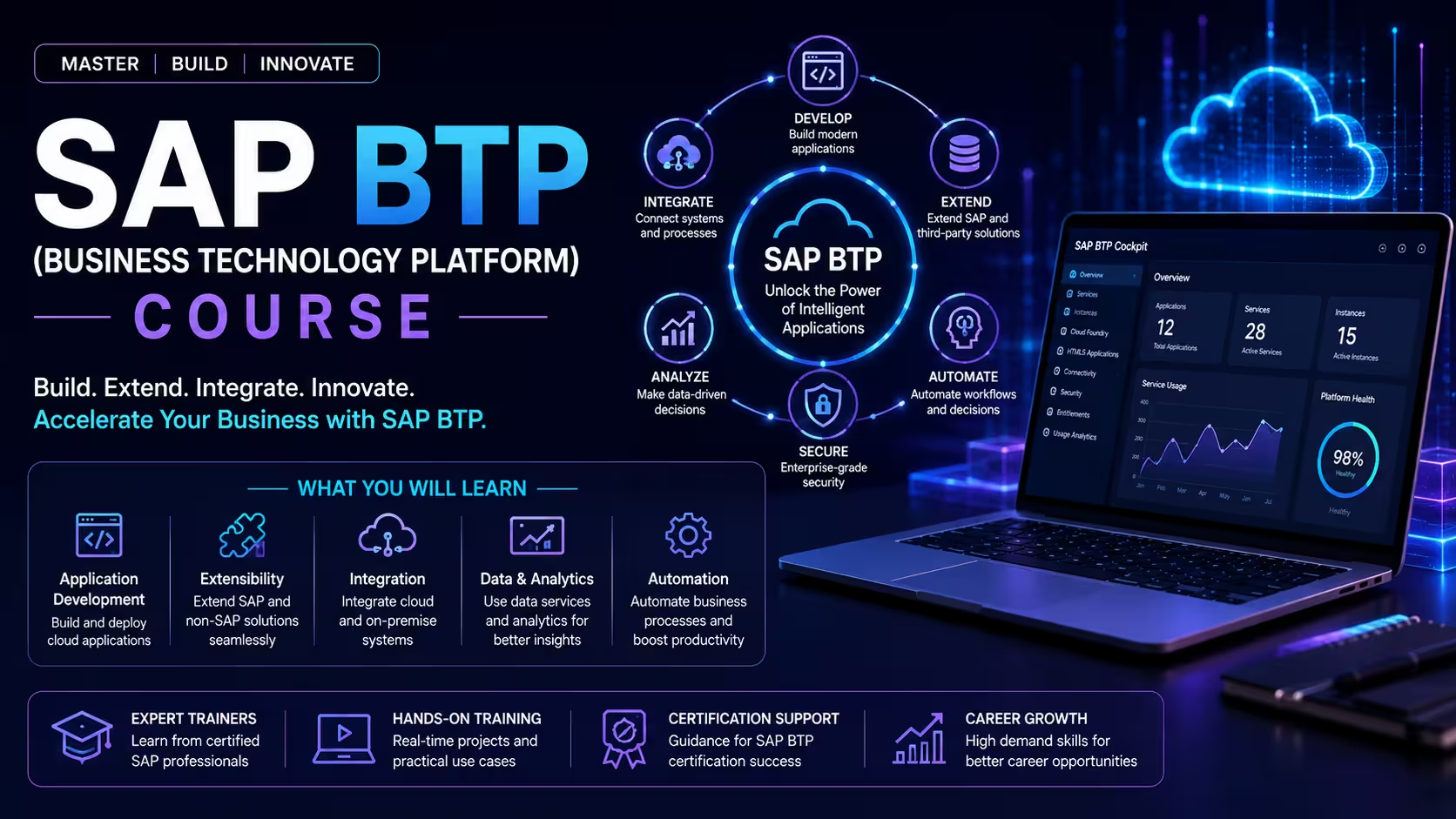
Course Objectives
1. What will I learn by taking the SAP BTP (Business Technology Platform) course in Bangalore?
You'll build a solid understanding of the core concepts, terminology, and fundamentals of SAP BTP (Business Technology Platform), giving you a strong foundation to build on.
2. What hands-on skills will I gain from the SAP BTP (Business Technology Platform) training?
You'll get hands-on experience with industry-relevant SAP BTP (Business Technology Platform) tools and workflows through guided exercises, so you learn by doing rather than just reading theory.
3. How does the SAP BTP (Business Technology Platform) course prepare me for real-world work?
The SAP BTP (Business Technology Platform) course is designed around how SAP BTP (Business Technology Platform) is actually applied to solve real-world problems in professional settings, not just textbook scenarios.
4. What practical, job-ready skills will I build during SAP BTP (Business Technology Platform) training in Bangalore?
You'll develop the practical skills needed to confidently work with SAP BTP (Business Technology Platform) on the job, so you're ready to contribute from day one in a SAP BTP (Business Technology Platform) role.
5. Will I work on real projects during the SAP BTP (Business Technology Platform) course?
Yes, the SAP BTP (Business Technology Platform) course includes real-time projects and case studies that reinforce concepts through practice, giving you portfolio-ready work by the end.
6. How does the SAP BTP (Business Technology Platform) course help with certification and job interviews?
The SAP BTP (Business Technology Platform) course is structured to help you prepare for relevant certifications and interviews, covering the concepts and terminology employers and exam boards expect.
Popular Techniques Covered in This Course
SAP BTP Fundamentals
Cloud Application Development
SAP Integration Suite
SAP Extension Suite
Workflow Automation
API Management
Data Management and Analytics
SAP Business Application Studio
SAP Cloud Services
Enterprise Application Integration
Get Hands-on Knowledge about Real-Time Projects
Project 1
Project 1: Employee Self-Service Portal
Build a cloud-based application that allows employees to manage leave requests, personal information, and approvals online.
Project 2
Project 2: SAP and Third-Party System Integration
Create an integration solution that connects SAP systems with external applications for seamless data exchange.
Project 3
Project 3: Automated Approval Workflow
Develop a workflow automation process for purchase requests, expense approvals, and document management.
Project 4
Project 4: Business Performance Dashboard
Design an interactive dashboard that displays key business metrics, reports, and operational insights in real time
Project 5
Project 5: Customer Service Application Extension
Extend an existing SAP application with additional features to improve customer support and service management.
Key Features
Edubrights offers SAP BTP (Business Technology Platform) in virtual mode with expert trainers. Here are the key features,
40 Hours Course Duration
100% Job Oriented Training
Industry Expert Faculties
Free Demo Class Available
Completed 500+ Batches
Certification Guidance
Curriculum
Module 1: Introduction to SAP BTP
- Overview of SAP Business Technology Platform
- BTP pillars: Database & Data Management, Analytics, Application Development, Integration, AI
- BTP Global Account, Sub-accounts, and directories
- BTP cockpit navigation
- BTP service catalog overview
Module 2: BTP Account and Security
- Global account and sub-account management
- Identity and Access Management (IAM)
- SAP Identity Authentication Service (IAS)
- Role collections and role assignments
- Trust configuration with identity providers
Module 3: Cloud Foundry Environment
- Cloud Foundry architecture on BTP
- Orgs, spaces, and apps
- CF CLI commands
- Buildpacks and service instances
- Application deployment and scaling
Module 4: SAP BTP, Kyma Runtime
- Kubernetes-based runtime overview
- Kyma modules and components
- Deploying applications on Kyma
- Serverless functions
- Integration with SAP systems
Module 5: SAP Extension Suite
- Side-by-side extensibility
- SAP AppGyver (Build Apps)
- SAP Build Work Zone
- SAP Build Process Automation
- Extension factory and API management
Module 6: SAP HANA Cloud
- SAP HANA Cloud architecture
- HANA Cloud Central administration
- Data provisioning and replication
- HANA Cloud database explorer
- SAP HANA Cloud, Data Lake
Module 7: SAP Analytics Cloud on BTP
- SAC architecture and connection to BTP
- Live and import data models
- Stories and dashboards
- Predictive analytics
- Planning and forecasting
Module 8: SAP Integration Suite on BTP
- Cloud Integration (CPI) iFlows
- API Management
- Open Connectors
- Event Mesh
- Trading Partner Management
Module 9: SAP AI Core and AI Services
- AI Core overview and use cases
- Generative AI Hub on BTP
- Document Information Extraction
- Business Entity Recognition
- AI API integration
Module 10: SAP Build (Low-Code/No-Code)
- SAP Build Apps
- SAP Build Process Automation (workflows, RPA)
- SAP Build Work Zone (portals)
- Citizen developer scenarios
- Integration with backend SAP systems
Module 11: BTP DevOps and CI/CD
- SAP Continuous Integration and Delivery service
- SAP Cloud Transport Management
- Git-based development workflows
- SAP Landscape Management Cloud
- BTP monitoring and alerting
Module 12: Real-Time Projects and Case Studies
- S/4HANA extension on BTP
- Multi-cloud integration scenarios
- End-to-end BTP implementation
- Certification and interview preparation
Receive Training From Our Skilled and Effective Trainers
Learn from Experienced SAP BTP (Business Technology Platform) Professionals
Gain practical expertise from experienced SAP BTP (Business Technology Platform) professionals in Bangalore who have successfully delivered cloud application development, SAP integration, data management, analytics, automation, and enterprise extension projects across banking, manufacturing, retail, healthcare, telecommunications, energy, and consulting organizations. Learn real-world implementation methodologies and cloud transformation strategies used by global enterprises.
Industry Exposure with Enterprise SAP BTP Projects
Our SAP BTP trainers in Bangalore have extensive hands-on experience implementing SAP Integration Suite, SAP Extension Suite, SAP HANA Cloud, SAP Build Apps, SAP Build Process Automation, SAP Build Work Zone, SAP Business Application Studio (BAS), SAP CAP (Cloud Application Programming Model), SAP Event Mesh, and enterprise cloud-native applications. Learn implementation best practices followed by leading SAP consulting firms and multinational organizations.
Simple, Practical & Business-Oriented Teaching Approach
Core SAP BTP (Business Technology Platform) concepts—including SAP Integration Suite, SAP Extension Suite, SAP HANA Cloud, SAP Build, Cloud Foundry, Kyma Runtime, Business Application Studio, CAP, SAP Fiori, REST & OData APIs, Identity Authentication, Workflow Automation, and cloud application development—are taught through live demonstrations, enterprise case studies, and practical business scenarios. This approach helps learners understand how SAP BTP is implemented in real enterprise cloud environments.
Hands-On Real-Time SAP BTP Projects
Build job-ready expertise through structured lab sessions and enterprise projects covering Application Development, SAP Integration Suite, API Management, Cloud Integration (CPI), SAP HANA Cloud, CAP Applications, SAP Build Apps, Workflow Automation, SAP Fiori Applications, Business Rules, Identity & Security Configuration, Data Services, and complete SAP BTP implementation scenarios using real-world business use cases.
Updated with the Latest SAP Cloud Technologies
Our SAP BTP curriculum is continuously updated with the latest SAP BTP services, SAP Build portfolio, SAP Joule AI, SAP Integration Suite enhancements, SAP HANA Cloud, Generative AI capabilities, cloud-native development practices, and modern enterprise integration best practices. This ensures learners develop practical, certification-ready, and industry-relevant SAP BTP skills that are highly valued by organizations in Bangalore and across the global SAP ecosystem.
You will succeed with our recognized certification
The SAP BTP Professional Certification validates your skills in cloud development, system integration, application extension, and business process automation. It demonstrates your ability to work with SAP Business Technology Platform and create modern business solutions. This certification can help you build a successful career in cloud technologies and SAP development.

Course FAQs
1. What is SAP BTP?
SAP Business Technology Platform (BTP) is SAP's cloud platform for application development, data management, analytics, integration, automation, and AI. It enables organizations to build, extend, and integrate SAP and non-SAP business applications.
2. What are the main pillars of SAP BTP?
SAP BTP covers application development and automation, integration, data and database management, analytics, and AI. These capabilities can be combined to develop and extend enterprise applications.
3. What is the SAP BTP global account?
A global account is the top-level structure used to manage an SAP BTP environment. It provides access to subaccounts, entitlements, services, and other platform-level resources.
4. What is a subaccount in SAP BTP?
A subaccount is an isolated environment within a BTP global account where applications, services, users, and configurations can be managed. Organizations can create separate subaccounts for development, testing, and production environments.
5. What are directories in SAP BTP?
Directories provide an organizational layer within a global account for grouping and managing subaccounts. They can help enterprises organize environments and distribute entitlements across different business or technical areas.
6. What is the SAP BTP cockpit?
The SAP BTP cockpit is a web-based administration interface used to manage BTP accounts, services, applications, security, environments, and configurations. Administrators can use it to monitor and manage platform resources.
7. What is the SAP BTP service catalog?
The service catalog provides access to services and capabilities that can be provisioned in an SAP BTP environment. Administrators can review available services and create service instances based on their entitlements.
8. What is Identity and Access Management in SAP BTP?
Identity and Access Management (IAM) controls user identities, roles, permissions, and access to BTP resources. It helps organizations implement controlled access to applications, services, and administrative functions.
9. What is SAP Identity Authentication Service (IAS)?
SAP Identity Authentication Service provides cloud-based authentication and identity-management capabilities. It can be used to authenticate users and integrate BTP applications with configured identity providers.
10. What are role collections in SAP BTP?
Role collections group multiple roles that can be assigned to users or groups. They simplify authorization management by providing a predefined set of permissions for a particular responsibility.
11. What is trust configuration in SAP BTP?
Trust configuration establishes a trusted relationship between a BTP subaccount and an identity provider. It allows users to authenticate through the configured identity service and enables applications to use required identity information.
11. What is trust configuration in SAP BTP?
Trust configuration establishes a trusted relationship between a BTP subaccount and an identity provider. It allows users to authenticate through the configured identity service and enables applications to use required identity information.
12. What is Cloud Foundry on SAP BTP?
Cloud Foundry is an application runtime environment available on SAP BTP for deploying and operating cloud applications. It supports application deployment, service binding, scaling, and lifecycle management.
13. What are organizations and spaces in Cloud Foundry?
An organization provides a logical structure for Cloud Foundry resources, while spaces provide environments within an organization where applications and services are deployed. Spaces can be used to separate development, testing, and production workloads.
14. What is the Cloud Foundry CLI?
The Cloud Foundry Command Line Interface (CF CLI) is a command-line tool used to interact with Cloud Foundry environments. Developers and administrators can use it to log in, deploy applications, manage services, inspect applications, and perform operational tasks.
15. What are buildpacks in Cloud Foundry?
Buildpacks provide runtime components required to prepare applications for deployment. They can detect application types, install dependencies, and configure the runtime environment needed to execute applications.
16. What are service instances in SAP BTP?
Service instances are configured instances of BTP services that applications can consume. Examples include database, authentication, messaging, integration, and other platform services.
17. How are applications deployed and scaled in Cloud Foundry?
Applications can be deployed using tools such as the Cloud Foundry CLI and configured with service bindings and environment settings. Scaling can involve increasing application instances or adjusting available resources according to workload requirements.
18. What is SAP BTP Kyma Runtime?
Kyma Runtime is a Kubernetes-based runtime environment on SAP BTP. It supports cloud-native applications, containerized workloads, microservices, APIs, event-driven applications, and serverless scenarios.
19. What are Kyma modules?
Kyma modules provide additional capabilities that can be installed and managed within the Kyma environment. They can support areas such as application connectivity, API management, observability, and cloud-native development.
20. How are applications deployed on Kyma?
Applications can be packaged as containers and deployed to the Kubernetes-based Kyma Runtime. Kubernetes resources, services, configurations, and deployment definitions are used to manage application workloads.
21. What are serverless functions in SAP BTP?
Serverless functions allow developers to execute application logic without directly managing the underlying server infrastructure. They are useful for event-driven processing, lightweight automation, and backend operations.
22. What is the SAP Extension Suite?
SAP Extension Suite provides capabilities for extending SAP applications and developing additional business functionality. It supports side-by-side extensions, application development, integration, workflow automation, and user experience enhancements.
23. What is side-by-side extensibility in SAP BTP?
Side-by-side extensibility allows additional applications or services to be developed outside the SAP S/4HANA core system while integrating with it through supported interfaces. This approach helps keep custom extension logic separate from the core application.
24. What is SAP Build Apps?
SAP Build Apps is a low-code application development environment for creating business applications. It provides visual development capabilities for building user interfaces, application logic, and connections to backend services.
25. What is SAP Build Work Zone?
SAP Build Work Zone provides a central digital workplace for accessing business applications, content, and services. It can bring relevant SAP and other enterprise applications together into a unified user experience.
26. What is SAP Build Process Automation?
SAP Build Process Automation supports workflow and business-process automation. It can be used to design workflows, automate repetitive activities, and connect human tasks with system-based actions.
27. What is SAP HANA Cloud?
SAP HANA Cloud is a cloud database service that provides in-memory data processing and database capabilities. It can support application development, analytics, data management, and enterprise data workloads on SAP BTP.
28. What is HANA Cloud Central?
HANA Cloud Central is an administration interface for managing SAP HANA Cloud resources. It provides capabilities for monitoring and managing database instances and related configurations.
29. What is SAP HANA Cloud Database Explorer?
SAP HANA Cloud Database Explorer provides tools for accessing and working with databases in SAP HANA Cloud. Developers and administrators can use it to execute SQL, inspect database objects, and analyze data.
30. What is data provisioning in SAP HANA Cloud?
Data provisioning involves making data available from source systems in SAP HANA Cloud. Depending on the architecture, it can involve replication, data integration, transformation, and other supported data-movement technologies.
31. What is SAP HANA Cloud Data Lake?
SAP HANA Cloud Data Lake provides scalable storage for large volumes of data that may not require the same processing characteristics as frequently accessed operational data. It can complement SAP HANA Cloud database capabilities in broader data architectures.
32. How does SAP Analytics Cloud integrate with SAP BTP?
SAP Analytics Cloud can connect with SAP BTP and related data sources to support analytics and planning scenarios. The course curriculum covers SAC architecture, BTP connectivity, live and imported data models, dashboards, predictive analytics, and planning.
33. What is a live connection in SAP Analytics Cloud?
A live connection allows SAP Analytics Cloud to access data directly from a supported source without importing the underlying data into SAC. This can help organizations work with current source-system data while retaining source-system governance.
34. What is SAP Integration Suite?
SAP Integration Suite is a collection of cloud integration capabilities used to connect SAP and non-SAP applications, APIs, data, and business processes. It includes capabilities such as Cloud Integration, API Management, Open Connectors, and Event Mesh.
35. What are iFlows in SAP Cloud Integration?
Integration flows, commonly called iFlows, define how messages are received, transformed, routed, and delivered between connected systems. They can contain adapters, mappings, routing logic, transformations, and exception-handling steps.
36. What is SAP API Management?
SAP API Management helps organizations expose, secure, govern, monitor, and manage APIs. It can be used to control access to backend services and provide standardized APIs for application and partner integrations.
37. What are SAP Open Connectors?
SAP Open Connectors provide standardized connectivity to various third-party applications. They can simplify integration with external SaaS applications and reduce the effort required to develop individual connectivity mechanisms.
38. What is SAP Event Mesh?
SAP Event Mesh supports event-driven integration by enabling applications and systems to exchange business events. Applications can publish and consume events to support loosely coupled and responsive business processes.
39. What is Trading Partner Management in SAP BTP?
Trading Partner Management supports the configuration and management of business-to-business integration relationships. It can help organizations manage partner-specific communication requirements and integration processes.
40. What is SAP AI Core?
SAP AI Core is an SAP service for running and managing AI workloads within enterprise environments. It can support AI lifecycle activities and integration of AI capabilities with business applications.
41. What is Generative AI Hub on SAP BTP?
Generative AI Hub provides capabilities for accessing and integrating generative AI models within enterprise scenarios. It can be used in applications that require AI-assisted processing together with enterprise-oriented governance and integration considerations.
42. What is Document Information Extraction in SAP BTP?
Document Information Extraction uses AI capabilities to extract relevant information from documents. It can help automate business-document processing by identifying structured information from unstructured content.
43. What is Business Entity Recognition?
Business Entity Recognition identifies relevant business entities or information within text or documents. It can support intelligent processing scenarios where applications need to automatically recognize specific business-related information.
44. What is CI/CD in SAP BTP?
Continuous Integration and Continuous Delivery (CI/CD) automate parts of the software development and deployment lifecycle. In SAP BTP, CI/CD services and Git-based workflows can help teams build, test, and deliver cloud applications more consistently.
45. What is SAP Cloud Transport Management?
SAP Cloud Transport Management supports the movement of development content and application artifacts between different environments. It can help organize controlled transport processes across development, test, and production landscapes.
46. How is Git used in SAP BTP development?
Git provides version control for source code and development artifacts. Teams can use Git-based workflows to track changes, collaborate on application development, manage branches, and integrate source control into CI/CD pipelines.
47. How is monitoring performed in SAP BTP?
BTP monitoring involves observing applications, services, integrations, runtime environments, and system events. Monitoring and alerting capabilities help identify failures, performance issues, resource problems, and operational exceptions.
48. How does SAP BTP integrate with SAP S/4HANA?
SAP BTP can integrate with SAP S/4HANA through APIs, events, integration services, and other supported connectivity mechanisms. This enables scenarios such as side-by-side extensions, data exchange, workflow automation, and enterprise application integration.
49. What practical SAP BTP projects are covered in the Bangalore course?
The Edubrights course lists projects including an Employee Self-Service Portal, SAP and third-party system integration, an automated approval workflow, a business performance dashboard, and a customer service application extension. The curriculum also covers S/4HANA extension, multi-cloud integration, and end-to-end BTP implementation scenarios.
50. What technical skills can learners develop through SAP BTP training in Bangalore?
Learners can develop skills in BTP administration, IAM, Cloud Foundry, Kyma Runtime, SAP Extension Suite, HANA Cloud, SAP Analytics Cloud, Integration Suite, API Management, Event Mesh, AI services, SAP Build, CI/CD, monitoring, and enterprise application integration. These areas align with the technical curriculum published on the Edubrights SAP BTP Bangalore course page.
Get Training Quote for Free
Testimonials
Hear What our Students say
"Transform your life through Education, hear it from our Alumni"

6 LPA
Fathima
Student
Software Engineer
"Transform your life through Education, hear it from our Alumni"

8 LPA
Rahul
Student
Data Scientist
"Transform your life through Education, hear it from our Alumni"

8 LPA
Siddharth
NIELSON IQ
Data Analyst