Course Objectives
1. Why should I learn SAP BRIM?
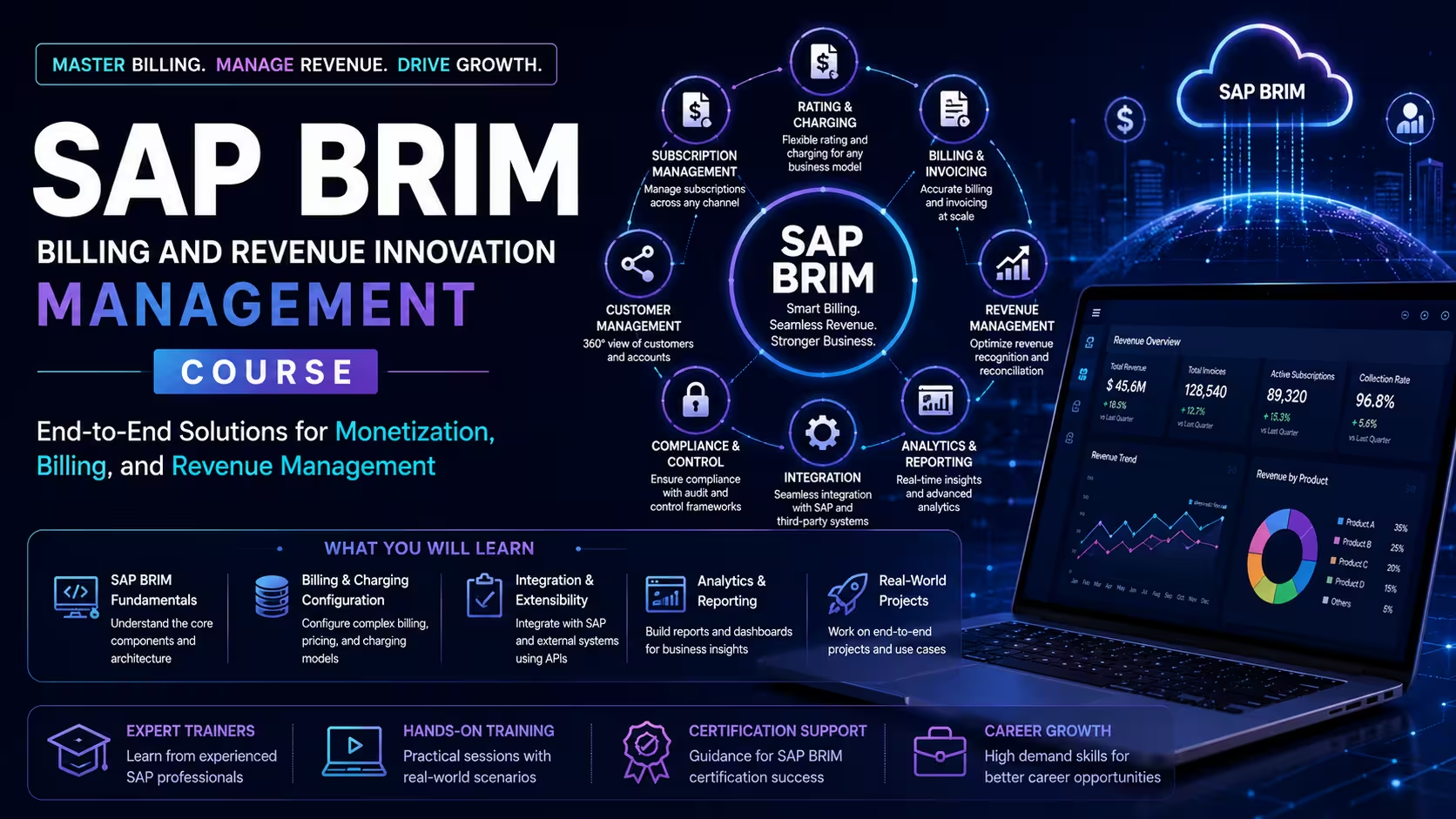
SAP BRIM is a leading solution for subscription billing, revenue management, and digital business models. Learning SAP BRIM helps you build expertise in managing complex billing processes and recurring revenue for enterprise organizations.
2. What will I learn in this SAP BRIM Course?
You will learn Subscription Order Management (SOM), SAP Convergent Charging (CC), SAP Convergent Invoicing (CI), SAP FI-CA, pricing, billing, revenue management, payment processing, customer lifecycle management, and SAP S/4HANA integration.
3. How will this course help my career?
This course prepares you for careers in SAP BRIM consulting, subscription billing, revenue management, SAP implementation, and enterprise billing solutions through practical, project-based learning.
4. Will I get hands-on experience during the training?
Yes. The course includes real-time projects, hands-on labs, billing scenarios, subscription management workflows, and end-to-end SAP BRIM implementation exercises.
Popular Techniques Covered in This Course
SAP Syniti Platform
Enterprise Data Migration
Data Profiling
Data Cleansing & Standardization
Source-to-Target Data Mapping
Data Transformation
Master Data Management (MDM)
Data Quality Management
Metadata Management
SAP S/4HANA Data Migration
Get Hands-on Knowledge about Real-Time Projects
Project 1
Subscription Order Management Implementation
Configure and manage the complete subscription lifecycle, including customer onboarding, subscription creation, contract modification, renewal, and cancellation.
Project 2
Usage-Based Charging System
Design and implement a usage-based charging solution using SAP Convergent Charging (CC), including pricing models, charge plans, and balance management.
Project 3
Enterprise Billing & Invoice Management
Develop an end-to-end billing solution using SAP Convergent Invoicing (CI), including billable items, invoice generation, invoice corrections, and consolidated billing.
Project 4
SAP FI-CA Payment & Collections
Configure SAP FI-CA for payment processing, contract accounts, dunning procedures, collections management, refunds, and payment reconciliation.
Key Features
Edubrights offers SAP BRIM Training in virtual mode with expert trainers. Here are the key features,
40 Hours Course Duration
100% Job Oriented Training
Industry Expert Faculties
Free Demo Class Available
Completed 500+ Batches
Certification Guidance
Curriculum
Module 1: Introduction to SAP BRIM
- Overview of SAP BRIM
- Billing and Revenue Management Fundamentals
- SAP BRIM Architecture
- SAP BRIM Components
- Digital Business Models
- Subscription-Based Business Concepts
- SAP BRIM Use Cases
Module 2: SAP BRIM Solution Overview
- SAP Convergent Charging (CC)
- SAP Convergent Invoicing (CI)
- SAP Contract Accounts Receivable and Payable (FI-CA)
- Subscription Order Management (SOM)
- SAP CRM Integration
- SAP S/4HANA Integration
Module 3: Subscription Order Management (SOM)
- Introduction to SOM
- Subscription Lifecycle
- Product Catalog
- Subscription Contracts
- Order Management
- Contract Modifications
- Subscription Renewal
Module 4: SAP Convergent Charging (CC)
- Charging Fundamentals
- Charge Plans
- Price Plans
- Rating Process
- Usage-Based Charging
- Balance Management
- Charging Scenarios
Module 5: SAP Convergent Invoicing (CI)
- Invoice Processing
- Billing Document Creation
- Invoice Corrections
- Invoice Consolidation
- Billable Items
- Billing Process
- Invoice Management
Module 6: SAP FI-CA (Contract Accounts Receivable & Payable)
- FI-CA Overview
- Business Partner Management
- Contract Accounts
- Payment Processing
- Dunning Process
- Collections Management
- Refund Processing
Module 7: Master Data Management
- Business Partners
- Contract Accounts
- Products and Services
- Subscription Data
- Customer Data Management
- Data Validation
Module 8: Pricing & Billing Configuration
- Pricing Concepts
- Billing Configuration
- Pricing Procedures
- Discount Management
- Promotions
- Tax Configuration
- Billing Rules
Module 9: Revenue Management
- Revenue Recognition
- Revenue Accounting
- Financial Integration
- Revenue Reporting
- Billing Analytics
- Revenue Optimization
Module 10: Payment Processing
- Payment Methods
- Payment Runs
- Incoming Payments
- Outgoing Payments
- Payment Reconciliation
- Payment Monitoring
Module 11: Integration with SAP Solutions
- SAP S/4HANA Integration
- SAP CRM Integration
- SAP ERP Integration
- SAP Fiori
- SAP CPI Integration
- External System Integration
Module 12: Workflow & Automation
- Workflow Configuration
- Business Process Automation
- Approval Workflows
- Notifications
- Scheduled Jobs
- Exception Handling
Module 13: Reporting & Analytics
- SAP BRIM Reports
- Billing Reports
- Revenue Reports
- Customer Reports
- SAP Fiori Dashboards
- Performance Monitoring
Module 14: Security & Administration
- User Management
- Roles & Authorizations
- Security Configuration
- Audit Logs
- Compliance
- Best Practices
Module 15: Performance Optimization & Troubleshooting
- Performance Tuning
- Error Handling
- Log Analysis
- Troubleshooting Billing Issues
- Debugging Techniques
- Best Practices
Module 16: Real-Time Project
- Subscription Product Configuration
- Customer Onboarding
- Pricing Configuration
- Usage-Based Charging
- Billing & Invoice Generation
- Payment Processing
- Revenue Reporting
- SAP S/4HANA Integration
- End-to-End SAP BRIM Implementation
Receive Training From Our Skilled and Effective Trainers
Learn from Experienced SAP BRIM Professionals
Gain insights from trainers with hands-on experience in SAP BRIM implementations, subscription billing, revenue management, SAP FI-CA, and SAP S/4HANA integration projects. Learn how organizations manage complex billing processes, automate revenue operations, and deliver seamless customer billing experiences using SAP BRIM.
Industry Exposure and Real-World Billing & Revenue Management Knowledge
Our instructors bring practical experience from enterprise SAP projects across industries such as telecommunications, utilities, banking, healthcare, manufacturing, software, and subscription-based businesses. Learn industry-standard billing processes, revenue management strategies, and best practices used in large-scale SAP BRIM implementations.
Simple and Practical Teaching Approach
Complex SAP BRIM concepts are explained in a simple and structured manner using real-world billing scenarios, practical demonstrations, business use cases, and interactive sessions. This approach helps both beginners and experienced professionals understand subscription billing and revenue management with confidence.
Project-Based Learning Experience
Build practical expertise through hands-on labs, enterprise case studies, and real-world SAP BRIM projects covering subscription order management, convergent charging, convergent invoicing, SAP FI-CA, payment processing, pricing configuration, revenue management, and SAP S/4HANA integration.
Updated with the Latest SAP Technologies and Industry Best Practices
Our curriculum is regularly updated to reflect the latest SAP BRIM capabilities, subscription business models, SAP S/
SAP BRIM Course Certification
Upon successful completion of the **SAP BRIM – Billing and Revenue Innovation Management Course**, you will receive an **Edubrights Course Completion Certificate** validating your knowledge of subscription billing, SAP Convergent Charging (CC), SAP Convergent Invoicing (CI), SAP FI-CA, revenue management, pricing, payment processing, customer lifecycle management, and SAP S/4HANA integration. This certification demonstrates your practical understanding of SAP BRIM concepts and real-world billing and revenue management processes, helping you strengthen your resume and showcase your expertise to employers. It also supports career opportunities in SAP consulting, subscription billing, revenue management, digital transformation, and SAP BRIM implementation projects across various industries.

Course FAQs
1. What is SAP BRIM, and what business problems does it solve?
SAP Billing and Revenue Innovation Management (BRIM) is a solution portfolio designed to support subscription-based business models, recurring billing, usage-based charging, and revenue-related processes. It helps organizations manage complex pricing structures and large volumes of customer billing transactions.
2. What are the main components of SAP BRIM?
The main components covered in SAP BRIM implementations include Subscription Order Management (SOM), SAP Convergent Charging (CC), SAP Convergent Invoicing (CI), and Contract Accounts Receivable and Payable (FI-CA). Their integration supports subscription management, rating, invoicing, payment processing, and financial operations.
3. What is the difference between SAP BRIM and traditional billing systems?
Traditional billing systems often focus on straightforward product sales or periodic invoices. SAP BRIM supports more complex scenarios, including recurring subscriptions, usage-based pricing, tiered charges, bundled services, and high-volume billing processes.
4. What is Subscription Order Management (SOM) in SAP BRIM?
SOM manages subscription orders and related contract lifecycle activities. It supports processes such as subscription creation, product selection, contract changes, renewals, and cancellations, depending on the implementation.
5. How does the subscription lifecycle work in SAP BRIM?
A typical subscription lifecycle includes customer onboarding, product selection, order creation, contract activation, billing, renewal, modification, and termination. The relevant processes coordinate customer, product, pricing, and billing information across integrated components.
6. What is a subscription product catalog?
A product catalog defines the products and services available for subscription, including their characteristics and commercial options. It helps structure subscription offerings and connect products with the applicable pricing and order-management processes.
7. How are subscription contracts managed in SAP BRIM?
Subscription contracts maintain information about the services a customer has purchased, including contract terms, validity periods, and applicable products. Contract modifications may trigger changes to billing schedules, charges, or downstream processing.
8. How are subscription renewals and cancellations handled?
Renewals extend a subscription according to configured contract terms, while cancellations initiate the relevant termination process. Depending on business rules, these events may affect future billing, outstanding charges, refunds, and contract status.
9. What is SAP Convergent Charging?
SAP Convergent Charging is a charging solution used to calculate charges for subscription services and measurable usage. It supports pricing structures such as recurring fees, usage-based rates, tiered pricing, and other configured charging models.
10. What is the rating process in SAP Convergent Charging?
Rating calculates the financial charge associated with a service event or usage record using configured pricing rules. The result depends on the applicable charge plan, price plan, customer context, usage quantity, and other relevant parameters.
11. What is the difference between recurring and usage-based charging?
Recurring charging applies fees at defined intervals, such as monthly subscription charges. Usage-based charging calculates amounts from measured activity, such as data consumption, transaction volume, call duration, or service utilization.
12. What are charge plans and price plans in SAP Convergent Charging?
Charge plans define the charging logic and structure used to calculate amounts for services or usage. Price plans determine how applicable prices and pricing conditions are applied within the charging process, depending on the configured solution design.
13. What is balance management in SAP Convergent Charging?
Balance management tracks configured balances associated with a customer or service, such as prepaid units, allowances, or consumption limits. Charging processes can update or evaluate these balances according to the applicable business rules.
14. How does SAP BRIM handle tiered pricing?
Tiered pricing applies different rates according to defined usage ranges or quantity thresholds. For example, a service may charge one rate for the first usage band and another rate for usage exceeding that threshold.
15. How are discounts and promotions configured in SAP BRIM?
Discounts and promotions are configured according to the pricing capabilities of the relevant BRIM component and implementation. They may apply to subscription fees, specific services, usage charges, or eligible customer groups within defined validity periods.
16. What is SAP Convergent Invoicing?
SAP Convergent Invoicing is used to process billable items and create invoices or billing documents within the BRIM landscape. It can consolidate eligible charges from different sources into a customer's billing output according to configured rules.
17. What are billable items in SAP Convergent Invoicing?
Billable items represent charge information that is ready for billing processing. They may originate from usage charging, subscription-related processes, or external systems and contain the information needed to determine invoice amounts.
18. How does the end-to-end billing process work in SAP BRIM?
A typical process begins with subscription or service activity, followed by charge calculation where applicable, billable-item creation, invoicing, and financial posting. The exact sequence depends on the integration design, billing scenario, and component configuration.
19. What is convergent billing?
Convergent billing combines eligible charges from multiple products, services, or usage sources into a consolidated billing process. This can simplify customer invoicing when an organization provides several services under related customer or contract-account relationships.
20. How are invoice corrections handled in SAP BRIM?
Invoice corrections address errors or changes in previously processed billing documents. Depending on the scenario, correction processes may involve reversals, adjustments, rebilling, or the creation of corrected documents while maintaining appropriate financial records.
21. What is SAP FI-CA in SAP BRIM?
SAP Contract Accounts Receivable and Payable (FI-CA) supports high-volume receivables and payables processing for industry and contract-based business scenarios. It provides functions for contract accounts, payments, open items, collections, dunning, and financial reconciliation.
22. What is the difference between a business partner and a contract account?
A business partner represents a customer or another business entity in the system. A contract account groups financial and payment-related information for that partner, according to the organization's account-management structure.
23. How does SAP BRIM process incoming payments?
Incoming payments are recorded and processed against relevant customer account information and outstanding receivables. Depending on configuration, payment processing can include payment allocation, clearing, exception handling, and reconciliation.
24. What is payment clearing in SAP FI-CA?
Payment clearing matches payment amounts with relevant open items or receivables. Correct clearing helps maintain accurate customer balances and supports the reconciliation of financial transactions.
25. What is dunning in SAP FI-CA?
Dunning is the process of notifying customers about overdue receivables according to defined collection rules. Dunning procedures can determine when notices are issued, which items qualify, and what follow-up actions are required.
26. How does collections management support SAP BRIM?
Collections management supports activities for handling overdue accounts and outstanding receivables. Depending on the implementation, it can help prioritize collection activities, track customer payment behavior, and coordinate follow-up actions.
27. How are refunds processed in SAP BRIM?
Refund processing handles eligible amounts that must be returned to customers, such as overpayments or approved billing adjustments. The process depends on the originating transaction, account balances, payment method, and applicable approval controls.
28. How does SAP BRIM support payment reconciliation?
Payment reconciliation compares payment records, clearing results, bank information, and relevant financial postings. Investigating unmatched or partially matched transactions helps maintain accurate customer account balances.
29. What is master data management in SAP BRIM?
Master data management maintains the business information needed for subscription and billing processes. Important data includes business partners, contract accounts, products, subscription details, pricing information, and other configuration-dependent attributes.
30. How is customer data validated in SAP BRIM?
Customer data validation checks whether required business partner and account information is present and consistent. Validation can include checking identifiers, account relationships, payment details, contract data, and required attributes before processing transactions.
31. How are pricing procedures and billing rules used in SAP BRIM?
Pricing procedures and billing rules determine how charges, discounts, taxes, and other financial conditions are calculated or applied within the relevant component. The exact configuration method varies across SOM, Convergent Charging, Convergent Invoicing, and integrated SAP applications.
32. How is tax handled in SAP BRIM billing?
Tax calculation depends on the applicable tax configuration, customer and service data, jurisdiction, and integration with relevant tax or financial systems. Correct tax determination should be validated against the organization's tax requirements and deployed solution.
33. What is revenue recognition in the SAP BRIM landscape?
Revenue recognition determines when revenue is recognized according to the applicable accounting rules and contract conditions. The process may involve integrated revenue accounting capabilities and financial systems, depending on the organization's SAP architecture.
34. What is the difference between billing and revenue accounting?
Billing determines amounts owed by customers and produces billing documents. Revenue accounting addresses the recognition and allocation of revenue under applicable accounting requirements, which may differ from invoice timing or payment timing.
35. How does SAP BRIM integrate with SAP S/4HANA?
SAP BRIM can integrate with SAP S/4HANA to support financial postings, customer accounting, payment processes, and related enterprise operations. The integration approach depends on the product versions, deployment architecture, and business requirements.
36. What is the role of SAP CRM in SAP BRIM processes?
Where SAP CRM is part of the architecture, it can support customer-facing processes and relevant order or service information. Integration enables applicable customer and subscription data to be shared with billing and revenue-management components.
37. How can SAP Cloud Integration (CPI) be used with SAP BRIM?
SAP Cloud Integration can support integration flows between SAP applications and external systems where suitable interfaces are available. Integration scenarios may exchange customer data, subscription information, usage records, billing details, or financial data.
38. How does SAP BRIM integrate with SAP S/4HANA?
SAP BRIM can integrate with SAP S/4HANA to support financial and enterprise processes. Depending on the architecture, integration can connect subscription, billing, receivables, and financial information across the solution landscape.
39. How does SAP BRIM integrate with SAP CRM?
SAP CRM integration can connect customer and subscription-related processes with BRIM billing and revenue workflows. The exact integration design depends on the deployed SAP architecture and supported interfaces.
40. What is SAP CPI integration in a BRIM environment?
SAP Cloud Integration (CPI) can be used to connect SAP BRIM-related processes with other SAP or external systems through integration flows. It can support data transformation, routing, message exchange, and system-to-system integration.
41. How can SAP BRIM integrate with external systems?
External integrations can exchange customer, subscription, usage, payment, product, and financial information with other applications. Interface design should address data mapping, validation, error handling, security, and monitoring.
42. How is workflow automation used in SAP BRIM?
Workflow and automation can coordinate activities such as approvals, notifications, scheduled processing, and exception handling. Automation helps standardize recurring business processes while reducing manual intervention.
43. What are scheduled jobs in SAP BRIM?
Scheduled jobs execute recurring system activities at defined intervals or according to configured schedules. They can be used for processes such as data processing, billing-related activities, payment processing, or monitoring.
44. How are SAP BRIM billing errors troubleshot?
Troubleshooting generally involves identifying the failed process, reviewing application logs and error messages, checking configuration and master data, and validating upstream and downstream data. The specific troubleshooting approach depends on whether the issue occurs in SOM, CC, CI, FI-CA, or an integration layer.
45. What is log analysis in SAP BRIM?
Log analysis involves reviewing system and application logs to identify processing failures, integration problems, configuration errors, or data inconsistencies. Logs provide technical information that can help isolate the stage where a process failed.
46. How can SAP BRIM performance be optimized?
Performance optimization can involve reviewing data volumes, charging and billing configurations, scheduled jobs, integration processes, database performance, and application logs. High-volume BRIM environments require careful monitoring and appropriate technical design.
47. What security concepts are important in SAP BRIM?
Important security areas include user management, roles, authorizations, access control, audit logging, and protection of customer and financial information. Security design should follow the organization's business responsibilities and segregation requirements.
48. What reports can be created in SAP BRIM?
BRIM reporting can cover billing information, revenue, customers, payments, and operational processing. SAP Fiori dashboards and other reporting mechanisms can provide analytical views depending on the implemented SAP landscape.
49. What practical SAP BRIM projects are covered in the Bangalore course?
The published Edubrights course includes projects covering Subscription Order Management implementation, usage-based charging, enterprise billing and invoice management, and SAP FI-CA payment and collections. These projects cover subscription lifecycle management, pricing, billable items, invoice generation, payments, dunning, collections, refunds, and reconciliation.
50. What technical skills can learners develop through SAP BRIM training?
Learners can develop skills in subscription order management, Convergent Charging, Convergent Invoicing, FI-CA, pricing and billing configuration, payment processing, revenue management, SAP S/4HANA integration, workflow automation, reporting, security, and troubleshooting. The published curriculum also includes practical implementation work across the end-to-end BRIM process.
Get Training Quote for Free
Testimonials
Hear What Our Students Say
"Transform your life through Education, hear it from our Alumni"

6 LPA
Fathima
Student
Software Engineer
"Transform your life through Education, hear it from our Alumni"

8 LPA
Rahul
Student
Data Scientist
"Transform your life through Education, hear it from our Alumni"

8 LPA
Siddharth
NIELSON IQ
Data Analyst