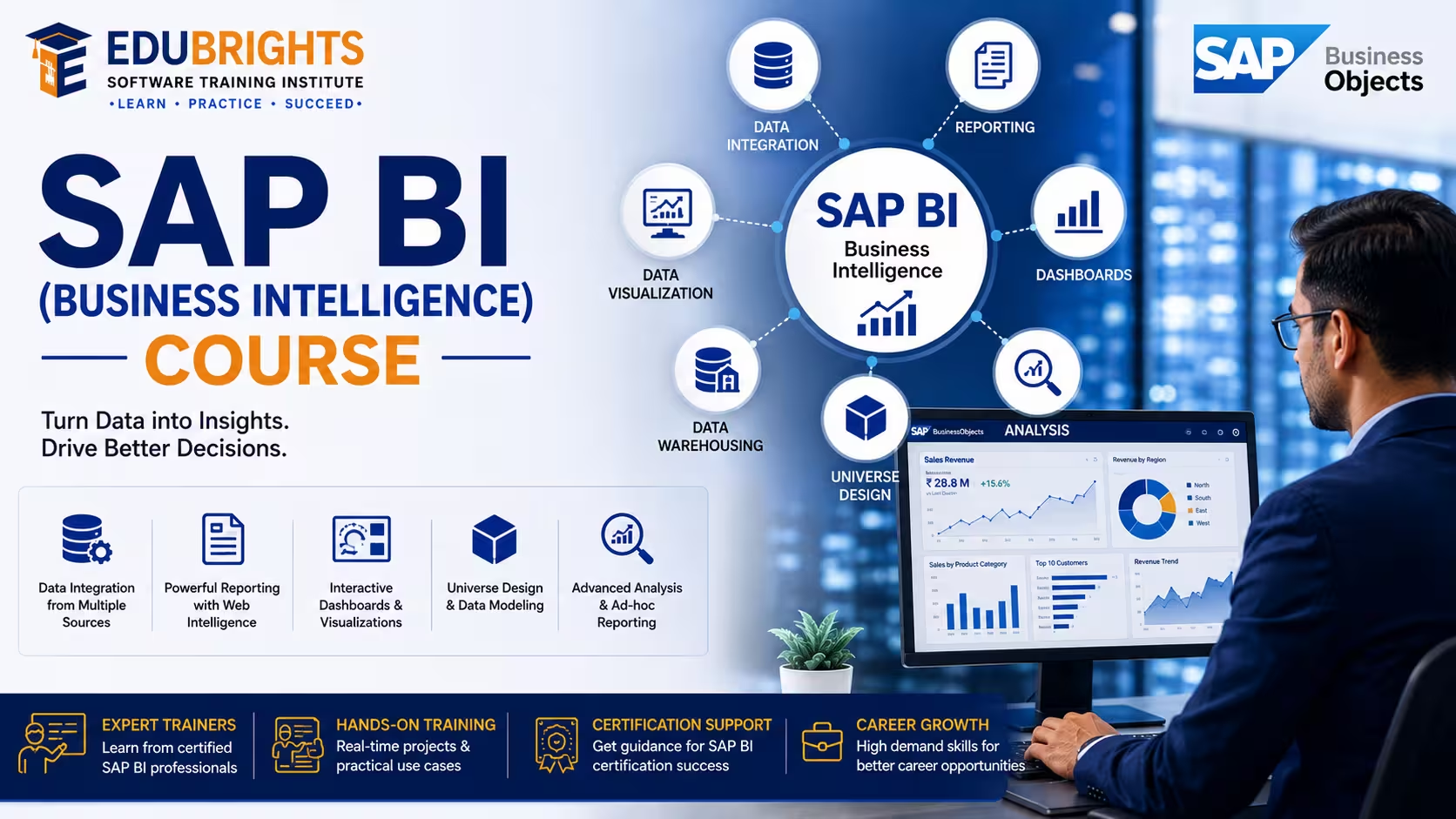
Course Objectives
1. What will I learn by taking the SAP BI (Business Intelligence) course in Bangalore?
You'll build a solid understanding of the core concepts, terminology, and fundamentals of SAP BI (Business Intelligence), giving you a strong foundation to build on.
2. What hands-on skills will I gain from the SAP BI (Business Intelligence) training?
You'll get hands-on experience with industry-relevant SAP BI (Business Intelligence) tools and workflows through guided exercises, so you learn by doing rather than just reading theory.
3. How does the SAP BI (Business Intelligence) course prepare me for real-world work?
The SAP BI (Business Intelligence) course is designed around how SAP BI (Business Intelligence) is actually applied to solve real-world problems in professional settings, not just textbook scenarios.
4. What practical, job-ready skills will I build during SAP BI (Business Intelligence) training in Bangalore?
You'll develop the practical skills needed to confidently work with SAP BI (Business Intelligence) on the job, so you're ready to contribute from day one in a SAP BI (Business Intelligence) role.
5. Will I work on real projects during the SAP BI (Business Intelligence) course?
Yes, the SAP BI (Business Intelligence) course includes real-time projects and case studies that reinforce concepts through practice, giving you portfolio-ready work by the end.
6. How does the SAP BI (Business Intelligence) course help with certification and job interviews?
The SAP BI (Business Intelligence) course is structured to help you prepare for relevant certifications and interviews, covering the concepts and terminology employers and exam boards expect.
Popular Techniques Covered in This Course
SAP BI Architecture
Data Warehousing Concepts
Data Extraction and ETL Processes
InfoObjects and InfoProviders
SAP BW Modeling
Query Design and Reporting
Dashboard Development
Business Analytics and KPI Reporting
Data Integration and Transformation
SAP BI Performance Optimization
Get Hands-on Knowledge about Real-Time Projects
Project 1
Project 1: Sales Performance Analytics Dashboard
Develop an interactive dashboard to analyze sales performance, customer trends, product profitability, and regional growth.
Project 2
Project 2: Financial Reporting and Analysis System
Create automated financial reports for revenue tracking, expense analysis, budgeting, and executive decision-making.
Project 3
Project 3: Supply Chain Analytics Solution
Build business intelligence reports that monitor inventory levels, procurement efficiency, logistics performance, and supplier metrics.
Project 4
Project 4: Human Resources Analytics Dashboard
Design HR reports to track employee performance, workforce planning, recruitment metrics, and training effectiveness.
Project 5
Project 5: Enterprise Data Warehouse Implementation
Develop a centralized data warehouse solution integrating multiple business systems for advanced reporting and analytics.
Key Features
Edubrights offers SAP BI (Business Intelligence) in virtual mode with expert trainers. Here are the key features,
40 Hours Course Duration
100% Job Oriented Training
Industry Expert Faculties
Free Demo Class Available
Completed 500+ Batches
Certification Guidance
Curriculum
Module 1: Introduction to SAP BI
- Overview of SAP Business Intelligence solutions
- SAP BI tools: BW, SAC, BusinessObjects, Lumira
- BI architecture and reporting landscape
- BI strategy and roadmap
- Integration with SAP and non-SAP data sources
Module 2: SAP BusinessObjects (BOBJ) Suite
- BOBJ components: Universe, Web Intelligence, Crystal Reports
- Central Management Console (CMC)
- User and group management
- Publication and scheduling
- BOBJ upgrade and administration
Module 3: Universe Design Tool (UDT)
- Universe creation and maintenance
- Classes, objects, and conditions
- Joins and cardinality
- Derived tables and aggregate awareness
- Universe integrity check
Module 4: Web Intelligence (WebI)
- Report creation in WebI
- Queries, filters, and variables
- Formulas and functions
- Charts and visualization
- Scheduling and distribution
Module 5: SAP Crystal Reports
- Crystal Reports designer
- Database connections and queries
- Formula editor and functions
- Subreports and cross-tabs
- Publishing to BOBJ BI platform
Module 6: SAP Lumira
- Lumira Designer and Discovery
- Data acquisition and preparation
- Visualization creation
- Story and storyboard design
- Publishing to SAC or BOBJ
Module 7: SAP Analysis for Office
- Analysis for Office overview
- BW and BPC data access
- Workbook design and navigation
- Planning functions integration
- Crosstab analysis and reporting
Module 8: SAP Fiori and Embedded Analytics
- Embedded analytics in S/4HANA
- CDS-based analytical apps
- KPI tiles and overview pages
- Multidimensional reporting
- Smart Business Cockpit
Module 9: Data Visualization Best Practices
- Dashboard design principles
- Choosing the right chart type
- Color, layout, and storytelling
- Mobile-first reporting design
- Accessibility in BI reports
Module 10: BI Administration and Security
- BI platform administration
- Security: Users, groups, access levels
- Content lifecycle management
- Monitoring and auditing
- Backup and recovery
Module 11: SAP BI and SAC Integration
- Migration from BOBJ to SAC
- Live connection to BW and HANA
- Hybrid BI landscape management
- SAC as modern BI frontend
Module 12: Real-Time Projects and Case Studies
- Enterprise BI dashboard development
- Financial and operational reporting
- End-to-end BI implementation
- Certification and interview preparation
Receive Training From Our Skilled and Effective Trainers
Learn from Experienced SAP BI (Business Intelligence) Professionals
Gain practical expertise from experienced SAP BI (Business Intelligence) professionals in Bangalore who have successfully delivered enterprise reporting, business intelligence, data warehousing, analytics, and dashboard development projects across banking, manufacturing, retail, healthcare, telecommunications, energy, and consulting organizations. Learn real-world implementation methodologies and reporting strategies used by global enterprises.
Industry Exposure with Enterprise SAP BI Projects
Our SAP BI (Business Intelligence) trainers in Bangalore have extensive hands-on experience implementing SAP BusinessObjects, SAP BW/4HANA, SAP Analytics Cloud (SAC), SAP S/4HANA Embedded Analytics, data modeling, ETL processes, enterprise reporting, and business intelligence solutions. Learn implementation best practices followed by leading SAP consulting firms and multinational organizations.
Simple, Practical & Business-Oriented Teaching Approach
Core SAP BI (Business Intelligence) concepts—including SAP BW, SAP BusinessObjects, InfoProviders, Data Modeling, ETL Processes, Queries, Reports, Dashboards, Analytics, SAP Analytics Cloud (SAC), and Embedded Analytics—are taught through live demonstrations, enterprise case studies, and practical business scenarios. This approach helps learners understand how SAP BI solutions are implemented in real enterprise environments.
Hands-On Real-Time SAP BI Projects
Build job-ready expertise through structured lab sessions and real-world projects covering Data Extraction, ETL Development, Data Modeling, InfoProviders, Queries, Enterprise Reporting, Dashboard Development, BusinessObjects Reports, SAP Analytics Cloud Dashboards, Performance Analysis, Business Intelligence Solutions, and complete SAP BI implementation scenarios using live enterprise datasets.
Updated with the Latest SAP Analytics Technologies
Our SAP BI curriculum is continuously updated with the latest SAP BW/4HANA, SAP BusinessObjects, SAP Analytics Cloud (SAC), SAP S/4HANA Embedded Analytics, AI-powered analytics capabilities, cloud-based reporting solutions, and modern business intelligence best practices. This ensures learners develop practical, certification-ready, and industry-relevant SAP BI skills that are highly valued by organizations in Bangalore and across the global SAP ecosystem.
Succeed Our Resourceful Certification
The Certified SAP Business Intelligence (BI) Professional certification validates expertise in data warehousing, reporting, analytics, dashboard development, and business intelligence solutions using SAP technologies. It demonstrates the ability to transform business data into meaningful insights that support strategic decision-making. This certification enhances career opportunities in analytics, reporting, data management, and enterprise intelligence consulting.
Course FAQs
1. What is SAP BI (Business Intelligence)?
SAP BI is a set of SAP technologies used to collect, integrate, model, analyze, and report business data. It supports enterprise reporting and decision-making by transforming data from different sources into meaningful information.
2. What is SAP BW in SAP BI?
SAP BW (Business Warehouse) is SAP's data warehousing platform for collecting, transforming, consolidating, and analyzing business data. It provides structured data models and reporting capabilities for enterprise analytics.
3. What is SAP BW/4HANA?
SAP BW/4HANA is SAP's modern data warehousing platform designed to run on SAP HANA. It provides capabilities for data acquisition, modeling, integration, and analytical reporting.
4. What are the major components of an SAP BI architecture?
An SAP BI landscape can include data sources, data acquisition and transformation processes, data warehouse models, reporting tools, dashboards, and analytics platforms. The exact architecture depends on the organization's reporting and integration requirements.
5. What is data warehousing in SAP BI?
Data warehousing involves collecting data from multiple sources, transforming and consolidating it, and storing it for analysis and reporting. SAP BW/4HANA uses data flows and modeling objects to make this information available for analytical use.
6. What is an InfoObject in SAP BW?
An InfoObject represents reusable business information such as customer, material, company code, or a key figure. InfoObjects can provide characteristics, attributes, texts, and other metadata used in BW modeling and reporting.
7. What is an InfoProvider?
An InfoProvider is an SAP BW object that provides data for reporting and analysis. Depending on the BW environment, InfoProviders can include objects such as DataStore Objects and other modeled data structures.
8. What is an Advanced DataStore Object (ADSO)?
An Advanced DataStore Object is a central data persistence and modeling object in SAP BW/4HANA. Different ADSO configurations can support staging, reporting, data mart, or other data warehousing requirements.
9. What is a CompositeProvider?
A CompositeProvider combines data from multiple BW and supported external sources into a unified analytical model. It can be used to create flexible reporting and virtual data-mart scenarios.
10. What is an Open ODS View?
An Open ODS View provides reusable semantics for external or field-based data structures without requiring every source to be physically loaded into traditional BW persistence. It can help integrate sources such as database tables, HANA views, and other supported structures.
11. What is SAP BI data extraction?
Data extraction is the process of obtaining business data from SAP or non-SAP source systems for analysis. The extracted data can then be transformed, cleansed, consolidated, and loaded into the BI environment.
12. What is ETL in SAP BI?
ETL stands for Extract, Transform, and Load. In SAP BI, it describes the process of extracting data from source systems, transforming it according to business requirements, and loading it into analytical structures.
13. What is a DataStore Object in SAP BW?
A DataStore Object is a BW data storage object used for storing and managing detailed data. It can also participate in data flows where processed information is transferred to other analytical providers.
14. What is a process chain in SAP BW?
A process chain is a sequence of background processes used to automate and monitor recurring BW activities. SAP describes process chains as event-controlled process flows that can centrally control and monitor BW processes.
15. Why are process chains important in SAP BI?
Process chains reduce manual intervention by automating data loading and subsequent processing steps. They can connect multiple processes and provide centralized monitoring of scheduled BI workflows.
16. What is LSA++ in SAP BW/4HANA?
LSA++ is a layered architecture approach for SAP BW/4HANA that supports flexible data warehousing and analytical scenarios. It includes layers such as data acquisition, enterprise data warehousing, data marts, and virtual data marts.
17. What is a BEx query?
A BEx query is an analytical query defined on SAP BW data that can be used for reporting and analysis. BI reporting applications can access BEx queries and BW InfoProviders through supported connectivity mechanisms.
18. What is query design in SAP BI?
Query design involves defining the data, filters, characteristics, measures, conditions, and calculations required for an analytical report. A well-designed query provides users with relevant information while reducing unnecessary data processing.
19. What are characteristics and key figures in SAP BI?
Characteristics describe business dimensions such as customer, product, region, or company. Key figures represent measurable values such as revenue, quantity, cost, or profit.
20. What is SAP BusinessObjects?
SAP BusinessObjects is an enterprise business intelligence and reporting platform that provides tools for reporting, analysis, information delivery, and BI administration. The Edubrights course covers components such as Universe, Web Intelligence, Crystal Reports, and the Central Management Console.
21. What are classes and objects in a BusinessObjects Universe?
Classes organize related reporting objects, while objects represent business elements that users can use in queries and reports. Proper organization of classes and objects makes a universe easier for report developers and business users to understand.
22. What are joins in Universe Design Tool?
Joins define relationships between tables in the universe data model. Correct join configuration is important for retrieving accurate results and avoiding unwanted duplication or incorrect data combinations.
23. What is cardinality in a BusinessObjects Universe?
Cardinality describes the relationship between records in two joined tables, such as one-to-one or one-to-many. Understanding cardinality helps designers create accurate joins and identify potential query issues.
24. What are derived tables in SAP BusinessObjects?
Derived tables are query-based table structures created within the universe layer. They can be used to build more complex data structures when standard physical database tables are not sufficient for a reporting requirement.
25. What is aggregate awareness in SAP BusinessObjects?
Aggregate awareness allows a universe to use appropriate aggregated tables when available instead of always querying detailed data. This can improve query performance while maintaining the required reporting results.
26. What is a Universe integrity check?
A universe integrity check validates elements of the universe design for potential errors or inconsistencies. It helps identify problems with objects, joins, conditions, and other universe components before reports depend on them.
27. What is SAP Web Intelligence (WebI)?
Web Intelligence is a reporting and analysis tool in the SAP BusinessObjects ecosystem. It enables users to create reports using queries, filters, variables, formulas, tables, charts, and other reporting components.
28. What are filters in Web Intelligence?
29. What are variables in Web Intelligence?
Variables are custom report-level calculations or expressions created to support analysis and presentation. They can be used to derive values from existing report data and implement reporting logic.
30. What are formulas and functions in Web Intelligence?
Formulas and functions are used to perform calculations and manipulate report data. They can support arithmetic operations, conditional logic, date calculations, aggregation, and other analytical requirements.
31. How are charts used in Web Intelligence?
Charts convert report data into visual representations such as bar charts, line charts, and other graphical formats. Appropriate chart selection helps users identify trends, comparisons, and patterns more efficiently.
32. What is report scheduling in SAP BusinessObjects?
Report scheduling allows BI content to run automatically at defined times or according to recurring schedules. Scheduled reports can be processed and distributed without requiring users to manually execute them each time.
33. What is SAP Crystal Reports?
SAP Crystal Reports is a reporting tool used to create formatted, data-driven business reports. The SAP BI syllabus includes database connections, queries, formulas, subreports, cross-tabs, and publishing through the BI platform.
34. What are subreports in Crystal Reports?
Subreports are reports embedded within a primary Crystal Report. They are useful when a report needs to present additional related information using a separate reporting structure or data query.
35. What are cross-tabs in Crystal Reports?
Cross-tabs organize summarized data into rows and columns for easier comparison. They are commonly used for analyzing measures across multiple business dimensions.
36. What is SAP Lumira?
SAP Lumira is a data visualization and discovery technology used for preparing, analyzing, and visually presenting business data. The course syllabus covers data acquisition, preparation, visualization, story creation, and publishing.
37. What is data preparation in SAP Lumira?
Data preparation involves connecting to data, cleaning it, structuring fields, and preparing datasets for analysis. Proper preparation helps improve the quality and usability of visualizations.
38. What is SAP Fiori Embedded Analytics?
SAP S/4HANA Embedded Analytics provides analytical capabilities directly within the transactional S/4HANA environment. It can use analytical applications, KPIs, and multidimensional reporting to support business analysis.
39. What are CDS-based analytical apps?
CDS-based analytical applications use Core Data Services views and related analytical capabilities to expose business information for analysis. They are an important part of modern SAP S/4HANA analytical scenarios.
40. What are KPI tiles in SAP Fiori analytics?
KPI tiles provide visual representations of important business performance indicators. They can help users monitor metrics and navigate from summarized information to more detailed analytical content.
41. What is SAP Analytics Cloud integration with SAP BI?
SAP Analytics Cloud can serve as a modern analytics and visualization layer connected to SAP data sources. The Edubrights syllabus covers live connections to BW and HANA, hybrid BI landscapes, and migration scenarios from BusinessObjects to SAC.
42. What is a live connection in SAP Analytics Cloud?
A live connection allows SAP Analytics Cloud to access data from supported source systems without replicating the complete dataset into the cloud. The specific connection architecture depends on the source system and SAP landscape.
43. What is BI administration?
BI administration involves managing the BI platform, users, groups, security, content, system monitoring, scheduling, and related operational activities. The Edubrights course includes BI administration, security, lifecycle management, monitoring, auditing, and backup/recovery.
44. How is security managed in SAP BusinessObjects?
Security can be configured around users, groups, access levels, and permissions for BI content and platform resources. Proper security configuration helps ensure that users access only the reports and resources appropriate to their assigned permissions.
45. What is content lifecycle management in SAP BI?
Content lifecycle management involves moving BI content between development, test, and production environments in a controlled manner. It helps organizations manage changes to reports, Universes, dashboards, and related BI objects.
46. What is monitoring and auditing in SAP BI?
Monitoring involves observing the health and operation of BI platform components, jobs, reports, and related services. Auditing provides information about system and user activities that can support security, compliance, and operational analysis.
47. How can SAP BI performance be optimized?
BI performance can be improved by optimizing data models, queries, joins, filters, report design, data volumes, and system configuration. Performance analysis should consider the complete flow from source data through transformation and reporting.
48. What are SAP BI dashboard design best practices?
Effective dashboards should present relevant KPIs clearly, use appropriate visualizations, maintain logical layouts, and avoid unnecessary complexity. The Edubrights syllabus also covers mobile-first reporting design and accessibility considerations.
49. What practical projects are covered in SAP BI training in Bangalore?
The course page lists projects such as Sales Performance Analytics Dashboard, Financial Reporting and Analysis System, Supply Chain Analytics Solution, Human Resources Analytics Dashboard, and Enterprise Data Warehouse Implementation. These projects cover reporting, dashboards, data integration, and business analytics scenarios.
50. What technical skills can I gain from SAP BI training in Bangalore?
Learners can develop skills in SAP BI architecture, data warehousing, ETL, BW modeling, BusinessObjects, Universe design, Web Intelligence, Crystal Reports, Lumira, Analysis for Office, embedded analytics, dashboard development, BI administration, security, and SAP Analytics Cloud integration. These areas correspond closely with the technical curriculum published on the Edubrights SAP BI course page.
Get Training Quote for Free
Testimonials
Hear What our Students say
"Transform your life through Education, hear it from our Alumni"

6 LPA
Fathima
Student
Software Engineer
"Transform your life through Education, hear it from our Alumni"

8 LPA
Rahul
Student
Data Scientist
"Transform your life through Education, hear it from our Alumni"

8 LPA
Siddharth
NIELSON IQ
Data Analyst