Course Objectives
1. What will I learn by taking the SAP Activate Methodology course in Bangalore?
You'll build a solid understanding of the core concepts, terminology, and fundamentals of SAP Activate Methodology, giving you a strong foundation to build on.
2. What hands-on skills will I gain from the SAP Activate Methodology training?
You'll get hands-on experience with industry-relevant SAP Activate Methodology tools and workflows through guided exercises, so you learn by doing rather than just reading theory.
3. How does the SAP Activate Methodology course prepare me for real-world work?
The SAP Activate Methodology course is designed around how SAP Activate Methodology is actually applied to solve real-world problems in professional settings, not just textbook scenarios.
4. What practical, job-ready skills will I build during SAP Activate Methodology training in Bangalore?
You'll develop the practical skills needed to confidently work with SAP Activate Methodology on the job, so you're ready to contribute from day one in a SAP Activate Methodology role.
5. Will I work on real projects during the SAP Activate Methodology course?
Yes, the SAP Activate Methodology course includes real-time projects and case studies that reinforce concepts through practice, giving you portfolio-ready work by the end.
6. How does the SAP Activate Methodology course help with certification and job interviews?
The SAP Activate Methodology course is structured to help you prepare for relevant certifications and interviews, covering the concepts and terminology employers and exam boards expect.
Popular Techniques Covered in This Course
1. SAP Activate Methodology
2. SAP Project Lifecycle Management
3. Agile Project Management
4. SAP Best Practices Analysis
5. Fit-to-Standard Workshop Execution
6. Stakeholder Management
7. Risk and Issue Management
8. SAP S/4HANA Implementation Planning
9. Project Governance and Compliance
10. Project Scheduling and Resource Planning
Get Hands-on Knowledge about Real-Time Projects
Project 1
Project 1: SAP S/4HANA Greenfield Implementation Planning
Create a complete project plan for a new SAP S/4HANA implementation using SAP Activate methodology. Learners will define project phases, timelines, deliverables, and governance structures.
Project 2
Project 2: Agile SAP Project Execution Framework
Develop an Agile project execution strategy for an SAP implementation project. Students will work with sprint planning, backlog management, and project monitoring techniques.
Project 3
Project 3: SAP Project Risk Assessment and Mitigation
Conduct a Fit-to-Standard workshop to gather business requirements and align them with SAP best practices while minimizing custom developments.
Project 4
Project 4: SAP Fit-to-Standard Workshop Simulation
Conduct a Fit-to-Standard workshop to gather business requirements and align them with SAP best practices while minimizing custom developments.
Project 5
Project 5: SAP Deployment and Hypercare Planning
Design deployment strategies, cutover plans, and post-go-live support models for successful SAP project delivery and transition management.
Key Features
Edubrights offers SAP Activate Methodology & Project Management in virtual mode with expert trainers. Here are the key features,
40 Hours Course Duration
100% Job Oriented Training
Industry Expert Faculties
Free Demo Class Available
Completed 500+ Batches
Certification Guidance
& Project Management
Curriculum
Module 1: Introduction to SAP Activate
- SAP Activate overview: agile project methodology for SAP implementations
- SAP Activate vs ASAP: evolution from waterfall to agile delivery
- SAP Activate components: methodology, content, and guided configuration
- SAP Activate for different scenarios: new implementation, conversion, and agile release
Module 2: SAP Activate Phases
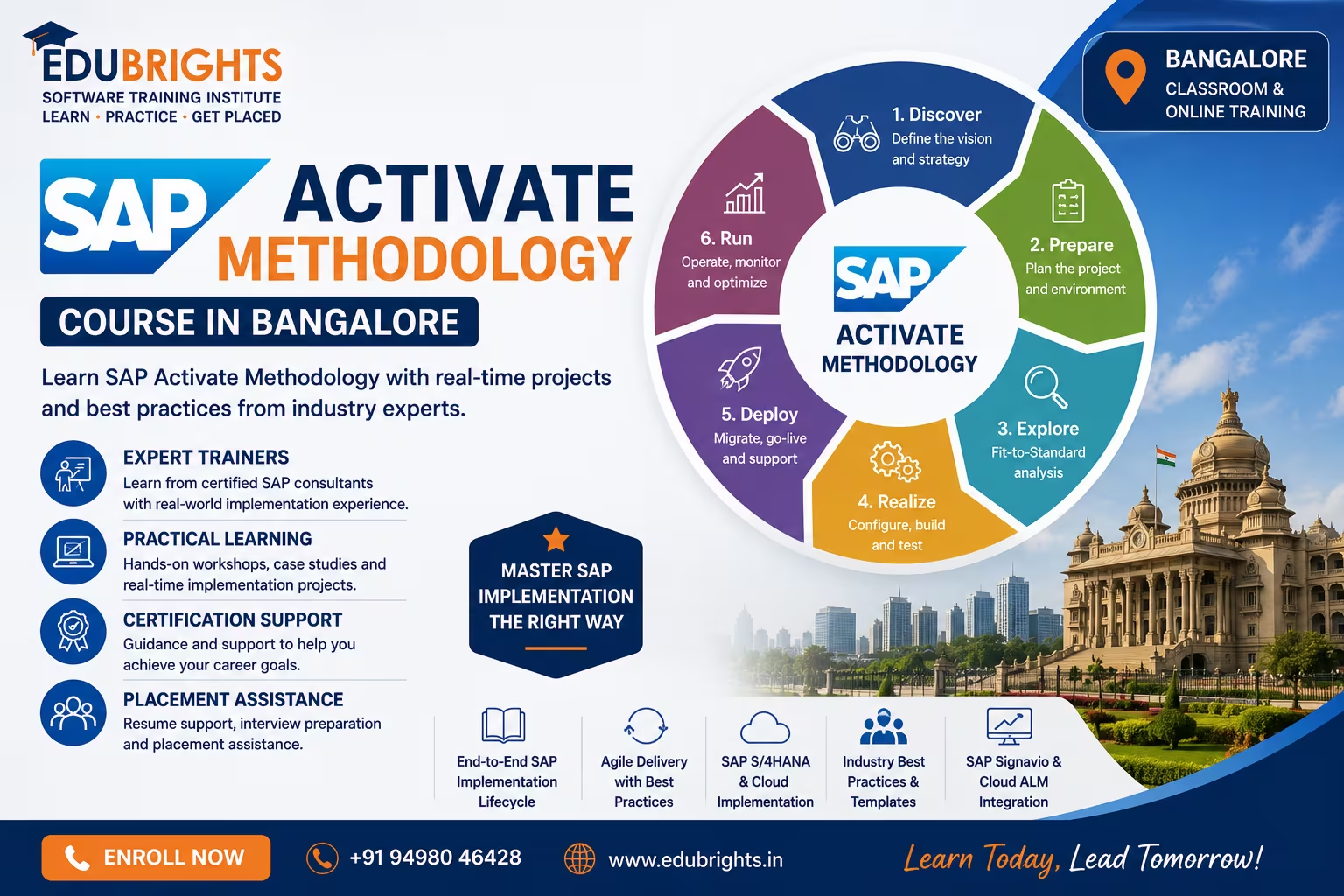
- Discover phase: value discovery, business case, and solution exploration
- Prepare phase: project initiation, standards, and infrastructure setup
- Explore phase: Fit-to-Standard workshops and backlog creation
- Realise phase: iterative configuration, development, and testing sprints
- Deploy phase: cutover planning, go-live, and hypercare
- Run phase: continuous improvement and release management
Module 3: Fit-to-Standard Workshops
- Fit-to-Standard approach: adopting SAP best practices over customisation
- Workshop preparation: demo system, business process scope, and attendees
- Delta definition: documenting gaps, risks, and decisions from workshops
- Business-Driven Configuration (BDC): configuring SAP from business answers
Module 4: Agile Delivery in SAP Projects
- Scrum in SAP Activate: sprints, backlog, and sprint review ceremonies
- Product backlog management: user stories, acceptance criteria, and prioritisation
- Sprint planning and velocity tracking for SAP project teams
- Combining agile sprints with SAP transport management
Module 5: SAP Best Practices and Solution Documentation
- SAP Best Practices: pre-configured business processes for S/4HANA
- SAP Cloud ALM: project and task management for SAP implementations
- Solution Documentation: business process hierarchy and test case management
- SAP Signavio: process modelling and Fit-to-Standard documentation
Module 6: Testing in SAP Activate
- Testing strategy: unit testing, integration testing, and UAT in SAP projects
- SAP Cloud ALM test management: test plans, cases, and execution
- Defect management: logging, tracking, and resolving SAP test defects
- Regression testing: managing re-test cycles during realise phase sprints
Module 7: Cutover and Go-Live Management
- Cutover strategy: big bang vs phased go-live approaches
- Cutover plan: tasks, owners, durations, and dependencies
- Go-live readiness checklist: technical and business readiness criteria
- Hypercare: post go-live support, issue triage, and stabilisation
Module 8: Capstone Project and Assessment
- SAP Activate project plan: phases, workstreams, and milestone schedule
- Fit-to-Standard workshop simulation and delta documentation exercise
- Cutover plan build and go-live readiness checklist project
- Final assessment and course certification
Receive Training From Our Skilled and Effective Trainers
Experience in the Industry Gain expertise from SAP Activate Methodology professionals training in Bangalore who have applied their skills on live projects across corporate, product, and consulting environments, bringing practical, real-world context into every SAP Activate Methodology session.
Backgrounds at the Top Our SAP Activate Methodology trainers in Bangalore bring hands-on industry experience, having worked on real SAP Activate Methodology projects for organizations across various industries before moving into training.
Clear & Effective Teaching Core SAP Activate Methodology concepts, tools, and workflows are explained using real project examples and practical scenarios, so you understand not just the theory but how SAP Activate Methodology is actually used on the job.
Hands-On Learning Focus Students get structured, hands-on practice with SAP Activate Methodology through guided exercises, mini-projects, and lab work designed to build practical, job-ready skills.
Up-to-Date Knowledge Trainers keep the SAP Activate Methodology curriculum current with the latest tools, versions, and industry best practices, so what you learn stays relevant to how SAP Activate Methodology is used today in Bangalore and beyond.
SAP Activate Methodology Professional Certification Preparation
This training helps learners understand SAP Activate concepts, implementation phases, Agile delivery principles, project governance, and SAP best practices. The curriculum is designed to build knowledge required for SAP Activate-related certification pathways and implementation projects.
Course FAQs
1. What is SAP Activate Methodology?
SAP Activate is an implementation methodology that combines SAP Best Practices, guided configuration, and Agile delivery principles to structure SAP implementation projects. It provides a framework for planning, executing, deploying, and continuously improving SAP solutions.
2. What is SAP Activate Methodology Training in Bangalore?
SAP Activate Methodology Training in Bangalore focuses on SAP implementation planning, Agile project delivery, Fit-to-Standard workshops, project governance, testing, deployment, and post-go-live activities. The training follows the SAP implementation lifecycle and practical project scenarios.
3. Who should learn SAP Activate Methodology?
SAP consultants, project managers, business analysts, implementation specialists, functional consultants, project coordinators, and professionals involved in SAP transformation projects can learn SAP Activate Methodology.
4. Is SAP Activate suitable for SAP S/4HANA implementation?
Yes. SAP Activate is designed to support SAP S/4HANA implementation scenarios, including new implementations, system conversions, and other SAP transformation approaches. The methodology provides structured activities for planning, realization, testing, deployment, and operations.
5. What are the main phases of SAP Activate?
The main SAP Activate phases are Discover, Prepare, Explore, Realize, Deploy, and Run. Each phase contains specific implementation activities, deliverables, milestones, and governance requirements.
6. What is the Discover phase in SAP Activate?
The Discover phase focuses on understanding business requirements, identifying transformation opportunities, evaluating solution options, and establishing the initial business case. It helps define the overall direction of the SAP implementation.
7. What is the Prepare phase in SAP Activate?
The Prepare phase focuses on project initiation, team setup, governance, project standards, infrastructure readiness, and implementation planning. It establishes the foundation for executing the SAP project.
8. What is the Explore phase in SAP Activate?
The Explore phase focuses on Fit-to-Standard workshops, business process validation, SAP Best Practices evaluation, gap identification, and backlog creation. It connects business requirements with the standard SAP solution.
9. What is the Realize phase in SAP Activate?
The Realize phase focuses on iterative configuration, development, testing, and validation. Project teams typically work through sprints to progressively build and validate the SAP solution.
10. What is the Deploy phase in SAP Activate?
The Deploy phase prepares the SAP solution for production use. Activities include cutover planning, final testing, go-live preparation, deployment execution, and transition to post-go-live support.
11. What is the Run phase in SAP Activate?
The Run phase focuses on operating the SAP solution after deployment. It includes stabilization, monitoring, release management, continuous improvement, and ongoing support activities.
12. What is Fit-to-Standard in SAP Activate?
Fit-to-Standard is an implementation approach where business processes are evaluated against standard SAP capabilities and SAP Best Practices. The goal is to adopt standard functionality where possible and reduce unnecessary customization.
13. What is the difference between Fit-to-Standard and Fit-Gap analysis?
Fit-to-Standard focuses on demonstrating and adopting standard SAP processes. Fit-Gap analysis identifies differences between business requirements and standard SAP functionality and determines how those differences should be handled.
14. How are Fit-to-Standard workshops conducted?
Fit-to-Standard workshops involve business users, process owners, SAP consultants, and project stakeholders reviewing standard SAP processes. Business requirements, gaps, decisions, and follow-up actions are documented during the workshops.
15. What is Business-Driven Configuration in SAP Activate?
Business-Driven Configuration connects business decisions from Fit-to-Standard workshops with SAP configuration activities. It helps project teams configure the solution according to validated business process requirements.
16. What is Agile methodology in SAP Activate?
Agile methodology supports iterative SAP implementation through short delivery cycles, prioritized backlogs, sprint planning, reviews, and continuous feedback. This approach allows project teams to validate solution components progressively.
17. What is a product backlog in SAP implementation?
User stories describe required functionality from the perspective of a business user or stakeholder. They can include acceptance criteria that define the expected behavior and outcome of the requirement.
18. What are user stories in SAP Activate?
User stories describe required functionality from the perspective of a business user or stakeholder. They can include acceptance criteria that define the expected behavior and outcome of the requirement.
19. What is sprint planning in an SAP project?
Sprint planning determines which backlog items will be addressed during a specific sprint. The team defines the sprint scope, tasks, responsibilities, dependencies, and expected deliverables.
20. What is a sprint review in SAP Activate?
A sprint review allows project stakeholders to evaluate the functionality completed during a sprint. Feedback from the review can be used to refine requirements and prioritize future backlog items.
21. What is a sprint retrospective?
A sprint retrospective allows the project team to review what worked well, what caused challenges, and what improvements should be introduced in future sprints. It supports continuous improvement of the project delivery process.
22. How is Scrum used in SAP Activate?
Scrum concepts such as sprints, product backlogs, sprint planning, reviews, and retrospectives can be applied to SAP Activate delivery. These practices support iterative implementation and regular stakeholder feedback.
23. What are SAP Best Practices?
SAP Best Practices provide predefined business processes, configuration content, and implementation guidance for common SAP scenarios. They provide a reference point for Fit-to-Standard workshops and solution design.
24. How does SAP Activate use SAP Best Practices?
SAP Best Practices are used to demonstrate standard business processes and evaluate how closely they meet business requirements. This helps project teams make informed decisions about configuration, extensions, or identified gaps.SAP Best Practices are used to demonstrate standard business processes and evaluate how closely they meet business requirements. This helps project teams make informed decisions about configuration, extensions, or identified gaps.
25. What is SAP Cloud ALM?
SAP Cloud ALM is a cloud-based application lifecycle management platform that supports SAP implementation and operations activities. It can be used for project management, task tracking, testing, monitoring, and other lifecycle activities.
26. How is SAP Cloud ALM used in SAP Activate?
SAP Cloud ALM can support implementation project planning, task management, test management, requirements, and monitoring. It helps project teams maintain visibility into implementation progress and testing activities.
27. What is SAP Signavio?
SAP Signavio is a process transformation platform that supports business process modeling, analysis, management, and documentation. It can help organizations understand current processes and design target processes.
28. How is SAP Signavio used with SAP Activate?
SAP Signavio can support process modeling and Fit-to-Standard documentation during SAP transformation projects. It helps stakeholders visualize business processes and document process-related decisions.
29. What is solution documentation in SAP Activate?
Solution documentation records business processes, requirements, solution decisions, configuration information, and testing-related information. It provides traceability throughout the implementation lifecycle.
30. What is testing in SAP Activate?
Testing validates whether the configured and developed SAP solution meets technical and business requirements. SAP implementation testing can include unit testing, integration testing, user acceptance testing, and regression testing.
31. What is integration testing in SAP projects?
Integration testing validates whether different SAP modules, business processes, applications, and external systems work together correctly. It helps identify process and interface issues that may not appear during isolated testing.
32. What is User Acceptance Testing in SAP Activate?
User Acceptance Testing, or UAT, allows business users to validate the SAP solution against agreed business processes and requirements. UAT results can contribute to the overall go-live readiness assessment.
33. What is regression testing in SAP implementation?
Regression testing verifies that previously working functionality continues to operate correctly after configuration changes, development changes, fixes, or new releases. It helps identify unintended impacts on existing processes.
34. What is defect management in SAP Activate?
Defect management involves logging, categorizing, prioritizing, assigning, resolving, and retesting defects identified during SAP testing. Proper defect management helps project teams monitor solution quality and testing progress.
35. What is cutover planning in SAP Activate?
Cutover planning defines the activities required to move from the existing environment to the new SAP solution. It can include task sequencing, data activities, system activities, dependencies, responsibilities, execution windows, and validation steps.
36. What is a cutover plan?
A cutover plan is a detailed schedule of tasks that must be completed before, during, and after SAP deployment. It normally identifies task owners, dependencies, timings, execution sequences, and validation requirements.
37. What is the difference between Big Bang and phased deployment?
A Big Bang deployment moves the defined implementation scope to production during a concentrated go-live event. A phased deployment introduces the solution in multiple stages based on factors such as geography, business unit, process, or system scope.
38. What is go-live readiness in SAP Activate?
Go-live readiness evaluates whether the required technical, functional, business, data, testing, training, support, and operational activities have been completed before production deployment.
39. What is a go-live readiness checklist?
A go-live readiness checklist contains criteria and activities that must be completed or validated before production deployment. It can cover testing, defects, data readiness, cutover activities, business sign-off, training, technical readiness, and support preparation.
40. What is hypercare in SAP implementation?
Hypercare is the intensive support period immediately following SAP go-live. Project and support teams monitor incidents, prioritize issues, stabilize business processes, and provide rapid assistance to users.
41. What is risk management in SAP Activate?
Risk management involves identifying potential project risks, assessing their impact and probability, assigning ownership, and defining mitigation or contingency actions. Risks are monitored throughout the SAP implementation lifecycle.
42. What is issue management in an SAP project?
Issue management focuses on problems that have already occurred and require corrective action. Issues are recorded, prioritized, assigned to responsible teams, monitored, and closed after resolution and validation.
43. What is stakeholder management in SAP Activate?
Stakeholder management involves identifying stakeholders, understanding their expectations, maintaining communication, and involving appropriate stakeholders in project decisions. It helps maintain alignment between business and implementation teams.
44. What is SAP project governance?
SAP project governance defines decision-making structures, roles, responsibilities, escalation processes, controls, reporting, and approval mechanisms. It helps maintain project direction and accountability.
45. How does SAP Activate support Greenfield implementation?
For a Greenfield implementation, SAP Activate provides a structured framework for planning the new SAP environment, adopting SAP Best Practices, conducting Fit-to-Standard workshops, configuring processes, testing, deploying, and transitioning to operations.
46. How is SAP Activate used for system conversion?
SAP Activate can structure activities for transforming an existing SAP environment, including assessment, project planning, process validation, technical activities, testing, cutover, and deployment. The exact technical approach depends on the SAP landscape and transformation scenario.
47. What project documents are used in SAP Activate?
SAP implementation projects can use project plans, backlogs, user stories, acceptance criteria, workshop documentation, process models, test plans, test cases, defect logs, risk registers, cutover plans, readiness checklists, and governance reports.
48. What practical projects are included in SAP Activate training in Bangalore?
The course can include practical projects covering SAP S/4HANA Greenfield implementation planning, Agile SAP project execution, SAP project risk assessment, Fit-to-Standard workshop simulation, and SAP deployment and hypercare planning.
49. What tools and techniques are covered in SAP Activate Methodology Training?
The course covers SAP Activate methodology, SAP project lifecycle management, Agile project management, SAP Best Practices analysis, Fit-to-Standard workshops, stakeholder management, risk and issue management, S/4HANA implementation planning, project governance, and resource planning.
50. What skills can I gain from SAP Activate Methodology Training in Bangalore?
You can develop skills in SAP implementation planning, Activate phases, Fit-to-Standard workshops, Agile delivery, backlog management, SAP Best Practices, SAP Cloud ALM, SAP Signavio, testing, defect management, risk and issue management, cutover planning, go-live readiness, deployment, and hypercare support. These skills can help you contribute effectively to SAP implementation and transformation projects.
Get Training Quote for Free
Testimonials
Hear What Our Students Say
"Transform your life through Education, hear it from our Alumni"

8 LPA
Rahul
Student
Data Scientist
"Transform your life through Education, hear it from our Alumni"

6 LPA
Fathima
Student
Software Engineer
"Transform your life through Education, hear it from our Alumni"

8 LPA
Siddharth
NIELSON IQ
Data Analyst