Course Objectives
1. What is the main objective of IFS Finance training ?
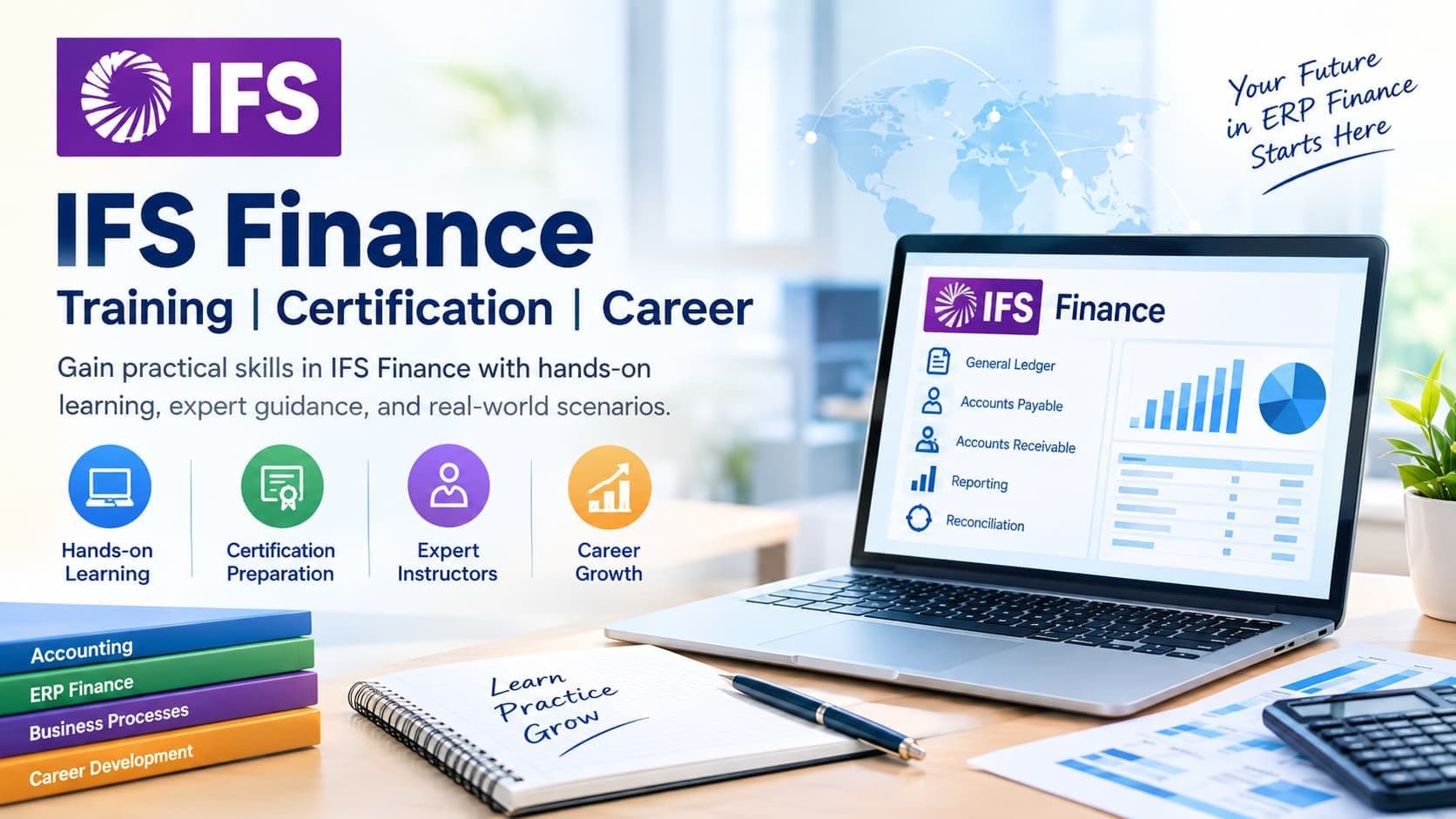
The main objective is to help learners understand how financial processes are managed within an IFS ERP environment. Students develop practical knowledge of accounting, financial transactions, reporting, and integrated business workflows.
2. Can beginners learn IFS Finance?
Yes, beginners can learn IFS Finance through a structured learning approach. The training starts with essential accounting and ERP concepts before progressing into practical finance processes, transactions, reporting, and business workflows
3. What practical knowledge will I gain from this course?
Learners can develop practical knowledge of finance modules, accounting processes, financial transactions, reporting, reconciliation, and ERP workflows. Hands-on exercises help students understand how these activities are performed in realistic business scenarios.
4. How does IFS Finance training support career development?
The course combines finance, accounting, ERP, and application knowledge. These skills can help learners prepare for suitable opportunities related to ERP finance support, functional consulting, business analysis, finance operations, and enterprise application environments
5. Why should professionals learn IFS Finance?
IFS Finance knowledge can help finance and ERP professionals understand how financial operations are integrated with enterprise business processes. It can also strengthen their ability to work with ERP-based financial systems and participate in implementation, support, testing, or functional activities
Popular Techniques Covered in This Course
Accounting Fundamentals
IFS ERP Fundamentals
Finance Module Navigation
General Ledger
Chart of Accounts
Accounts Payable
Accounts Receivable
Invoice Processing
Payment Management
Financial Reporting
Tax Configuration
Budget Management
Financial Reconciliation
ERP Finance Implementation
Get Hands-on Knowledge about Real-Time Projects
Project 1
1. IFS Finance General Ledger and Accounting Management
Work on a practical finance scenario involving the Chart of Accounts, journal entries, accounting transactions, and General Ledger processes. Learners practice recording and reviewing financial transactions while understanding how accounting postings contribute to financial reporting.
Project 2
2. IFS Finance Accounts Payable and Supplier Invoice Management
Complete a practical project focused on supplier-related financial activities. Learners work with supplier invoices, invoice processing, payment workflows, and accounting entries while understanding how Accounts Payable connects with the wider ERP finance process.
Project 3
3. IFS Finance Accounts Receivable and Customer Payment Processing
Work on a customer finance scenario covering Accounts Receivable activities. The project includes customer transactions, invoice management, receipts, payment processing, outstanding balances, and related accounting activities.
Project 4
4. IFS Finance Financial Reporting and Reconciliation
Develop a finance reporting project involving financial data analysis, account reconciliation, transaction verification, and report preparation. Learners practice reviewing financial information, identifying discrepancies, and performing reconciliation activities.
Project 5
5. IFS Finance ERP Implementation Scenario
Complete an ERP finance implementation scenario based on a realistic business requirement. Learners explore finance process mapping, accounting structures, configuration concepts, transactional workflows, testing, reporting, and user validation to understand the ERP finance implementation lifecycle.
Key Features
This IFS Finance program offers comprehensive hands-on training to prepare you for industry demands.
40 Hours Course Duration
100% Job Oriented Training
Industry Expert Faculties
Free Demo Class Available
Completed 500+ Batches
Certification Guidance
Curriculum
Module 1: Introduction to IFS Finance
- Introduction to IFS ERP
- Overview of IFS Finance
- IFS Finance functional areas
- Role of finance in an ERP environment
- IFS Finance terminology
- Enterprise finance workflows
- Navigation and user interface fundamentals
Module 2: Accounting Fundamentals & Finance Structures
- Accounting concepts and principles
- Debit and credit fundamentals
- Chart of Accounts
- Accounting structures
- Financial periods
- Accounting calendars
- Financial dimensions
- Basic accounting workflows
Module 3: General Ledger Management
- General Ledger overview
- Ledger transactions
- Journal entries
- Manual journal processing
- Accounting postings
- Voucher management
- Period closing concepts
- General Ledger review and analysis
Module 4: Accounts Payable
- Accounts Payable overview
- Supplier master concepts
- Supplier invoices
- Invoice registration and processing
- Invoice matching concepts
- Payment processing
- Supplier balances
- Accounts Payable reporting
Module 5: Accounts Receivable
- Accounts Receivable overview
- Customer master concepts
- Customer invoices
- Customer transactions
- Receipt processing
- Payment allocation
- Outstanding receivables
- Customer balance management
Module 6: Financial Transactions & Accounting Processes
- Financial transaction processing
- Transaction types
- Accounting entries
- Voucher handling
- Transaction validation
- Posting and corrections
- Reversals and adjustments
- Transaction review and monitoring
Module 7: Payments, Banking & Reconciliation
- Payment management concepts
- Supplier payments
- Customer receipts
- Bank transaction processing
- Bank reconciliation
- Account reconciliation
- Payment matching
- Handling discrepancies and adjustments
Module 8: Tax, Currency & Financial Controls
- Tax concepts in ERP finance
- Tax-related configuration concepts
- Tax transactions
- Multi-currency fundamentals
- Currency exchange concepts
- Financial controls
- Transaction validation
- Compliance-oriented finance processes
Module 9: Budgeting & Financial Reporting
- Budget management concepts
- Budget structures
- Budget planning
- Budget monitoring
- Financial reporting fundamentals
- Financial analysis
- Account reporting
- Management reporting concepts
Module 10: IFS Finance Configuration & Business Processes
- Finance configuration fundamentals
- Financial structures and setup concepts
- Accounting rules
- Finance-related master data
- Business process mapping
- Requirement analysis
- Workflow concepts
- Functional configuration practices
Module 11: ERP Implementation, Testing & Support
- ERP implementation lifecycle
- IFS Finance implementation phases
- Requirement gathering
- Functional design concepts
- Test case preparation
- Unit and integration testing
- User Acceptance Testing
- Issue identification and resolution
- Application support processes
- Functional documentation
- User training and support
Receive Training From Our Skilled and Effective Trainers
Learn from Experienced IFS Finance Professionals Learn from experienced IFS Finance professionals who understand enterprise finance processes, accounting operations, ERP workflows, and financial management requirements across different business environments.
Industry Exposure with Practical IFS Finance Projects Our IFS Finance trainers provide practical guidance across General Ledger, Accounts Payable, Accounts Receivable, financial transactions, invoice processing, payment workflows, reconciliation, and financial reporting.
Simple, Practical & Business-Oriented Teaching Approach Complex IFS Finance concepts are explained through structured lessons, live demonstrations, practical exercises, and realistic business scenarios. This approach helps learners connect accounting concepts with actual ERP finance workflows.
Hands-On Real-Time IFS Finance Projects Learners work on guided projects covering financial transactions, ledger processes, supplier invoices, customer payments, financial reporting, reconciliation, and end-to-end ERP finance workflows.
Focused on Practical and Relevant IFS Finance Skills Our training emphasizes practical finance processes, ERP functionality, business requirements, reporting, testing, and functional concepts to help learners develop skills relevant to modern enterprise finance environments.
Build Confidence with IFS Finance Certification
Earn an IFS Finance course completion certificate that demonstrates your understanding of finance processes, ERP workflows, accounting operations, and practical IFS Finance concepts. Prepare through hands-on exercises, guided projects, and certification-focused training designed to strengthen your functional knowledge. A certificate can enhance your professional profile and support your preparation for suitable IFS Finance and ERP-related career opportunities.

Course FAQs
1. What is IFS Finance?
IFS Finance is the financial management area within the IFS ERP ecosystem. It supports important business activities such as accounting, financial transactions, Accounts Payable, Accounts Receivable, reporting, reconciliation, and other finance-related processes. IFS Finance training helps learners understand how these activities are managed through an integrated enterprise system.
2. Who can join an IFS Finance course?
IFS Finance training is suitable for commerce graduates, accounting students, freshers, finance professionals, ERP aspirants, working professionals, and career switchers. Learners from other educational backgrounds can also start the course if they have an interest in finance and enterprise software along with basic computer knowledge.
3. Is IFS Finance suitable for beginners?
Yes, beginners can learn IFS Finance through a structured training approach. A good course introduces accounting and ERP fundamentals before moving into advanced finance processes. Practical demonstrations and exercises can help learners gradually understand financial transactions, reporting, workflows, and other IFS Finance functionality.
4. What are the prerequisites for learning IFS Finance?
Basic accounting knowledge, computer literacy, and an understanding of common business processes can be helpful. Advanced programming knowledge is generally not required for functional IFS Finance learning. A background in commerce, finance, accounting, or ERP can provide an additional advantage but is not essential for starting the course.
5. Do I need programming knowledge for IFS Finance?
Programming knowledge is generally not required for learning the functional side of IFS Finance. The primary focus is on finance processes, ERP functionality, configuration concepts, transactions, reporting, and business workflows. Technical knowledge can become useful for professionals who want to work across functional and technical ERP areas.
6. What accounting concepts should I know before starting IFS Finance?
Basic concepts such as debit and credit, journals, ledgers, Accounts Payable, Accounts Receivable, invoices, payments, reconciliation, and financial statements are useful. Advanced accounting expertise is not necessarily required. A structured course can connect these accounting fundamentals with ERP-based finance processes.
7. What will I learn in an IFS Finance course?
You can learn General Ledger management, Accounts Payable, Accounts Receivable, financial transactions, invoice processing, payments, budgeting, reporting, reconciliation, tax-related concepts, and ERP finance workflows. Training can also introduce how finance processes interact with other enterprise functions and business operations.
8. Does IFS Finance training include practical sessions?
Yes. Practical learning can include finance transactions, accounting scenarios, reporting activities, reconciliation tasks, and business workflows in a training environment. Hands-on exercises help learners connect theoretical accounting concepts with their practical application within an enterprise resource planning system.
9. What is the difference between accounting and IFS Finance?
Accounting focuses on financial principles and activities such as recording transactions, maintaining ledgers, preparing statements, and reconciliation. IFS Finance applies these concepts within an ERP environment, connecting financial activities with broader organizational processes and enterprise data.
10. Is IFS Finance an ERP skill?
Yes. Working professionals in accounting, finance, ERP support, business operations, or related fields can learn IFS Finance to strengthen their enterprise application knowledge. Training can help professionals understand how financial processes are represented within an ERP system and prepare for implementation, support, analysis, or functional responsibilities
11. Can commerce graduates learn IFS Finance?
Yes. Commerce graduates can be well suited to IFS Finance because their academic background may already include accounting and financial concepts. Training can help them extend this knowledge into an ERP environment by learning finance workflows, transactions, reporting, and application functionality.
12. Can working professionals learn IFS Finance ?
Yes. Working professionals in accounting, finance, ERP support, business operations, or related fields can learn IFS Finance to strengthen their enterprise application knowledge. Training can help professionals understand how financial processes are represented within an ERP system and prepare for implementation, support, analysis, or functional responsibilities
13. What is the role of General Ledger in IFS Finance?
General Ledger provides a structured record of an organization's accounting transactions. In an IFS Finance environment, understanding General Ledger helps learners work with accounts, journals, financial postings, and reporting processes. It also provides a foundation for understanding how financial information is organized within an ERP system.
14. What are Accounts Payable and Accounts Receivable in IFS Finance?
Accounts Payable primarily deals with amounts an organization owes to suppliers, while Accounts Receivable focuses on amounts customers owe to the organization. IFS Finance training helps learners understand related processes such as invoices, payments, receipts, outstanding balances, and accounting activities.
15. Will I learn financial reporting in IFS Finance?
Yes. Financial reporting is an important part of finance operations. Training can introduce learners to financial information, reporting processes, accounting data, and how ERP systems support financial analysis. Learners can also understand how individual financial transactions contribute to broader business reporting.
16. Can IFS Finance training help me understand ERP implementation?
Yes. IFS Finance training can provide a foundation for understanding finance-related ERP implementation activities. Learners may study requirements, process mapping, configuration concepts, testing scenarios, workflows, and user validation. Actual implementation responsibilities depend on the professional's role, experience, and project requirements.
17. What is finance configuration in IFS?
Finance configuration involves setting up application functionality to support an organization's financial processes and business requirements. Depending on the implementation, this can include financial structures, accounting rules, tax-related settings, and transaction behavior. Training introduces these concepts through practical finance and business scenarios.
18. Is IFS Finance difficult to learn?
The difficulty depends on your accounting, ERP, and software background. Beginners may initially need time to understand both finance terminology and ERP workflows. With structured lessons, practical exercises, demonstrations, and regular practice, learners can gradually build confidence and understand IFS Finance functionality.
19. How long does it take to learn IFS Finance?
Learning time depends on the course structure, previous experience, and amount of practical practice. Learners with accounting or ERP experience may progress faster, while beginners may need additional practice. Consistent hands-on learning is important because practical understanding is more valuable than simply completing lessons.
20. Does IFS Finance require accounting experience?
Accounting experience can be beneficial but is not always mandatory for introductory IFS Finance training. Learners with accounting knowledge may find concepts such as ledgers, invoices, payments, and reconciliation easier to understand. Beginners can build these fundamentals while learning IFS Finance through structured training.
21. What practical topics can be covered in IFS Finance training?
Practical training can include financial transactions, General Ledger activities, supplier invoices, customer transactions, payments, reconciliation, reporting, and finance workflows. A practical approach helps learners understand how multiple activities connect within an ERP environment and how business requirements relate to finance application processes.
22. Is IFS Finance useful for ERP functional consultants?
Yes. IFS Finance can be relevant for ERP functional consultants because they need to understand business requirements and application processes. Finance knowledge can help consultants analyze accounting workflows, understand user requirements, support configuration, participate in testing, and assist with ERP implementation or support activities.
23. What career roles can I explore after IFS Finance training?
Yes. IFS Finance can be relevant for ERP functional consultants because they need to understand business requirements and application processes. Finance knowledge can help consultants analyze accounting workflows, understand user requirements, support configuration, participate in testing, and assist with ERP implementation or support activities.
24. Is IFS Finance in demand in the ERP industry?
Demand for IFS Finance skills can vary according to ERP projects, organizational requirements, implementation activity, industry needs, and market conditions. Professionals who combine finance knowledge with practical IFS application skills can explore opportunities across ERP consulting, implementation, application support, business analysis, and finance operations.
25. Can freshers get started with IFS Finance?
Yes. Freshers can use IFS Finance training to build knowledge of enterprise finance applications and business processes. However, completing a course does not guarantee employment. Developing accounting fundamentals, practical ERP skills, communication, problem-solving abilities, and project exposure can improve career readiness.
26. Is IFS Finance useful for finance professionals?
Yes. Finance professionals can benefit from understanding how accounting and financial responsibilities are supported by an ERP system. IFS Finance knowledge can help them become familiar with digital finance workflows, integrated transactions, reporting, and enterprise processes.
27. Can IFS Finance knowledge support a career transition into ERP?
Yes. IFS Finance can provide a foundation for professionals transitioning from accounting, finance, business operations, or related fields into ERP. A successful transition generally requires practical application knowledge, business-process understanding, project exposure, and awareness of implementation, testing, support, and functional consulting activities.
28. Is IFS Finance useful for international career opportunities?
IFS Finance knowledge can be relevant across different enterprise software environments because organizations worldwide use ERP systems to manage financial and business processes. International opportunities may additionally require knowledge of regional accounting standards, taxation, business practices, communication skills, and relevant professional experience.
29. Can IFS Finance skills be useful across different industries?
Yes. Finance and ERP processes are used across many industries, although specific workflows and requirements can differ. Learning IFS Finance can help professionals understand common enterprise finance activities while developing the ability to adapt application knowledge to different organizational processes and business scenarios.
30. Is IFS Finance certification enough to get a job?
Certification can demonstrate structured learning and knowledge of relevant finance and ERP concepts, but it should not be considered a job guarantee. Employers may also evaluate accounting knowledge, practical ERP skills, problem-solving ability, communication, project exposure, and professional experience.
Get Training Quote for Free
Testimonials
Hear What Our Students Say
"Transform your life through Education, hear it from our Alumni"

8 LPA
Rahul
Student
Data Scientist
"Transform your life through Education, hear it from our Alumni"

6 LPA
Fathima
Student
Software Engineer
"Transform your life through Education, hear it from our Alumni"

8 LPA
Siddharth
NIELSON IQ
Data Analyst