Course Objectives
1. Master End-to-End Machine Learning Workflows on Databricks
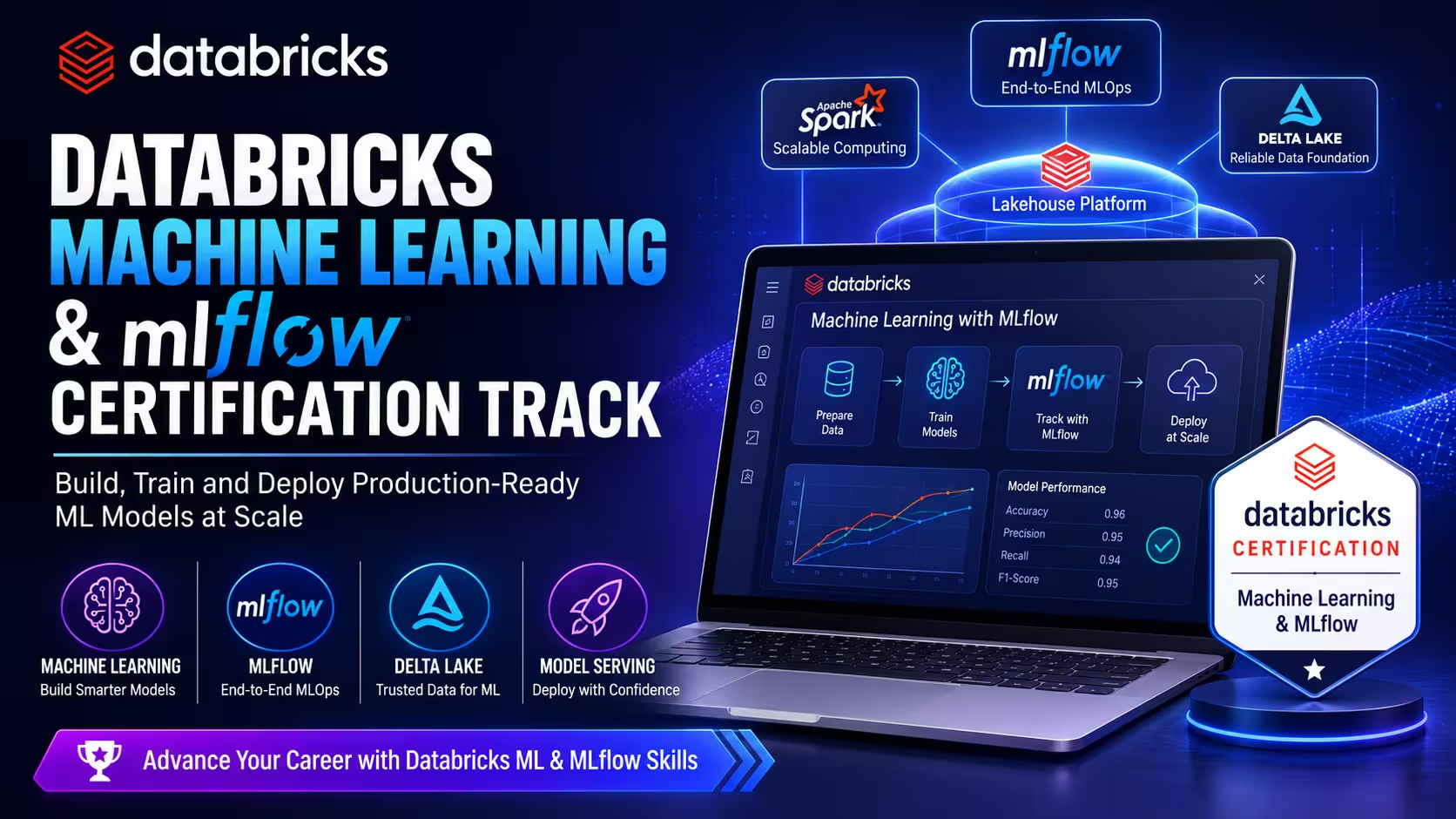
Learn how to build, train, manage, and deploy machine learning models using the Databricks Lakehouse Platform. Understand the complete ML lifecycle from data preparation to production deployment.
2. Develop Scalable Feature Engineering Skills
Gain practical experience in creating, managing, and reusing features using Spark and Databricks Feature Store. Learn techniques for handling large datasets efficiently in real-world machine learning projects.
3. Implement Experiment Tracking and Model Management
Learn how to track experiments, compare model performance, manage model versions, and maintain reproducible machine learning workflows using MLflow.
4. Deploy and Monitor Production-Ready Machine Learning Models
Understand how to deploy machine learning models for batch and real-time predictions, monitor model performance, and detect model drift in production environments.
5. Prepare for Databricks Machine Learning Certification
Build the knowledge and hands-on experience required to confidently prepare for Databricks Machine Learning certification through practical labs, real-world projects, and exam-focused exercises.
Popular Techniques Covered in This Course
Databricks Lakehouse Platform
Feature Engineering with Apache Spark
MLflow Experiment Tracking
MLflow Model Registry
Machine Learning Model Development
Hyperparameter Tuning with Hyperopt
AutoML Model Building
Model Deployment and Serving
Model Monitoring and Drift Detection
Responsible AI and Model Explainability
Get Hands-on Knowledge about Real-Time Projects
Project 1
1. Credit Risk Prediction System
Build a machine learning solution that analyzes customer financial information to predict loan repayment risks. Learners will perform feature engineering, train classification models, track experiments using MLflow, and deploy the best-performing model for risk assessment. This project demonstrates how financial institutions use machine learning to improve lending decisions.
Project 2
2. Customer Churn Prediction Platform
Develop a predictive model that identifies customers who are likely to stop using a service. Students will create customer behavior features, perform model training and tuning, register models using MLflow, and deploy prediction services for business teams. This project helps learners understand customer retention analytics used by telecom and e-commerce companies.
Project 3
3. Real-Time Fraud Detection System
Create a machine learning pipeline capable of identifying suspicious financial transactions in real time. Using Databricks, Spark, and MLflow, learners will process transaction data, train fraud detection models, deploy APIs, and monitor model performance. This project reflects real-world fraud prevention use cases in banking and digital payments.
Project 4
4. Hospital Readmission Prediction Solution
Build a healthcare analytics model that predicts whether a patient is likely to be readmitted after discharge. Students will engineer healthcare-related features, train predictive models, track experiments, and deploy solutions that assist healthcare providers in improving patient outcomes and operational planning.
Project 5
5. Air Quality Forecasting and Monitoring Platform
Design an end-to-end machine learning pipeline that predicts future air quality levels using environmental and weather data. Learners will develop scalable feature engineering workflows, train forecasting models, manage model versions through MLflow, and deploy dashboards that provide actionable environmental insights for decision-makers.
Key Features
Edubrights offers Databricks Machine Learning Engineering & MLflow Certification Track Training in virtual mode with expert trainers. Here are the key features,
40 Hours Course Duration
100% Job Oriented Training
Industry Expert Faculties
Free Demo Class Available
Completed 500+ Batches
Certification Guidance
Curriculum
Module 1: ML on the Lakehouse Overview
- Why Databricks for ML: unified data and model development environment
- ML Runtime clusters: pre-installed libraries and GPU support options
- Databricks ML workspace: experiments, models, and feature store navigation
- End-to-end ML workflow: from raw data to deployed model in Indian banking context
Module 2: Feature Engineering at Scale
- Spark-based feature engineering: handling millions of Indian credit card transactions
- Feature Store fundamentals: creating, publishing, and discovering reusable features
- Time-based features: recency, frequency, and monetary (RFM) for e-commerce churn
- Handling categorical data: encoding strategies for Indian demographic variables
Module 3: MLflow Experiment Tracking
- MLflow tracking API: logging parameters, metrics, and artifacts automatically
- Comparing runs: identifying best hyperparameters across 50+ training experiments
- Custom metrics: tracking F1-score and AUC for Indian loan default prediction
- MLflow Projects: packaging reproducible training code for team collaboration
Module 4: Model Training & Hyperparameter Tuning
- Training scikit-learn and XGBoost models with Spark-distributed data
- Hyperopt integration: Bayesian optimization across distributed worker nodes
- AutoML: automated model selection for Pune hospital readmission prediction
- Cross-validation strategies: avoiding data leakage in time-series medical data
Module 5: MLflow Model Registry
- Registering models: versioning and staging lifecycle (Staging, Production, Archived)
- Model lineage: tracing a production model back to its training dataset version
- Transition workflows: approval processes for promoting models to production
- Webhooks and CI/CD: automating model promotion with GitHub Actions triggers
Module 6: Model Deployment & Serving
- Batch inference: scoring millions of customer records overnight using Spark
- Real-time serving: Databricks Model Serving for sub-100ms fraud detection APIs
- A/B testing models: traffic splitting for two competing recommendation engines
- Monitoring model drift: detecting distribution shift in Indian seasonal sales patterns
Module 7: Advanced ML Techniques
- Deep learning with Horovod: distributed TensorFlow/PyTorch training on Databricks
- Graph ML: network-based fraud detection for UPI payment networks
- Responsible AI: bias detection and fairness metrics in Indian lending models
- Explainability with SHAP: communicating model decisions to RBI compliance teams
Module 8: Certification Prep & Capstone Project
- Capstone: end-to-end ML pipeline for Delhi air quality prediction with MLflow
- Associate ML Engineer exam blueprint: domains, question types, and scoring
- Practice labs: hands-on scenario-based questions mirroring actual exam difficulty
- Study plan: 2-week revision strategy covering all certification knowledge areas
Receive Training From Our Skilled and Effective Trainers
Experience in the Industry Learn from Databricks-certified data engineers and ML engineers who have built production lakehouse platforms, Delta Live Tables pipelines, and ML workflows on Databricks for data-driven enterprises.
Backgrounds at the Top Our Databricks trainers have delivered data platform projects at technology companies, financial services firms, and healthcare organisations where Databricks is the central platform for data engineering and machine learning.
Clear & Effective Teaching Databricks architecture, Spark DataFrames, Delta Lake, Databricks SQL, MLflow, Delta Live Tables, Unity Catalog, and governance are explained clearly with real lakehouse data platform examples.
Hands-On Learning Focus Students build end-to-end lakehouse pipelines, work with Delta tables, create DLT pipelines, track ML experiments with MLflow, and configure Unity Catalog governance through structured lab exercises.
Up-to-Date Knowledge Trainers keep content current with the latest Databricks platform releases, Databricks AI and GenAI capabilities, Unity Catalog enhancements, and evolving lakehouse architecture best practices.
Databricks Machine Learning Engineer Professional Certification
Edubrights Offers the Databricks Machine Learning Engineer Professional Certification validates your ability to build, manage, deploy, and monitor machine learning solutions using the Databricks Lakehouse Platform. This certification demonstrates practical knowledge of feature engineering, MLflow experiment tracking, model training, hyperparameter tuning, model registry management, and production deployment workflows

Course FAQs
1. What is Databricks Machine Learning?
Databricks Machine Learning is a unified platform that helps data scientists and machine learning engineers build, train, deploy, and manage machine learning models at scale.
2. Who should enroll in this Databricks Machine Learning Course?
This course is suitable for data analysts, data scientists, machine learning engineers, software developers, cloud professionals, and anyone interested in building production-ready machine learning solutions.
3. Do I need prior machine learning experience to learn Databricks ML?
Basic knowledge of Python and machine learning concepts is recommended. However, the course covers practical workflows that help learners gradually build confidence with Databricks tools and technologies.
4. What tools will I learn in this course?
You will learn Databricks, Apache Spark, MLflow, Feature Store, AutoML, Hyperopt, TensorFlow, PyTorch, SHAP, and model deployment techniques used in modern machine learning environments.
5. Is Databricks in demand for machine learning careers?
Yes. Many organizations use Databricks to manage large-scale data and machine learning workloads, creating strong demand for professionals with Databricks and MLOps expertise.
6. What job roles can I apply for after completing this course?
You can pursue roles such as Machine Learning Engineer, MLOps Engineer, Data Scientist, AI Engineer, Databricks Engineer, and Cloud Machine Learning Specialist.
7. Does the course include hands-on projects?
Yes. The course includes practical projects covering feature engineering, model training, deployment, monitoring, and real-world machine learning workflows.
8. What is MLflow and why is it important?
MLflow is an open-source platform for managing the machine learning lifecycle, including experiment tracking, model versioning, deployment, and collaboration among teams.
9. Will this course help me prepare for Databricks certification?
Yes. The curriculum includes certification-focused topics, practical labs, revision exercises, and project-based learning aligned with Databricks Machine Learning certification objectives.
10. What are the career opportunities after learning Databricks Machine Learning?
Professionals with Databricks ML skills can work in industries such as banking, healthcare, e-commerce, insurance, telecommunications, and technology, where machine learning solutions are widely adopted.
11. Will I learn AutoML?
Yes. The course introduces Databricks AutoML and demonstrates how it accelerates model development and optimization.
12. What career opportunities are available after completing this course?
Career options include Machine Learning Engineer, Data Scientist, AI Engineer, MLOps Engineer, Predictive Analytics Specialist, and Data Science Consultant.
13. How long does it take to complete the training?
The duration depends on the learning path, but most learners can gain strong practical skills within a few weeks of focused study.
14. Is this course suitable for beginners?
Yes. Beginners with basic programming knowledge can successfully learn machine learning concepts and MLflow workflows through structured training.
15. How does Databricks simplify machine learning development?
Databricks provides a collaborative platform that integrates data engineering, analytics, machine learning, and deployment capabilities in one environment.
Get Training Quote for Free
Testimonials
Hear What Our Students Say
"Transform your life through Education, hear it from our Alumni"

8 LPA
Rahul
Student
Data Scientist
"Transform your life through Education, hear it from our Alumni"

8 LPA
Siddharth
NIELSON IQ
Data Analyst
"Transform your life through Education, hear it from our Alumni"

6 LPA
Fathima
Student
Software Engineer