Popular
SAP FICO vs SAP MM vs SAP SD: Which Course Should I Choose?
Akram
June 30, 2026
5 min read
Compare SAP FICO, SAP MM, and SAP SD to find the right SAP course for your career. Learn about key features, job opportunities, required skills, and career prospects.
Introduction
SAP offers a wide range of modules, but SAP FICO, SAP MM, and SAP SD are among the most popular choices for students and working professionals. Each module focuses on a different business function, making it important to choose the one that aligns with your educational background, interests, and career goals.
If you're unsure which SAP course is right for you, this guide compares SAP FICO, SAP MM, and SAP SD, covering their features, career opportunities, required skills, and who should choose each module.
What Is SAP FICO?
SAP FICO (Financial Accounting and Controlling) helps organizations manage financial transactions, reporting, budgeting, and cost control. It is one of the most widely implemented SAP modules.
Key Topics
- General Ledger Accounting
- Accounts Payable
- Accounts Receivable
- Asset Accounting
- Cost Center Accounting
- Profit Center Accounting
- Financial Reporting
Best For
- B.Com and M.Com Graduates
- MBA Finance Students
- Finance Professionals
- Chartered Accountants
- Accountants and Auditors
What Is SAP MM?
SAP MM (Materials Management) focuses on procurement, inventory management, purchasing, and supply chain operations. It helps organizations manage materials efficiently while reducing operational costs.
Key Topics
- Procurement Process
- Vendor Management
- Purchase Orders
- Inventory Management
- Material Master
- Invoice Verification
- Warehouse Integration
Best For
- BBA and MBA Operations Graduates
- Supply Chain Professionals
- Procurement Executives
- Inventory Managers
- Logistics Professionals
What Is SAP SD?
SAP SD (Sales and Distribution) manages customer orders, pricing, shipping, billing, and sales processes. It plays an important role in customer relationship management and order fulfillment.
Key Topics
- Sales Order Processing
- Customer Master Data
- Pricing
- Shipping
- Billing
- Credit Management
- Returns Processing
Best For
- Sales Professionals
- Marketing Graduates
- Business Analysts
- Customer Relationship Executives
- MBA Marketing Students
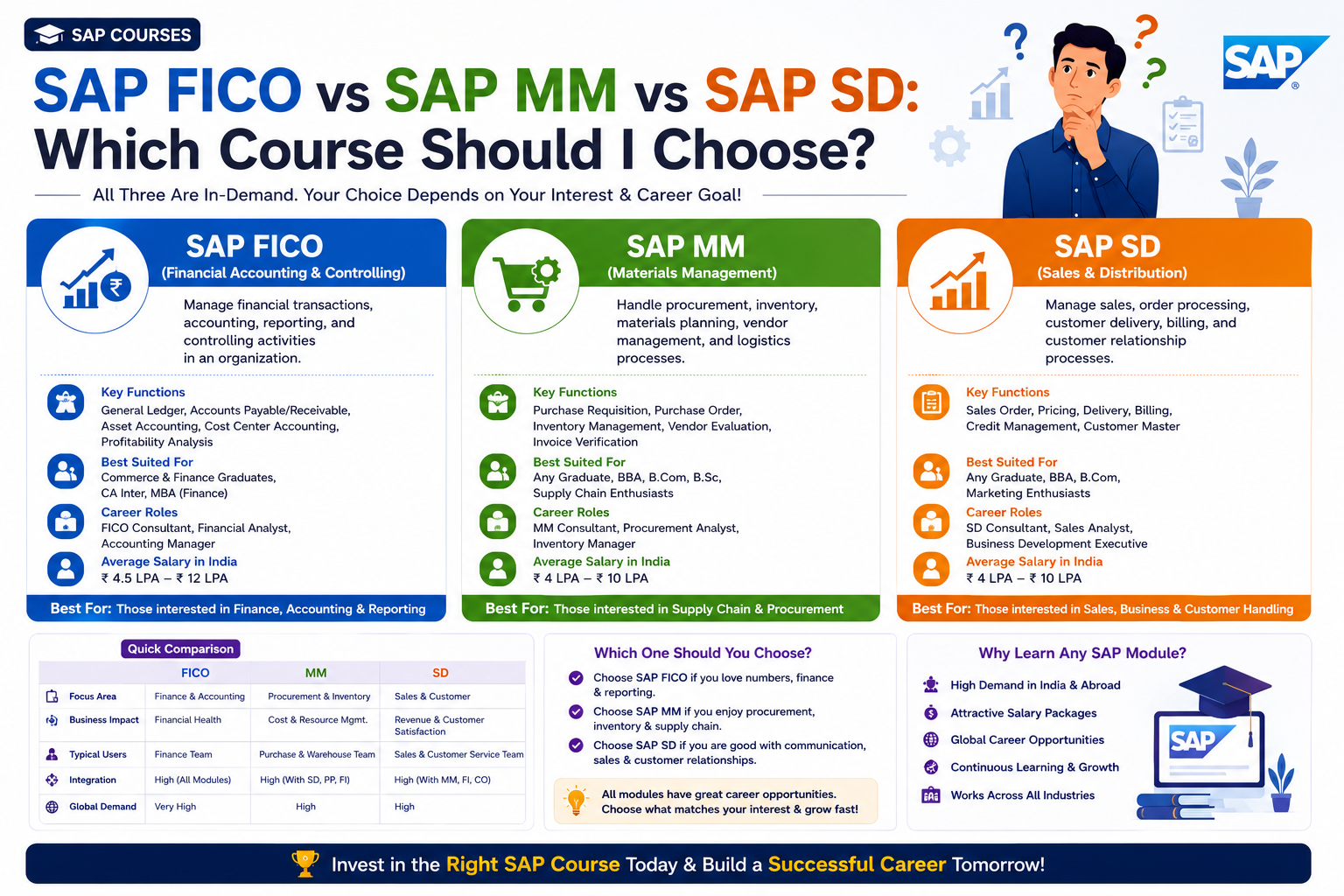
SAP FICO vs SAP MM vs SAP SD
| Feature | SAP FICO | SAP MM | SAP SD |
|---|---|---|---|
| Primary Focus | Finance & Accounting | Procurement & Inventory | Sales & Distribution |
| Best For | Finance Professionals | Supply Chain Professionals | Sales & Marketing Professionals |
| Coding Required | No | No | No |
| Business Domain | Finance | Procurement | Sales |
| Career Demand | Very High | High | High |
Each module serves a unique business function, and all three are widely used by organizations implementing SAP ERP.
Which SAP Module Has Better Career Opportunities?
All three modules offer excellent career prospects, but the right choice depends on your interests and educational background.
- SAP FICO is ideal for finance and accounting careers.
- SAP MM is best for procurement, logistics, and supply chain roles.
- SAP SD is suitable for sales operations, customer management, and distribution roles.
Professionals with practical implementation experience are highly valued across industries.
Skills You'll Gain
Regardless of the module you choose, you'll develop skills such as:
- ERP Fundamentals
- Business Process Management
- SAP Navigation
- Business Documentation
- Reporting and Analysis
- Problem Solving
- Process Optimization
- Enterprise Workflow Management
Career Opportunities
After completing SAP training, you can pursue roles including:
SAP FICO
- SAP FICO Consultant
- Financial Analyst
- ERP Finance Consultant
SAP MM
- SAP MM Consultant
- Procurement Analyst
- Inventory Management Consultant
SAP SD
- SAP SD Consultant
- Sales Operations Analyst
- Distribution Consultant
These professionals are employed in manufacturing, banking, retail, healthcare, logistics, IT services, and consulting firms.
How to Choose the Right SAP Course
Before enrolling, consider the following:
- Your educational background
- Your preferred business domain
- Long-term career goals
- Industry demand
- Practical training opportunities
- Placement support offered by the training institute
Choosing a module that matches your strengths can improve both your learning experience and career growth.
Frequently Asked Questions (FAQs)
Q1. Which SAP course is best for freshers?
It depends on your background. Finance graduates often choose SAP FICO, operations students prefer SAP MM, while candidates interested in sales and customer management may choose SAP SD.
Q2. Which SAP module has the highest demand?
SAP FICO, SAP MM, and SAP SD all remain highly demanded, with opportunities available across industries implementing SAP ERP solutions.
Q3. Do SAP FICO, MM, and SD require coding?
No. These are functional SAP modules and generally do not require programming knowledge.
Q4. Can I learn more than one SAP module?
Yes. Many professionals begin with one module and later expand their expertise by learning related SAP modules as their careers progress.
Q5. Which SAP module offers better salary?
Salary depends on experience, certifications, implementation projects, and employer. All three modules offer competitive salary potential with the right skills and practical experience.
Conclusion
SAP FICO, SAP MM, and SAP SD are among the most popular and rewarding SAP modules for building a successful ERP career. Rather than choosing the module with the highest demand, select the one that best aligns with your education, interests, and career aspirations.
With quality training, hands-on projects, and continuous learning, any of these SAP modules can lead to excellent job opportunities and long-term professional growth in India's expanding ERP market.
SAP FICO vs SAP MM vs SAP SD
SAP FICO
SAP MM
SAP SD
SAP Training
SAP Career
SAP Consultant
SAP ERP
SAP Jobs
SAP Course


