SAP Analytics Cloud Course: Should Beginners Learn It?
Thinking about learning SAP Analytics Cloud (SAC)? Discover whether it's suitable for beginners, what you'll learn during training, career opportunities, salary expectations, and how SAC fits into the growing world of SAP analytics.
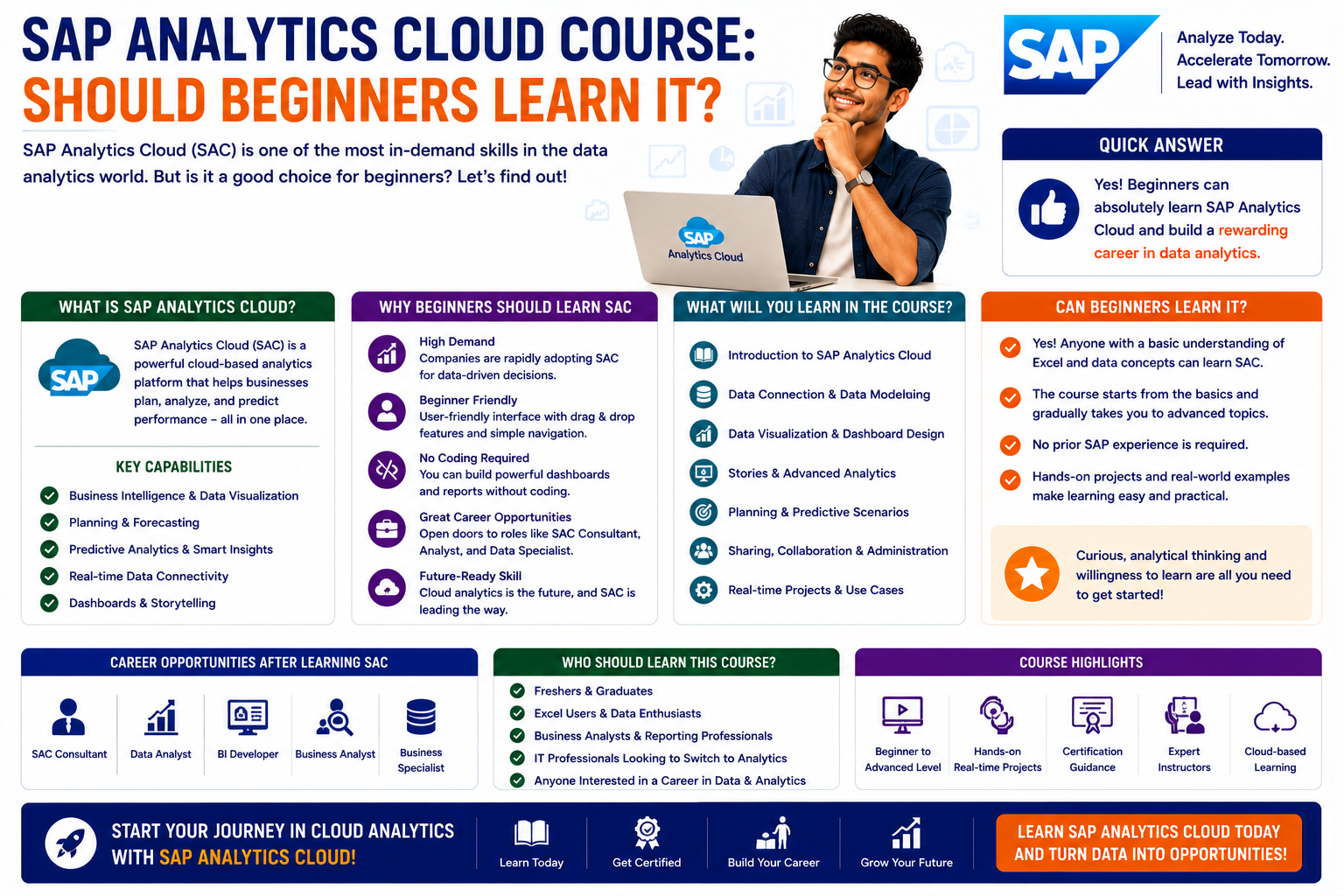
Introduction
Data has become one of the most valuable business assets. Organizations today rely on analytics, dashboards, and real-time reporting to make faster and smarter decisions. As businesses continue adopting cloud technologies, SAP Analytics Cloud (SAC) has emerged as one of SAP's leading solutions for business intelligence, planning, and predictive analytics.
Many students and IT professionals ask:
"Is SAP Analytics Cloud suitable for beginners?"
"Can I build a successful career by learning SAP SAC?"
The answer is yes, provided you have an interest in data, reporting, and business analytics. SAP Analytics Cloud combines business intelligence, planning, and analytics into a single cloud platform, making it one of the fastest-growing SAP technologies. This guide explains what SAC is, what you'll learn during training, career opportunities, salary expectations, and whether beginners should start with this technology.
What Is SAP Analytics Cloud?
SAP Analytics Cloud (SAC) is a cloud-based analytics platform that helps organizations analyze data, create interactive dashboards, generate reports, perform planning, and make data-driven business decisions.
Unlike traditional reporting tools, SAC combines multiple capabilities into a single platform:
- Business Intelligence (BI)
- Data Visualization
- Planning and Budgeting
- Predictive Analytics
- AI-assisted Insights
- Enterprise Reporting
It integrates with SAP and non-SAP data sources, providing organizations with a unified analytics environment.
What Will You Learn in a SAP Analytics Cloud Course?
A comprehensive SAP Analytics Cloud course covers both analytical concepts and practical implementation.
1. SAP Analytics Cloud Fundamentals
You'll begin by understanding the basics of SAP Analytics Cloud and modern business intelligence.
Topics include:
- Introduction to SAP SAC
- Cloud analytics concepts
- SAC architecture
- Navigation
- User interface
- Business intelligence overview
This foundation helps beginners understand how SAC supports business decision-making.
2. Data Connections
One of the most important aspects of SAP Analytics Cloud is connecting business data.
You'll learn:
- Live Data Connections
- Import Data Connections
- SAP Data Sources
- Non-SAP Data Sources
- Data Models
- Data Preparation
Understanding data connectivity is essential for building meaningful reports.
3. Story and Dashboard Creation
SAP Analytics Cloud allows users to create interactive dashboards.
You'll learn how to:
- Build dashboards
- Create charts
- Design reports
- Add filters
- Create visualizations
- Customize layouts
These skills help organizations monitor key business metrics effectively.
4. Data Modeling
Before building reports, data needs to be organized properly.
Topics include:
- Dimensions
- Measures
- Hierarchies
- Data Models
- Calculated Measures
- Data Preparation
Good data models improve reporting accuracy and performance.
5. Planning and Forecasting
SAP SAC includes enterprise planning capabilities.
You'll understand:
- Budget Planning
- Financial Planning
- Forecasting
- What-if Analysis
- Business Planning Models
- Version Management
These features support better business decision-making.
6. Predictive Analytics
Modern organizations increasingly use AI-powered analytics.
You'll learn:
- Smart Predict
- Predictive Models
- Forecasting
- Trend Analysis
- Machine Learning Features
- AI-generated Insights
These capabilities help businesses identify patterns and future trends.
7. Sharing and Collaboration
SAP Analytics Cloud enables teams to collaborate using business insights.
Topics include:
- Sharing Dashboards
- Collaboration Tools
- User Roles
- Security
- Permissions
- Publishing Reports
This ensures the right information reaches the right stakeholders.
Practical Skills You Will Gain
After completing an SAP Analytics Cloud course, you'll be able to:
- Create interactive dashboards.
- Build business reports.
- Connect multiple data sources.
- Develop analytical models.
- Perform planning and forecasting.
- Generate business insights.
- Create executive-level visualizations.
- Support business intelligence projects.
These practical skills are highly valued across industries.
Who Should Learn SAP Analytics Cloud?
SAP Analytics Cloud is suitable for:
- Fresh Graduates
- Business Analysts
- Data Analysts
- SAP Consultants
- Finance Professionals
- Reporting Specialists
- BI Developers
- MBA Graduates
- IT Professionals
- Professionals interested in analytics and visualization
Beginners with basic computer skills and an interest in data can start learning SAC.
Career Opportunities After SAP Analytics Cloud Training
Learning SAP Analytics Cloud can open doors to several career paths.
Popular job roles include:
- SAP Analytics Cloud Consultant
- SAP BI Consultant
- Business Intelligence Consultant
- SAP Reporting Consultant
- Data Analyst
- Business Analyst
- SAP Analytics Developer
- Dashboard Developer
- SAP Functional Consultant
- SAP Planning Consultant
Demand for cloud analytics professionals continues to increase as organizations modernize their reporting systems.
Industries Hiring SAP Analytics Cloud Professionals
SAP Analytics Cloud professionals are employed across various industries, including:
- Banking and Financial Services
- Manufacturing
- Retail
- Healthcare
- Pharmaceuticals
- IT Services
- Telecommunications
- Logistics
- Energy
- Consulting
Organizations that rely on data-driven decision-making increasingly invest in SAP analytics solutions.
Average SAP Analytics Cloud Salary in India
Professionals with SAP Analytics Cloud skills can expect competitive salaries.
| Experience | Approximate Salary |
|---|---|
| Fresher | ₹4 LPA – ₹7 LPA |
| 1–3 Years | ₹7 LPA – ₹12 LPA |
| 3–5 Years | ₹12 LPA – ₹18 LPA |
| 5–8 Years | ₹18 LPA – ₹28 LPA |
| 8+ Years | ₹28 LPA and above |
Actual salaries depend on business domain knowledge, project experience, certifications, employer, and technical expertise.
Should Beginners Learn SAP Analytics Cloud?
For many beginners, the answer is yes, especially if you're interested in analytics, business intelligence, and cloud technologies.
SAP Analytics Cloud is a good choice because:
- It has a modern cloud-based interface.
- Demand for analytics professionals is growing.
- It requires minimal programming compared to many analytics tools.
- It integrates with various SAP solutions.
- It supports business intelligence, planning, and predictive analytics in one platform.
- It offers excellent long-term career opportunities.
However, understanding basic business processes and data concepts will make learning easier.
Tips to Build a Successful SAP Analytics Cloud Career
To maximize your career opportunities:
- Learn basic business intelligence concepts.
- Practice building dashboards regularly.
- Understand SAP S/4HANA reporting.
- Improve Excel and data analysis skills.
- Learn data visualization best practices.
- Work on real business scenarios.
- Stay updated with new SAP cloud innovations.
- Build a portfolio of analytics dashboards.
Practical experience is often the biggest differentiator during interviews.
Frequently Asked Questions (FAQs)
Q1. Is SAP Analytics Cloud suitable for beginners?
Yes. Beginners with an interest in business analytics, reporting, and data visualization can successfully learn SAP Analytics Cloud.
Q2. Is coding required for SAP Analytics Cloud?
No. Most SAP Analytics Cloud tasks involve data modeling, dashboard creation, and reporting rather than traditional programming.
Q3. What jobs can I get after learning SAP Analytics Cloud?
You can pursue roles such as SAP Analytics Cloud Consultant, Business Intelligence Consultant, Data Analyst, SAP Reporting Consultant, and Business Analyst.
Q4. Is SAP Analytics Cloud in demand?
Yes. As organizations increasingly adopt cloud analytics and SAP S/4HANA, demand for SAP Analytics Cloud professionals continues to grow.
Q5. Should I learn SAP Analytics Cloud before other SAP modules?
If your career goal is business intelligence, reporting, analytics, or planning, SAP Analytics Cloud can be an excellent starting point. Those interested in finance, procurement, or sales may prefer beginning with functional modules such as SAP FICO, MM, or SD before expanding into analytics.
Conclusion
SAP Analytics Cloud is an excellent choice for beginners who want to build a career in business intelligence, cloud analytics, and enterprise reporting. Its combination of dashboard creation, planning, predictive analytics, and AI-powered insights makes it one of the most versatile SAP cloud solutions available today.
With organizations increasingly relying on data-driven decision-making and SAP S/4HANA, professionals skilled in SAP Analytics Cloud are well-positioned for rewarding careers across multiple industries. By developing practical dashboard-building skills, understanding business processes, and continuously learning new SAP innovations, beginners can build a successful long-term career in SAP analytics.
Get Training Quote for Free
Related Blogs

Top Interview Questions for Java Backend Developers
This blog covers top Java backend interview questions with clear answers, focusing on Spring Boot, REST APIs, Hibernate, security, and performance to help freshers and professionals prepare confidently.

What You Will Learn in a Professional MySQL Course – Curriculum Explained
In today’s data-driven world, databases play a critical role in almost every application, from small websites to large enterprise systems. Among all database technologies, MySQL continues to be one of the most widely used and trusted solutions across industries. If you are planning to build a career in database management, web development, or data-related roles, enrolling in professional mysql courses can be a smart and future-proof decision. This blog explains in detail what you will learn in a professional MySQL course, how the curriculum is structured, and why choosing the best mysql course can make a real difference in your career growth.

How Can You Get Ready for a Data Science Interview After Finishing a Course?
Preparing for a data science interview is an important step after completing a data science course. While training helps you learn key concepts, interviews require you to demonstrate practical knowledge, problem-solving ability, and clear communication. This blog explains how reviewing core data science concepts, practicing real-world projects, strengthening programming skills, and preparing common interview questions can help candidates succeed. It also highlights the importance of building a strong portfolio, improving communication skills, and staying updated with industry trends to increase your chances of starting a successful career in data science.

Java Courses: The Smart Way to Build a Strong Programming Career
This blog explains why Java remains a top programming language, highlights the benefits of Java courses and online training, and shows how certification and hands-on learning can boost career growth.