Is Murex Hard to Learn for Someone New to Finance?
Worried that a lack of financial background will make learning Murex impossible? Here is an honest assessment of the learning curve, key technical concepts, and practical learning strategies.
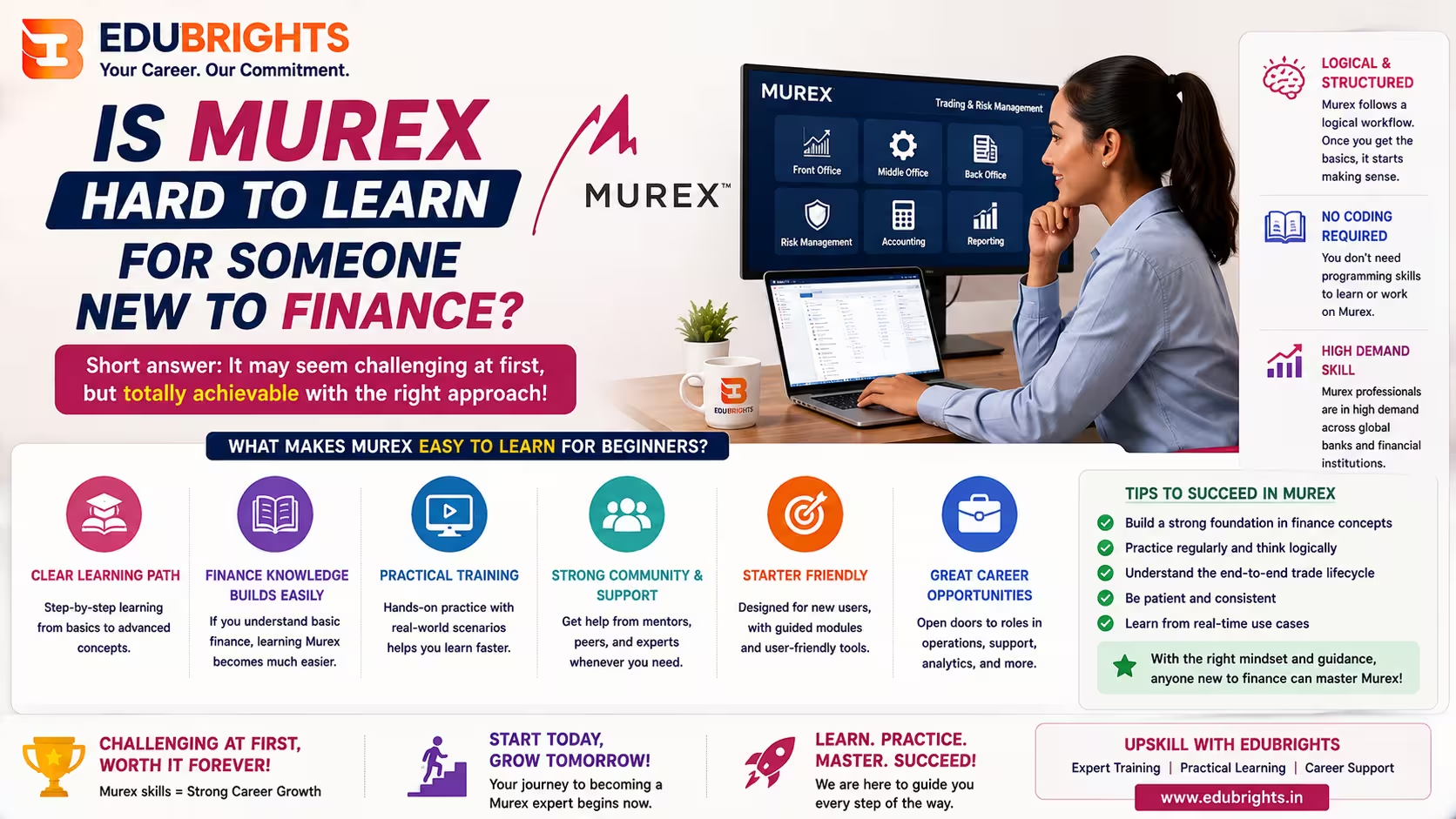
Is Murex Hard to Learn for Someone New to Finance?
When IT professionals, software engineers, or recent graduates look at career opportunities in capital markets, Murex consulting quickly surfaces as a lucrative option. However, seeing financial terms like derivatives, yield curves, FRTB, and CVA often leads to one immediate question: Is Murex too difficult to learn if I am new to finance?
Here is an honest breakdown of the learning curve and how non-finance learners navigate it successfully.
Understanding the Dual Nature of Murex
Murex MX.3 is not just an application; it is an operating system for capital markets. Learning Murex requires understanding two connected domains:
- The Domain Knowledge (Finance & Capital Markets): Understanding trade lifecycles, financial instruments (FX, interest rate swaps, bonds), and risk metrics.
- The Technical Knowledge (System Configuration & Workflows): Understanding MxML workflows, datamarts, SQL scripting, architecture nodes, and integration APIs.
If you are new to finance, the initial challenge isn't the software interface—it is getting comfortable with the financial terminology.
Why IT Professionals Often Learn Murex Quickly
If you come from an engineering, computer science, or general IT background, you already possess crucial problem-solving habits that make technical Murex roles accessible:
- Systematic Logic: Understanding database relationships and data flows makes learning Murex Datamart and MxML workflows intuitive.
- Scripting & SQL: Hands-on experience with database queries helps when navigating Murex reporting structures.
- Process Automation: Familiarity with IT support ticketing and SDLC pipelines aids in Murex production support roles.
How to Overcome the Finance Learning Curve
You do not need a master’s degree in finance to work with Murex. You only need a functional understanding of fundamental product mechanics:
- Focus on the Trade Lifecycle First: Learn what happens to a simple FX trade from booking (Front Office) to risk check (Middle Office) to payment settlement (Back Office).
- Master Basic Product Terminology: Understand linear products (Bonds, Money Market, FX Spot) before moving to complex options or derivatives.
- Use Guided Hands-On Scenarios: Practicing actual deal bookings in a sandbox environment makes abstract financial concepts concrete.
Common Myths About Learning Murex
- Myth: "You must be a quantitative mathematician." Fact: Most Murex functional analysts and technical consultants focus on system configuration and workflow management rather than pricing model math.
- Myth: "Self-study with manuals is enough." Fact: Murex software is proprietary and complex; structured guidance with practical lab exposure dramatically accelerates learning.
Final Word
While Murex presents a steep initial learning curve for complete finance newcomers, focusing on core trade lifecycles alongside structured platform configuration makes mastery entirely achievable.
Whether you're transitioning from IT, evaluating Murex training programs, or preparing for capital markets consulting, hands-on platform practice remains the single best predictor of real job readiness.
Explore Murex MX.3 Training in Bangalore at EduBrights →
EduBrights is a leading IT training institute offering hands-on Murex courses across capital markets and treasury specializations. View all courses.
Get Training Quote for Free
Related Blogs

Top Interview Questions for Java Backend Developers
This blog covers top Java backend interview questions with clear answers, focusing on Spring Boot, REST APIs, Hibernate, security, and performance to help freshers and professionals prepare confidently.

What You Will Learn in a Professional MySQL Course – Curriculum Explained
In today’s data-driven world, databases play a critical role in almost every application, from small websites to large enterprise systems. Among all database technologies, MySQL continues to be one of the most widely used and trusted solutions across industries. If you are planning to build a career in database management, web development, or data-related roles, enrolling in professional mysql courses can be a smart and future-proof decision. This blog explains in detail what you will learn in a professional MySQL course, how the curriculum is structured, and why choosing the best mysql course can make a real difference in your career growth.

How Can You Get Ready for a Data Science Interview After Finishing a Course?
Preparing for a data science interview is an important step after completing a data science course. While training helps you learn key concepts, interviews require you to demonstrate practical knowledge, problem-solving ability, and clear communication. This blog explains how reviewing core data science concepts, practicing real-world projects, strengthening programming skills, and preparing common interview questions can help candidates succeed. It also highlights the importance of building a strong portfolio, improving communication skills, and staying updated with industry trends to increase your chances of starting a successful career in data science.

Java Courses: The Smart Way to Build a Strong Programming Career
This blog explains why Java remains a top programming language, highlights the benefits of Java courses and online training, and shows how certification and hands-on learning can boost career growth.