Course Objectives
1. How are modern processors, AI chips, and SoCs designed from concept to silicon?
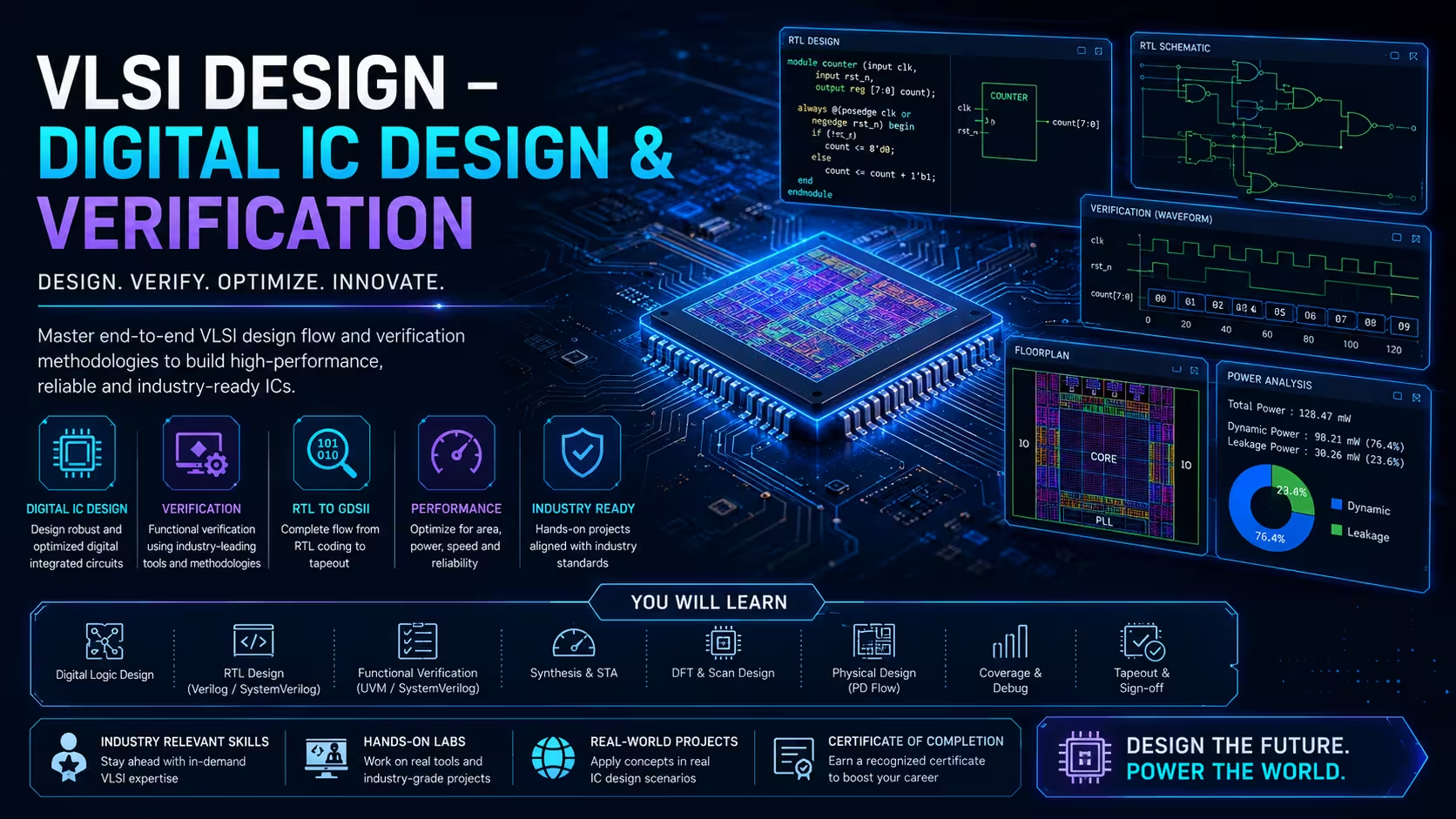
Learn the complete Digital IC design flow, including specification, RTL design, synthesis, verification, and implementation used in semiconductor companies.
2. How do engineers convert digital logic concepts into hardware circuits?
Master RTL design using Verilog and VHDL to create combinational logic, sequential circuits, finite state machines, and processor components.
3. How can design errors be identified before expensive chip manufacturing?
Learn simulation, debugging, testbench creation, functional verification, and validation techniques to ensure design correctness before tape-out.
4. How do semiconductor companies verify complex chips containing billions of transistors?
Understand verification methodologies, coverage analysis, assertions, SystemVerilog, and UVM concepts used in modern verification teams.
Popular Techniques Covered in This Course
Digital Electronics Fundamentals
CMOS Design Basics
Verilog HDL Programming
RTL Design Methodology
Combinational Circuit Design
Sequential Circuit Design
Finite State Machine (FSM) Design
Logic Synthesis Concepts
Functional Verification
Testbench Development
Get Hands-on Knowledge about Real-Time Projects
Project 1
1. Traffic Light Controller Using Verilog
Design and verify a traffic control system using finite state machine architecture.
Project 2
2. RISC Processor RTL Design Project
Develop a simplified processor core including ALU, registers, control unit, and instruction execution logic.
Project 3
3. UART Communication Controller
Create and verify a UART module for serial communication used in embedded systems.
Project 4
4. Digital Calculator ASIC Module
Design arithmetic and logic units and validate functionality through simulation.
Project 5
5. FPGA-Based Smart Device Controller
Implement and test a digital controller on FPGA hardware using RTL design methodology.
Key Features
Edubrights offers VLSI DESIGN – DIGITAL IC DESIGN & VERIFICATION Training in virtual mode with expert trainers. Here are the key features,
40 Hours Course Duration
100% Job Oriented Training
Industry Expert Faculties
Free Demo Class Available
Completed 500+ Batches
Certification Guidance
Curriculum
Module 1: Introduction to VLSI
- VLSI overview: very large scale integration and IC design industry
- VLSI design flow: RTL design, synthesis, place and route, and signoff
- ASIC vs FPGA: design approaches and trade-offs
- CMOS fundamentals: nMOS, pMOS, and CMOS inverter operation
Module 2: Verilog HDL Fundamentals
- Verilog basics: modules, ports, and wire/reg data types
- Combinational logic: assign statements and continuous assignments
- Sequential logic: always blocks, blocking, and non-blocking assignments
- Structural modelling: instantiating and connecting modules
Module 3: RTL Design with Verilog
- Finite State Machines: Mealy and Moore FSM coding in Verilog
- Arithmetic circuits: adders, subtractors, multipliers, and dividers
- Memory elements: registers, FIFOs, and SRAM models
- Parameterised designs: scalable RTL with parameter and localparameter
Module 4: SystemVerilog for Design
- SystemVerilog enhancements: logic type, always_ff, always_comb
- Interfaces: bundling signals for cleaner module connections
- Packages: shared type definitions and parameter collections
- Assertions: immediate assertions for design intent documentation
Module 5: Functional Verification
- Verification fundamentals: testbench structure and coverage goals
- SystemVerilog testbench: classes, randomisation, and constraints
- UVM (Universal Verification Methodology): overview and component hierarchy
- Coverage: code coverage and functional coverage metrics
Module 6: Logic Synthesis
- Synthesis flow: RTL to gate-level netlist with Design Compiler
- Timing constraints: clock definition, input/output delays, and false paths
- Area and power optimisation: synthesis directives and trade-offs
- Gate-level simulation: verifying netlist against RTL behaviour
Module 7: FPGA Implementation
- FPGA architecture: LUTs, flip-flops, DSPs, and BRAMs
- Xilinx Vivado or Intel Quartus: FPGA design flow
- Constraints: XDC or SDC timing and pin assignment
- FPGA debugging: Integrated Logic Analyser (ILA) and SignalTap
Module 8: Capstone Project and Assessment
- RTL design: processor datapath or communication controller in Verilog
- UVM testbench: constrained-random verification environment
- FPGA implementation: synthesise, implement, and verify on FPGA board
- Final assessment and course certification
Receive Training From Our Skilled and Effective Trainers
Experience in the Industry Gain expertise from VLSI design and verification engineers who have worked on ASIC and FPGA designs for semiconductor companies, communications, networking, and consumer electronics chip development.
Backgrounds at the Top Our VLSI trainers have worked at fabless semiconductor companies, IP development firms, and VLSI design service organisations delivering RTL design, verification, and FPGA implementation projects.
Clear & Effective Teaching VLSI design flow, Verilog and SystemVerilog RTL design, FSM coding, UVM verification, logic synthesis, timing constraints, FPGA implementation, and FPGA debugging are explained with real IC design examples.
Hands-On Learning Focus Students write Verilog RTL, build UVM testbenches, run synthesis with timing constraints, implement designs on FPGA, and debug with ILA through structured hands-on VLSI design and verification labs.
Up-to-Date Knowledge Trainers keep content current with the latest EDA tool releases from Synopsys, Cadence, and Xilinx/AMD, UVM 1.2 methodology updates, and evolving digital IC design and verification best practices.
You will succeed with our recognized certification
Our institution offers a recognized VLSI DESIGN – DIGITAL IC DESIGN & VERIFICATION certification that validates your ability to design and prototype professional user interfaces efficiently. This certification enhances your design portfolio and prepares you for collaborative projects in real-world environments. Gain practical skills through hands-on training and assessments.
Course FAQs
1. Why do semiconductor companies spend more time on verification than actual design?
Because a small design error can result in multi-million-dollar fabrication losses, making verification a critical phase in chip development
2. What is the difference between RTL Design and Verification?
RTL Design creates the hardware logic, while Verification ensures the logic behaves exactly according to specifications before manufacturing
3. Why are Verilog and VHDL important in VLSI careers?
They are industry-standard hardware description languages used to model and implement digital circuits.
4. How does a chip move from code to physical silicon?
The design passes through RTL coding, synthesis, verification, physical implementation, testing, and fabrication stages.
5. What makes verification one of the highest-demand semiconductor roles?
Modern chips are extremely complex, and verification often consumes a majority of the overall development effort.
6. How are bugs identified in digital chip designs?
Using simulation environments, assertions, waveform analysis, functional coverage, and automated testing frameworks.
7. Can VLSI engineers work in AI and processor development?
Yes. AI accelerators, GPUs, CPUs, networking chips, and automotive processors all require VLSI expertise.
8. Why is FPGA experience valuable for VLSI professionals?
FPGA platforms allow engineers to validate and test hardware designs before ASIC manufacturing.
9. What industries hire VLSI engineers?
Semiconductor, automotive, telecommunications, aerospace, consumer electronics, defense, and AI hardware industries.
10. What is tape-out in chip development?
Tape-out is the final stage where the verified design is sent for semiconductor fabrication.
11. How does timing analysis affect chip performance?
Timing analysis ensures signals propagate correctly across the chip without violating performance requirements.
12. Why is the semiconductor industry experiencing high demand for VLSI talent?
Growth in AI, 5G, IoT, cloud computing, automotive electronics, and advanced processors is driving demand for chip design professionals.
Get Training Quote for Free
Testimonials
Hear What Our Students Say
"Transform your life through Education, hear it from our Alumni"

8 LPA
Rahul
Student
Data Scientist
"Transform your life through Education, hear it from our Alumni"

8 LPA
Siddharth
NIELSON IQ
Data Analyst
"Transform your life through Education, hear it from our Alumni"

6 LPA
Fathima
Student
Software Engineer