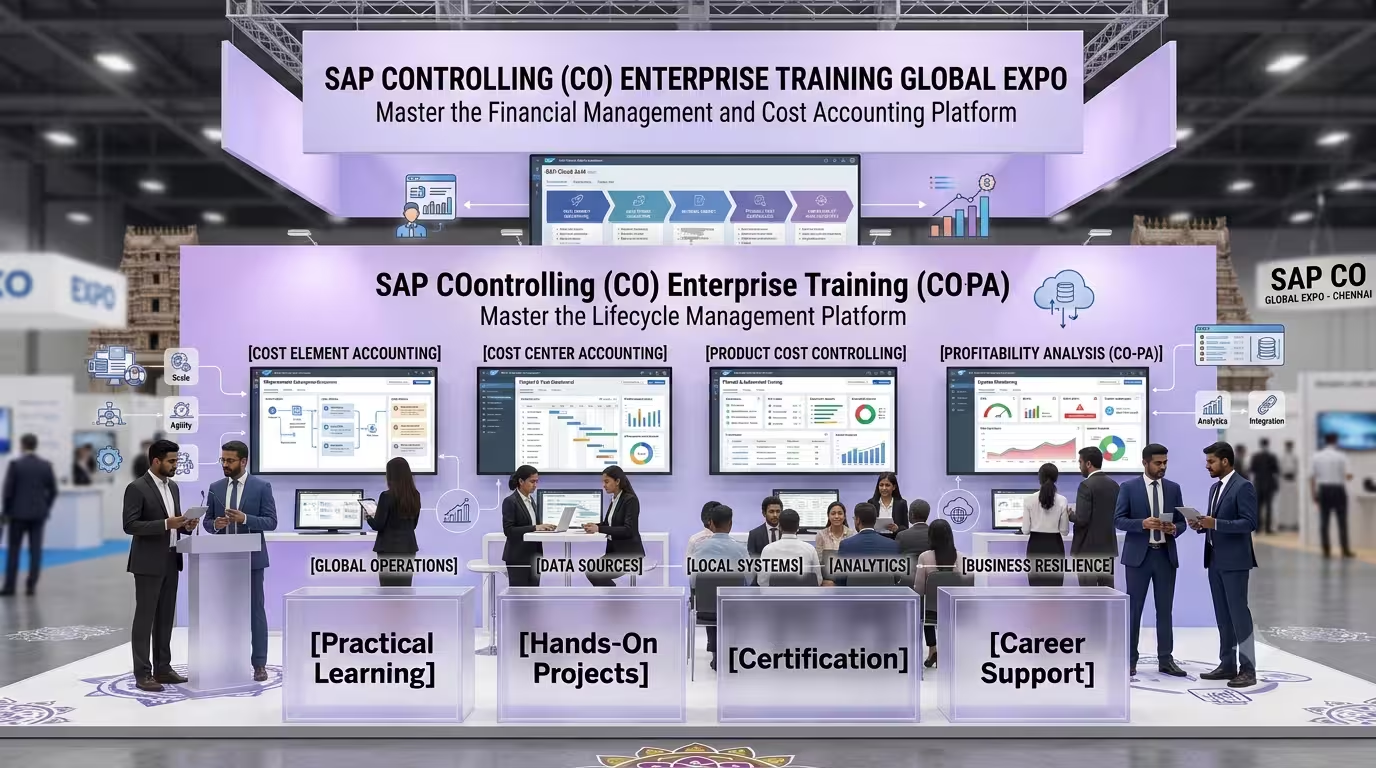
Course Objectives
1. Learn Cost and Profit Management
Understand how SAP CO helps organizations track costs, manage budgets, analyze profitability, and improve financial performance.
2. Master Internal Cost Control Processes
Learn how to manage cost centers, profit centers, internal orders, and product costing using SAP CO.
3. Gain Practical Experience with SAP CO
Develop hands-on skills in cost allocation, budgeting, planning, reporting, and management accounting processes.
4. Work on Real-World Financial Projects
Apply your knowledge through practical projects focused on cost management, profitability analysis, and financial planning.
Popular Techniques Covered in This Course
SAP CO Fundamentals
Cost Center Accounting
Profit Center Accounting
Internal Orders Management
Product Costing
Cost Allocation Processes
Budget Planning and Control
Profitability Analysis (CO-PA)
Management Reporting
SAP FI and CO Integration
Get Hands-on Knowledge about Real-Time Projects
Project 1
Project 1: Cost Center Management System
Create a solution to track departmental expenses, allocate costs, and monitor budget utilization across the organization.
Project 2
Project 2: Product Costing and Analysis
Develop a costing model that calculates manufacturing costs and helps businesses determine product profitability.
Project 3
Project 3: Profitability Analysis Dashboard
Build reports that analyze revenue, expenses, and profit margins across products, customers, and business units.
Project 4
Project 4: Internal Order Tracking Solution
Design a system to manage project costs, monitor spending, and track financial performance for specific business activities.
Project 5
Project 5: Budget Planning and Cost Control
Implement a budgeting process that helps management plan expenses, monitor costs, and improve financial control.
Key Features
Edubrights offers SAP CO (Controlling) in virtual mode with expert trainers. Here are the key features,
40 Hours Course Duration
100% Job Oriented Training
Industry Expert Faculties
Free Demo Class Available
Completed 500+ Batches
Certification Guidance
Curriculum
Module 1: Introduction to SAP CO
- Overview of SAP Controlling module
- CO integration with FI, MM, SD, PP, and PS
- CO organizational structure: Controlling area, company code
- CO components: CCA, IO, PC, PA, EC-PCA
- CO in S/4HANA: Margin analysis and Universal Journal
Module 2: Cost Center Accounting (CO-CCA)
- Cost center master data and hierarchy
- Cost element categories and structure
- Primary and secondary cost elements
- Cost center planning
- Actual postings and repostings
- Periodic allocation: Distribution and assessment
Module 3: Internal Orders (CO-IO)
- Internal order types and master data
- Order planning and budgeting
- Commitment management
- Order settlement to cost centers, assets, and GL
- Statistical orders vs. real orders
Module 4: Product Cost Controlling (CO-PC)
- Cost estimate with quantity structure
- Material cost estimate and costing run
- Work-in-process (WIP) calculation
- Variance calculation and analysis
- Production order settlement
Module 5: Profitability Analysis (CO-PA)
- Costing-based vs. account-based CO-PA
- Characteristics and value fields
- PA transfer structures
- Top-down distribution
- Profitability reporting and drill-down
Module 6: Profit Center Accounting (EC-PCA)
- Profit center master data and hierarchy
- Document splitting for profit centers
- Profit center planning
- Intercompany profit center transactions
- Profit center reporting
Module 7: Activity-Based Costing
- Business process master data
- Activity types and prices
- Process cost allocation
- Template allocation
- ABC reporting and analysis
Module 8: CO Planning
- Cost center planning layouts
- Integrated planning with CO-PA
- Plan version management
- Top-down and bottom-up planning
- Plan vs. actual comparison
Module 9: Period-End Closing in CO
- Overhead calculation (costing sheets)
- WIP and variance calculation
- Revaluation at actual prices
- Settlement of production and internal orders
- CO period-end closing sequence
Module 10: CO in S/4HANA
- Margin analysis replacing CO-PA
- Account-based CO-PA as default
- Real-time profitability in Universal Journal
- CO Fiori apps and embedded analytics
- Migration from ECC CO to S/4HANA
Module 11: CO Reporting
- Report Painter and Report Writer
- Cost center and profit center reports
- Drilldown reports in CO-PA
- Integration with SAC for CO analytics
- KPI dashboards for controlling
Module 12: Real-Time Projects and Case Studies
- Manufacturing controlling implementation
- Profitability analysis for retail
- End-to-end CO cycle
- Certification and interview preparation
Receive Training From Our Skilled and Effective Trainers
Experience in the Industry Gain knowledge from experts with hands-on SAP CO project experience in manufacturing, financial services, and retail controlling.
Backgrounds at the Top Prominent corporations such as HCL, TCS, Deloitte, and KPMG employ our SAP CO trainers.
Clear & Effective Teaching Excellent communication and real-world examples simplify complex cost accounting and profitability analysis.
Hands-On Learning Focus Students apply skills using live SAP CO systems with real cost center, product costing, and CO-PA projects.
Up-to-Date Knowledge Trainers stay current with SAP S/4HANA Controlling, margin analysis, and latest management accounting practices.
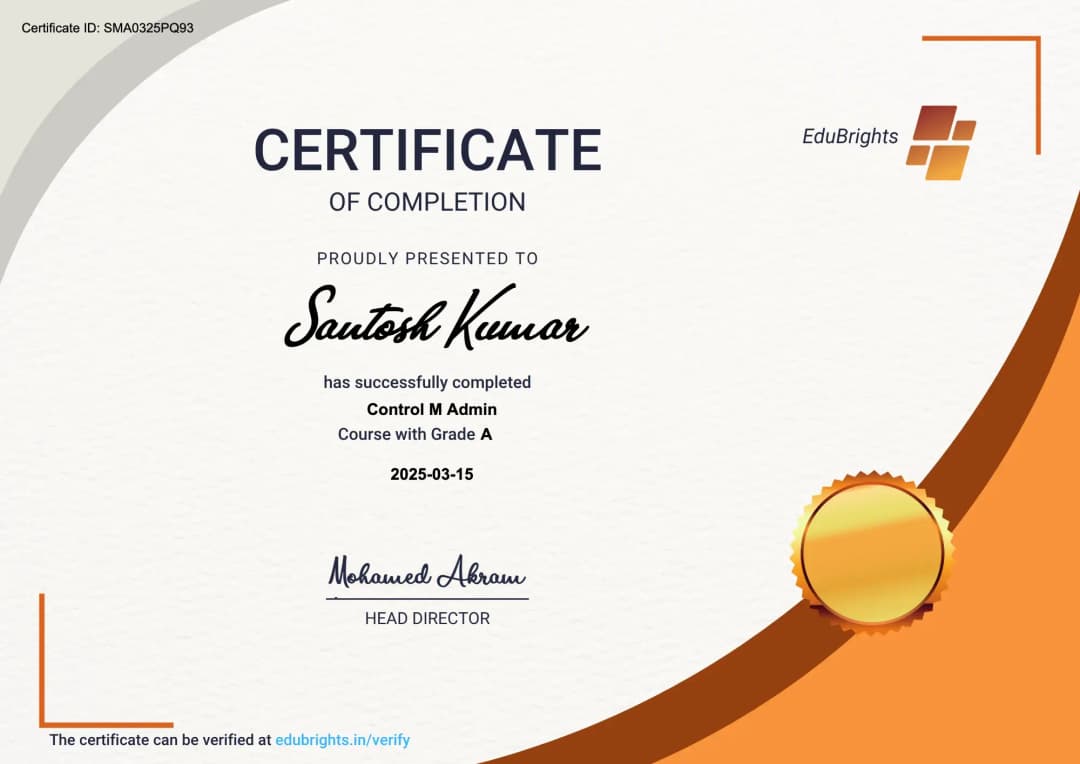
About Our Course Certification*
The SAP CO Professional Certification validates your skills in cost management, budgeting, profitability analysis, and internal financial controlling processes. It demonstrates your ability to manage organizational costs and support business decision-making using SAP CO. This certification can help you build a successful career in SAP Finance, controlling, and management accounting.
Course FAQs
1. What is SAP CO (Controlling)?
SAP CO (Controlling) is an SAP module used to monitor, analyze, and control an organization's internal costs and profitability. It supports management accounting, cost allocation, planning, budgeting, and performance analysis.
2. What are the main components of SAP CO?
The major SAP CO components include Cost Center Accounting, Internal Order Accounting, Profit Center Accounting, Product Cost Controlling, Profitability Analysis, and overhead management. These components help organizations analyze costs and business performance.
3. What is Cost Center Accounting in SAP CO?
Cost Center Accounting is used to collect and monitor costs incurred by organizational departments or functional areas. It helps management understand where costs are generated and compare actual costs with planned values.
4. What is a cost center?
A cost center represents an organizational unit or responsibility area where costs are incurred and monitored. Examples include administration, production support, IT, human resources, and maintenance departments.
5. How is a cost center created in SAP CO?
A cost center is created by defining attributes such as controlling area, cost center category, responsible person, validity period, and organizational assignment. Appropriate master-data configuration is required before the cost center can receive postings.
6. What is a controlling area in SAP CO?
A controlling area is the organizational structure used for internal management accounting within SAP CO. It provides the framework for cost accounting, planning, allocations, and reporting.
7. Can multiple company codes be assigned to one controlling area?
Yes, multiple company codes can be assigned to a controlling area when the organizational and accounting requirements allow them to use a common controlling structure. The company codes generally need compatible fiscal year and chart-of-accounts settings.
8. What is a cost element in SAP CO?
Cost elements classify costs for controlling purposes and provide a link between financial accounting postings and controlling information. In modern SAP S/4HANA, cost elements are represented through corresponding G/L accounts.
9. What are primary costs in SAP CO?
Primary costs originate from external business transactions such as salaries, utilities, materials, and services. These costs typically enter CO through corresponding financial accounting postings.
10. What are secondary costs in SAP CO?
Secondary costs are used for internal CO allocations and activities between controlling objects. They help organizations distribute or transfer internal costs between cost centers, orders, projects, and other objects.
11. What is Cost Center Planning?
Cost Center Planning allows organizations to define expected costs and activity levels for individual cost centers. Planned values can later be compared with actual costs to identify variances.
12. What is actual cost posting in SAP CO?
Actual cost posting records costs against relevant controlling objects such as cost centers, internal orders, or profitability segments. These postings provide the basis for management reporting and cost analysis.
13. What is activity type in SAP CO?
An activity type represents a measurable internal service or activity provided by one cost center to another. Examples include machine hours, labor hours, consulting hours, or maintenance activities.
14. What is activity type planning?
Activity type planning defines planned activity quantities and prices for cost centers. It helps calculate the expected cost of internally provided services and supports activity-based allocations.
15. What is activity price calculation?
Activity price calculation determines the cost rate associated with an activity type. The rate can be calculated using planned costs and planned activity quantities.
16. What is cost center allocation?
Cost center allocation distributes costs from one cost center to other receiving cost centers or controlling objects according to defined rules. It helps organizations assign shared or indirect costs more accurately.
17. What is assessment in SAP CO?
Assessment is an allocation method used to distribute costs using defined allocation rules. Costs can be transferred using an assessment cycle and appropriate secondary cost categories.
18. What is distribution in SAP CO?
Distribution reallocates primary costs from a sender cost center to receiver objects while preserving the original cost element information. It is commonly used to distribute shared expenses across departments.
19. What is an internal order in SAP CO?
An internal order is a cost object used to collect and monitor costs for a specific activity, project, event, or temporary purpose. It provides detailed cost tracking before costs are settled to their final receivers.
20. What are the different types of internal orders?
Internal orders can be used for overhead activities, investment-related activities, maintenance, marketing campaigns, events, and other temporary cost collection requirements. Their configuration depends on the organization's controlling processes.
21. What is internal order planning?
Internal order planning allows users to define expected costs and activities for an order. Planned values can be compared with actual costs to monitor financial performance.
22. What is internal order settlement?
Internal order settlement transfers accumulated costs from an internal order to one or more receiver objects. Receivers may include cost centers, G/L accounts, assets, profitability segments, or other controlling objects depending on the business scenario.
23. What is a settlement profile in SAP CO?
A settlement profile controls how an internal order can be settled. It defines settlement-related rules such as permitted receivers and settlement behavior.
24. What is Profit Center Accounting?
Profit Center Accounting is used to evaluate the financial performance of organizational units responsible for revenues and costs. It helps management analyze profitability across products, regions, business units, or other organizational dimensions.
25. What is a Profit Center?
A Profit Center represents an organizational unit for which revenues, costs, assets, and other financial information can be analyzed. It is commonly used to evaluate the performance of decentralized business areas.
26. How does SAP CO support Profit Center Accounting?
SAP CO collects relevant revenue and cost information for profit centers and enables management reporting. This helps organizations compare the financial performance of different business units.
27. What is Product Cost Controlling in SAP?
Product Cost Controlling is used to calculate and analyze the cost of manufacturing or producing products. It supports product cost planning, cost estimates, production cost analysis, and variance evaluation.
28. What is a standard cost estimate?
A standard cost estimate calculates the expected cost of producing a material or product based on relevant cost components. It can include material, labor, overhead, and other production-related costs.
29. What is a costing variant in SAP CO?
A costing variant controls how a product cost estimate is calculated. It defines important parameters such as valuation methods, costing types, date controls, and other calculation settings.
30. What is a cost component structure?
A cost component structure groups product costs into meaningful categories such as material, labor, machine costs, overhead, and external activities. It provides a detailed view of the composition of product costs.
31. What is actual product costing?
Actual product costing analyzes the actual costs incurred during production and compares them with planned or standard costs. It helps organizations understand cost differences and production performance.
32. What is variance analysis in SAP CO?
Variance analysis compares planned, standard, or target costs with actual costs. It helps identify differences caused by factors such as price changes, quantity variations, production efficiency, or overhead deviations.
33. What is Profitability Analysis (CO-PA)?
Profitability Analysis evaluates the profitability of market segments such as customers, products, regions, sales channels, or business units. It helps management understand revenue, cost, margin, and contribution performance.
34. What is an operating concern in CO-PA?
An operating concern is the highest organizational structure used for profitability analysis. It defines the characteristics and value fields or account-based structures used to analyze profitability.
35. What is account-based profitability analysis?
Account-based CO-PA analyzes profitability using G/L accounts and financial accounting information. It provides closer integration between Financial Accounting and profitability reporting.
36. What is margin analysis in SAP S/4HANA?
Margin analysis is the S/4HANA approach for account-based profitability analysis. It enables organizations to analyze revenues, costs, margins, and profitability characteristics using accounting data.
37. How does SAP FI integrate with SAP CO?
SAP FI and CO are closely integrated so that relevant financial postings can update controlling objects. For example, an expense posted in FI can simultaneously update a cost center, internal order, or other CO object.
38. How does SAP CO integrate with SAP MM?
SAP CO integrates with Materials Management to capture and analyze costs generated by procurement and inventory-related processes. Purchase transactions and goods movements can influence relevant controlling objects and cost calculations.
39. How does SAP CO integrate with SAP SD?
SAP CO integrates with Sales and Distribution to support revenue and profitability analysis. Sales transactions can contribute revenue and cost information to profitability segments and other controlling structures.
40. How does SAP CO integrate with SAP PP?
SAP CO integrates with Production Planning to analyze manufacturing costs, production activities, work centers, orders, and variances. Production orders can collect actual costs and later be analyzed or settled.
41. What is month-end closing in SAP CO?
Month-end closing involves activities required to finalize controlling information for an accounting period. Common activities include allocations, activity assessments, order settlement, variance calculation, and reconciliation.
42. What is period-end settlement in SAP CO?
Period-end settlement transfers accumulated costs or variances from temporary objects to their appropriate receivers. It is commonly used for internal orders, production orders, and other cost objects.
43. What is reconciliation between FI and CO?
FI-CO reconciliation ensures that financial accounting and controlling information is consistent and properly integrated. In SAP S/4HANA, the universal journal provides a common data foundation for FI and CO.
44. What is the Universal Journal in SAP S/4HANA?
The Universal Journal is the central financial data repository in SAP S/4HANA. It combines Financial Accounting and Controlling information into a unified journal, reducing the need for separate reconciliation between FI and CO.
45. What is cost center variance analysis?
Cost center variance analysis compares planned and actual costs for individual cost centers. It helps managers identify overspending, unexpected costs, operational inefficiencies, and areas requiring corrective action.
46. What is SAP CO reporting?
SAP CO reporting provides information about costs, allocations, profitability, variances, internal orders, cost centers, and profit centers. Reports can support operational monitoring as well as management decision-making.
47. What is plan-versus-actual analysis in SAP CO?
Plan-versus-actual analysis compares planned financial values with actual posted values. It helps organizations identify deviations and investigate the reasons behind cost or profitability differences.
48. How does SAP CO support management decision-making?
SAP CO provides detailed information about costs, profitability, resource consumption, business-unit performance, and operational variances. Management can use this information for budgeting, cost control, pricing, performance evaluation, and strategic planning.
49. What practical projects can be covered in SAP CO training in Chennai?
Practical SAP CO projects can include Cost Center Accounting Implementation, Internal Order Management, Profit Center Reporting, Product Costing and Variance Analysis, and Profitability Analysis. These scenarios provide experience with cost allocation, planning, settlement, reporting, and FI integration.
50. What technical skills can I gain from SAP CO training in Chennai?
SAP CO training can help develop skills in Controlling Area configuration, Cost Center Accounting, cost elements, cost center planning, activity types, activity allocation, distribution, assessment, internal orders, order settlement, Profit Center Accounting, product costing, variance analysis, CO-PA, margin analysis, FI integration, MM/SD/PP integration, period-end closing, and management reporting. These skills are useful for SAP CO and SAP FICO consulting roles.
Get Training Quote for Free
Testimonials
Hear What Our Students Say
"Transform your life through Education, hear it from our Alumni"

6 LPA
Fathima
Student
Software Engineer
"Transform your life through Education, hear it from our Alumni"

8 LPA
Rahul
Student
Data Scientist
"Transform your life through Education, hear it from our Alumni"

8 LPA
Siddharth
NIELSON IQ
Data Analyst