Course Objectives
1. What will I learn by taking the SAP CO (Controlling) course in Bangalore?
You'll build a solid understanding of the core concepts, terminology, and fundamentals of SAP CO (Controlling), giving you a strong foundation to build on.
2. What hands-on skills will I gain from the SAP CO (Controlling) training?
You'll get hands-on experience with industry-relevant SAP CO (Controlling) tools and workflows through guided exercises, so you learn by doing rather than just reading theory.
3. How does the SAP CO (Controlling) course prepare me for real-world work?
The SAP CO (Controlling) course is designed around how SAP CO (Controlling) is actually applied to solve real-world problems in professional settings, not just textbook scenarios.
4. What practical, job-ready skills will I build during SAP CO (Controlling) training in Bangalore?
You'll develop the practical skills needed to confidently work with SAP CO (Controlling) on the job, so you're ready to contribute from day one in a SAP CO (Controlling) role.
5. Will I work on real projects during the SAP CO (Controlling) course?
Yes, the SAP CO (Controlling) course includes real-time projects and case studies that reinforce concepts through practice, giving you portfolio-ready work by the end.
6. How does the SAP CO (Controlling) course help with certification and job interviews?
The SAP CO (Controlling) course is structured to help you prepare for relevant certifications and interviews, covering the concepts and terminology employers and exam boards expect.
Popular Techniques Covered in This Course
SAP CO Fundamentals
Cost Center Accounting
Profit Center Accounting
Internal Orders Management
Product Costing
Cost Allocation Processes
Budget Planning and Control
Profitability Analysis (CO-PA)
Management Reporting
SAP FI and CO Integration
Get Hands-on Knowledge about Real-Time Projects
Project 1
Project 1: Cost Center Management System
Create a solution to track departmental expenses, allocate costs, and monitor budget utilization across the organization.
Project 2
Project 2: Product Costing and Analysis
Develop a costing model that calculates manufacturing costs and helps businesses determine product profitability.
Project 3
Project 3: Profitability Analysis Dashboard
Build reports that analyze revenue, expenses, and profit margins across products, customers, and business units.
Project 4
Project 4: Internal Order Tracking Solution
Design a system to manage project costs, monitor spending, and track financial performance for specific business activities.
Project 5
Project 5: Budget Planning and Cost Control
Implement a budgeting process that helps management plan expenses, monitor costs, and improve financial control.
Key Features
Edubrights offers SAP CO (Controlling) in virtual mode with expert trainers. Here are the key features,
40 Hours Course Duration
100% Job Oriented Training
Industry Expert Faculties
Free Demo Class Available
Completed 500+ Batches
Certification Guidance
Curriculum
Module 1: Introduction to SAP CO
- Overview of SAP Controlling module
- CO integration with FI, MM, SD, PP, and PS
- CO organizational structure: Controlling area, company code
- CO components: CCA, IO, PC, PA, EC-PCA
- CO in S/4HANA: Margin analysis and Universal Journal
Module 2: Cost Center Accounting (CO-CCA)
- Cost center master data and hierarchy
- Cost element categories and structure
- Primary and secondary cost elements
- Cost center planning
- Actual postings and repostings
- Periodic allocation: Distribution and assessment
Module 3: Internal Orders (CO-IO)
- Internal order types and master data
- Order planning and budgeting
- Commitment management
- Order settlement to cost centers, assets, and GL
- Statistical orders vs. real orders
Module 4: Product Cost Controlling (CO-PC)
- Cost estimate with quantity structure
- Material cost estimate and costing run
- Work-in-process (WIP) calculation
- Variance calculation and analysis
- Production order settlement
Module 5: Profitability Analysis (CO-PA)
- Costing-based vs. account-based CO-PA
- Characteristics and value fields
- PA transfer structures
- Top-down distribution
- Profitability reporting and drill-down
Module 6: Profit Center Accounting (EC-PCA)
- Profit center master data and hierarchy
- Document splitting for profit centers
- Profit center planning
- Intercompany profit center transactions
- Profit center reporting
Module 7: Activity-Based Costing
- Business process master data
- Activity types and prices
- Process cost allocation
- Template allocation
- ABC reporting and analysis
Module 8: CO Planning
- Cost center planning layouts
- Integrated planning with CO-PA
- Plan version management
- Top-down and bottom-up planning
- Plan vs. actual comparison
Module 9: Period-End Closing in CO
- Overhead calculation (costing sheets)
- WIP and variance calculation
- Revaluation at actual prices
- Settlement of production and internal orders
- CO period-end closing sequence
Module 10: CO in S/4HANA
- Margin analysis replacing CO-PA
- Account-based CO-PA as default
- Real-time profitability in Universal Journal
- CO Fiori apps and embedded analytics
- Migration from ECC CO to S/4HANA
Module 11: CO Reporting
- Report Painter and Report Writer
- Cost center and profit center reports
- Drilldown reports in CO-PA
- Integration with SAC for CO analytics
- KPI dashboards for controlling
Module 12: Real-Time Projects and Case Studies
- Manufacturing controlling implementation
- Profitability analysis for retail
- End-to-end CO cycle
- Certification and interview preparation
Receive Training From Our Skilled and Effective Trainers
Experience in the Industry Gain expertise from SAP CO (Controlling) professionals training in Bangalore who have applied their skills on live projects across corporate, product, and consulting environments, bringing practical, real-world context into every SAP CO (Controlling) session.
Backgrounds at the Top Our SAP CO (Controlling) trainers in Bangalore bring hands-on industry experience, having worked on real SAP CO (Controlling) projects for organizations across various industries before moving into training.
Clear & Effective Teaching Core SAP CO (Controlling) concepts, tools, and workflows are explained using real project examples and practical scenarios, so you understand not just the theory but how SAP CO (Controlling) is actually used on the job.
Hands-On Learning Focus Students get structured, hands-on practice with SAP CO (Controlling) through guided exercises, mini-projects, and lab work designed to build practical, job-ready skills.
Up-to-Date Knowledge Trainers keep the SAP CO (Controlling) curriculum current with the latest tools, versions, and industry best practices, so what you learn stays relevant to how SAP CO (Controlling) is used today in Bangalore and beyond.
About Our Course Certification*
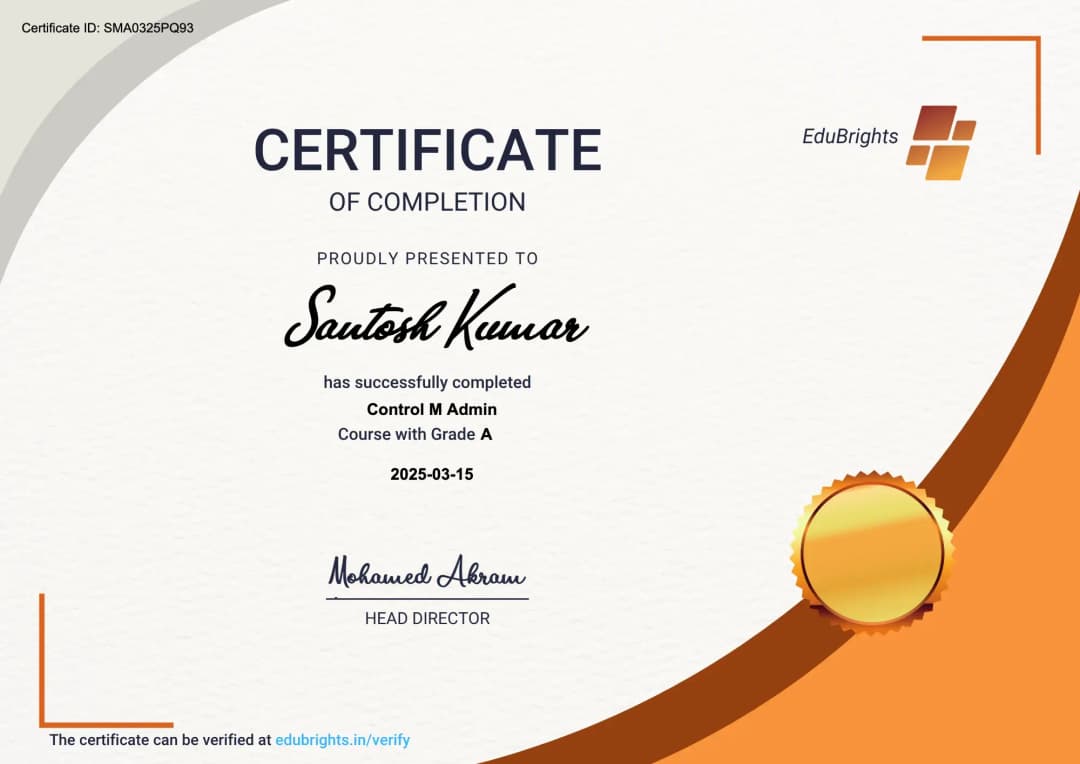
The SAP CO Professional Certification validates your skills in cost management, budgeting, profitability analysis, and internal financial controlling processes. It demonstrates your ability to manage organizational costs and support business decision-making using SAP CO. This certification can help you build a successful career in SAP Finance, controlling, and management accounting.
Course FAQs
1. What is SAP CO?
SAP CO (Controlling) is an SAP module used for internal cost management, planning, profitability analysis, and management reporting. It helps organizations monitor costs, revenues, budgets, and business performance.
2. What are the main components of SAP CO?
The major SAP CO components include Cost Center Accounting (CO-CCA), Internal Orders (CO-IO), Product Cost Controlling (CO-PC), Profitability Analysis (CO-PA), Profit Center Accounting, Activity-Based Costing, and CO Planning. These components support different areas of internal financial and management accounting.
3. What is a Controlling Area in SAP CO?
A Controlling Area is the organizational unit used for controlling and management accounting. It can contain one or more company codes, provided the required organizational and currency settings are compatible.
4. How is a company code assigned to a controlling area?
A company code is assigned to a controlling area so that its cost and management accounting transactions can be processed within CO. This assignment enables integration between Financial Accounting and Controlling.
5. What is Cost Center Accounting?
Cost Center Accounting tracks and analyzes costs incurred by organizational departments or responsibility areas. It helps management understand where costs are generated and how they can be controlled.
6. What is a cost center in SAP CO?
A cost center represents an organizational area where costs are incurred and monitored. Examples include administration, production support, IT, human resources, and maintenance departments.
7. What is cost center master data?
Cost center master data contains information such as the cost center name, responsible person, hierarchy assignment, validity period, and controlling-area assignment. Accurate master data is important for reliable cost allocation and reporting.
8. What is a cost center hierarchy?
A cost center hierarchy organizes cost centers into logical groups and structures. It allows organizations to analyze costs at individual department, division, and higher organizational levels.
9. What are primary cost elements?
Primary cost elements represent costs that originate from external or financial accounting transactions, such as salaries, utilities, purchases, and depreciation. In S/4HANA, cost elements are represented through G/L accounts within the Universal Journal architecture.
10. What are secondary cost elements?
Secondary cost elements are used for internal cost flows within Controlling. They support activities such as allocations, assessments, distributions, and internal activity allocations.
11. What is cost center planning?
Cost center planning involves estimating expected costs and activities for future periods. Planned values can later be compared with actual costs to identify variances.
12. What are actual postings in Cost Center Accounting?
Actual postings record costs that have actually occurred against cost centers. These postings can originate from FI transactions, logistics processes, payroll, allocations, and other integrated SAP processes.
13. What is a cost center reposting?
Cost center reposting is used to correct or transfer cost postings between cost centers. It can help organizations rectify incorrect assignments without changing the original business transaction.
14. What is activity type planning?
Activity type planning determines the planned quantity and price of activities provided by a cost center. Activity types can represent services such as machine hours, labor hours, or consulting hours.
15. What is activity allocation in SAP CO?
Activity allocation transfers the cost of an internal activity from a sender cost center to a receiver object. The allocation is generally based on activity quantities and activity prices.
16. What is distribution in SAP CO?
Distribution reallocates primary costs from sender cost centers to receiver cost centers while retaining the original cost element information. It is useful for distributing shared expenses across departments.
17. What is assessment in SAP CO?
Assessment reallocates costs from sender objects to receivers using an assessment cost element. Unlike distribution, the original primary cost element is generally summarized into the assessment flow.
18. What is an internal order?
An internal order is a controlling object used to collect and monitor costs for a specific activity, project, event, or temporary responsibility. It can help track costs separately before they are settled to final receivers.
19. What are internal order types?
Internal order types classify orders according to their business purpose and control requirements. They can determine aspects such as number ranges, planning behavior, settlement rules, and master-data defaults.
20. What is internal order planning?
Internal order planning allows organizations to define expected costs or revenues for specific orders. Planned values can be compared with actual postings to monitor financial performance.
21. What is commitment management for internal orders?
Commitment management tracks future financial obligations resulting from purchasing or other commitments. It provides visibility into expected expenditure before actual costs are posted.
22. What is internal order settlement?
Internal order settlement transfers collected costs or revenues from an internal order to one or more receiver objects. Receivers can include cost centers, assets, G/L accounts, or other controlling objects depending on the configuration.
23. What is a settlement rule in SAP CO?
A settlement rule defines where an internal order's costs or revenues should be transferred during settlement. It can specify receiver objects and distribution percentages or amounts.
24. What is the difference between statistical and real internal orders?
A real internal order can collect actual costs and can be settled to defined receivers. A statistical order is primarily used for additional reporting or information purposes while the actual accounting remains on another cost object.
25. What is Product Cost Controlling?
Product Cost Controlling (CO-PC) is used to calculate and analyze the costs associated with manufacturing products. It supports activities such as product costing, WIP calculation, variance analysis, and production-order settlement.
26. What is a material cost estimate?
A material cost estimate calculates the expected cost of producing or procuring a material. It can use material components, activity prices, overheads, and other cost elements to determine the planned product cost.
27. What is a costing run?
A costing run is used to process material cost estimates for a group of materials. It can support large-scale costing activities and help organizations update planned or standard costs according to their business process.
28. What is a cost estimate with quantity structure?
A quantity-structure-based cost estimate calculates product costs using information such as bills of material and routings. It combines material quantities, production activities, and applicable prices to determine product cost.
29. What is Work in Process (WIP) calculation?
WIP calculation determines the value of partially completed production at period end. It is important for accurate financial and management reporting in manufacturing environments.
30. What is variance calculation in Product Cost Controlling?
Variance calculation compares planned or target costs with actual production costs. It can identify differences related to materials, activities, quantities, prices, and other manufacturing factors.
31. What is production order settlement?
Production order settlement transfers the relevant costs or variances collected on a production order to appropriate receivers. The process is commonly performed as part of period-end closing.
32. What is Profitability Analysis (CO-PA)?
CO-PA analyzes profitability according to business characteristics such as product, customer, region, sales organization, or market segment. It helps management understand revenue, costs, margins, and contribution across different dimensions.
33. What is the difference between costing-based and account-based CO-PA?
Costing-based CO-PA uses value fields to analyze revenues and costs according to configured characteristics. Account-based CO-PA, now commonly referred to as Margin Analysis in S/4HANA, is closely integrated with G/L accounts and the Universal Journal.
34. What are characteristics and value fields in CO-PA?
Characteristics define the dimensions by which profitability data is analyzed, such as customer, product, or region. Value fields in costing-based CO-PA represent measurable values such as revenue, discounts, costs, or quantities.
35. What is a profitability segment?
A profitability segment represents a combination of CO-PA characteristics used to analyze a specific market segment. It can be used to evaluate profitability for combinations such as product, customer, region, and sales organization.
36. What is top-down distribution in CO-PA?
Top-down distribution allocates aggregated profitability values from higher-level characteristics to more detailed profitability segments. Distribution rules determine how the values are assigned to lower-level segments.
37. What is Profit Center Accounting?
Profit Center Accounting is used to evaluate the financial performance of organizational units responsible for generating profit. It can provide information about revenues, costs, assets, and profitability across business units.
38. What is a profit center hierarchy?
A profit center hierarchy organizes profit centers into logical groups for reporting and analysis. It allows management to review profitability at individual profit-center and consolidated organizational levels.
39. What is profit center planning?
Profit center planning involves creating planned financial values for profit centers. Planned revenues, costs, and other performance indicators can be compared with actual results.
40. What is Activity-Based Costing in SAP CO?
Activity-Based Costing (ABC) assigns costs based on business processes and activities that consume organizational resources. It can provide more detailed information about the cost drivers behind products, services, and business processes.
41. What are activity types and activity prices?
Activity types classify activities performed by cost centers, such as labor hours or machine hours. Activity prices determine the cost associated with each unit of an activity for planning and allocation purposes.
42. What is CO planning?
CO planning allows organizations to create planned values for costs, activities, profitability, and other controlling objects. SAP CO supports planning approaches such as top-down planning, bottom-up planning, and plan-versus-actual analysis.
43. What is plan versus actual analysis in SAP CO?
Plan-versus-actual analysis compares expected financial values with actual postings. It helps controllers identify significant deviations, investigate cost drivers, and take corrective management actions.
44. What is period-end closing in SAP CO?
Period-end closing includes activities required to finalize controlling information for a financial period. These can include allocations, overhead calculation, WIP calculation, variance calculation, revaluation, and settlement of internal and production orders.
45. What is overhead calculation in SAP CO?
Overhead calculation applies configured overhead rates or costing-sheet rules to relevant cost objects. It helps assign indirect manufacturing or organizational costs to products, orders, or other controlling objects.
46. What is Margin Analysis in SAP S/4HANA?
Margin Analysis is the S/4HANA approach to account-based profitability analysis. It uses the Universal Journal to provide integrated financial and profitability information, supporting real-time profitability reporting.
47. How does SAP CO integrate with FI, MM, SD, PP, and PS?
SAP CO integrates with Financial Accounting and logistics modules to capture and analyze financial impacts from business transactions. The Edubrights curriculum specifically covers CO integration with FI, MM, SD, PP, and PS, enabling cross-functional cost and profitability analysis.
48. How does SAP CO support management reporting?
SAP CO provides reports for cost centers, profit centers, internal orders, profitability segments, product costs, and planning results. Tools such as Report Painter, Report Writer, CO-PA drill-down reporting, and analytics integrations can support management reporting.
49. What practical projects can be covered in SAP CO training in Bangalore?
The Edubrights SAP CO course includes projects such as Cost Center Management, Product Costing and Analysis, Profitability Analysis Dashboard, Internal Order Tracking, and Budget Planning and Cost Control. These projects provide practical exposure to departmental cost tracking, product profitability, internal cost monitoring, and budgeting processes.
50. What technical skills can I gain from SAP CO training in Bangalore?
SAP CO training can help you develop skills in Cost Center Accounting, Internal Orders, Product Cost Controlling, CO-PA, Profit Center Accounting, Activity-Based Costing, CO Planning, cost allocation, budgeting, period-end closing, Margin Analysis, Universal Journal concepts, CO reporting, and FI/CO integration. These areas closely follow the technical curriculum published on the Edubrights SAP CO course page.
Get Training Quote for Free
Testimonials
Hear What Our Students Say
"Transform your life through Education, hear it from our Alumni"

6 LPA
Fathima
Student
Software Engineer
"Transform your life through Education, hear it from our Alumni"

8 LPA
Rahul
Student
Data Scientist
"Transform your life through Education, hear it from our Alumni"

8 LPA
Siddharth
NIELSON IQ
Data Analyst