Course Objectives
1. What will I learn by taking the SAP Build course in Bangalore?
You'll build a solid understanding of the core concepts, terminology, and fundamentals of SAP Build, giving you a strong foundation to build on.
2. What hands-on skills will I gain from the SAP Build training?
You'll get hands-on experience with industry-relevant SAP Build tools and workflows through guided exercises, so you learn by doing rather than just reading theory.
3. How does the SAP Build course prepare me for real-world work?
The SAP Build course is designed around how SAP Build is actually applied to solve real-world problems in professional settings, not just textbook scenarios.
4. What practical, job-ready skills will I build during SAP Build training in Bangalore?
You'll develop the practical skills needed to confidently work with SAP Build on the job, so you're ready to contribute from day one in a SAP Build role.
5. Will I work on real projects during the SAP Build course?
Yes, the SAP Build course includes real-time projects and case studies that reinforce concepts through practice, giving you portfolio-ready work by the end.
6. How does the SAP Build course help with certification and job interviews?
The SAP Build course is structured to help you prepare for relevant certifications and interviews, covering the concepts and terminology employers and exam boards expect.
Popular Techniques Covered in This Course
SAP Build Fundamentals
No-Code Application Development
Low-Code Development Techniques
Workflow Automation
Business Process Automation
SAP Build Apps
SAP Build Process Automation
User Experience Design
Application Deployment and Management
Form Creation and Management
Get Hands-on Knowledge about Real-Time Projects
Project 1
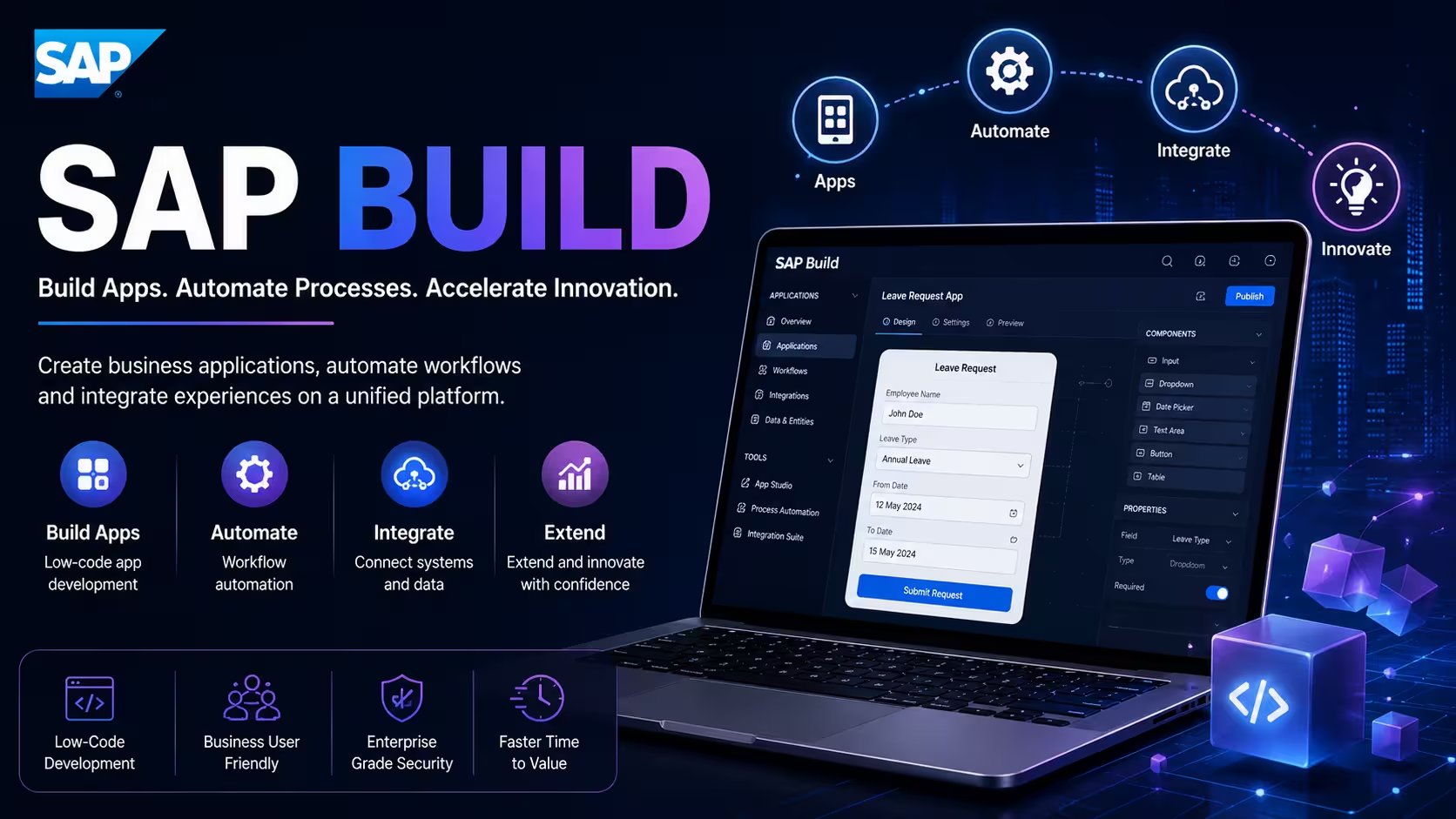
Project 1: Employee Leave Management Application
Build a user-friendly application that allows employees to apply for leave and managers to approve requests online.
Project 2
Project 2: Purchase Approval Workflow
Create an automated workflow for purchase requests, approvals, notifications, and status tracking.
Project 3
Project 3: Customer Feedback Management System
Develop an application to collect, analyze, and manage customer feedback for business improvement.
Project 4
Project 4: Asset Tracking Solution
Design a digital system for tracking company assets, maintenance schedules, and ownership details. Design a digital system for tracking company assets, maintenance schedules, and ownership details.
Project 5
Project 5: Vendor Registration Portal
Build a self-service portal that enables vendors to submit information, upload documents, and track approval status.
Key Features
Edubrights offers SAP Build in virtual mode with expert trainers. Here are the key features,
40 Hours Course Duration
100% Job Oriented Training
Industry Expert Faculties
Free Demo Class Available
Completed 500+ Batches
Certification Guidance
Curriculum
Module 1: Introduction to SAP Build
- Overview of SAP Build low-code/no-code platform
- SAP Build components: Build Apps, Build Process Automation, Build Work Zone
- SAP Build architecture on SAP BTP
- Citizen developer and fusion development concepts
- SAP Build implementation methodology
Module 2: SAP Build Apps
- Build Apps visual editor
- UI components and layouts
- Data binding and variables
- Logic flows and conditions
- Integration with SAP backend via OData
Module 3: Build Apps Advanced Features
- Custom component creation
- JavaScript in Build Apps
- Offline capability
- Authentication and security
- Publishing apps to mobile and web
Module 4: SAP Build Process Automation (Workflows)
- Process automation studio
- Workflow design: Tasks, gateways, events
- Form-based human tasks
- Automation steps and actions
- Decision tables and business rules
Module 5: SAP Build Process Automation (RPA)
- Robotic Process Automation in Build
- Bot development and recorder
- Desktop automation scenarios
- Screen scraping and UI automation
- Bot deployment and monitoring
Module 6: SAP Build Work Zone
- Work Zone Standard and Advanced
- Site creation and page configuration
- Content channels and workspaces
- Integration of SAP Fiori apps
- External application integration
Module 7: Build Work Zone – Advanced
- Workspace creation and management
- Knowledge management and documents
- Notifications and feed
- Mobile experience
- Community and collaboration features
Module 8: Integration with SAP Systems
- OData service consumption
- SAP S/4HANA integration in Build Apps
- SuccessFactors integration
- Ariba and Concur integration
- API management for Build
Module 9: Governance and Security
- Build governance framework
- Application lifecycle management
- Role-based access in Build
- Data privacy in citizen developer apps
- App review and approval process
Module 10: Build and AI
- Joule integration in Build
- AI-generated app templates
- Intelligent process automation
- Predictive decisions in workflows
- AI form recognition
Module 11: SAP Build Administration
- Tenant and subscription management
- User and license management
- Build lobby and content management
- Monitoring and analytics
- SAP BTP administration for Build
Module 12: Real-Time Projects and Case Studies
- HR self-service app with Build Apps
- Invoice approval automation with BPA
- End-to-end Build platform deployment
- Certification and interview preparation
Receive Training From Our Skilled and Effective Trainers
Experience in the Industry
Learn from certified SAP Build professionals with hands-on experience in enterprise application development, workflow automation, SAP Business Technology Platform (BTP), and real-world SAP Build implementation projects across diverse industries.
Backgrounds at the Top
Our trainers are experienced SAP Build consultants who have successfully delivered enterprise low-code application development, process automation, and SAP BTP projects for organizations across manufacturing, retail, banking, healthcare, telecommunications, and IT services.
Clear & Effective Teaching
Master SAP Build concepts through simplified explanations, live demonstrations, real-world business scenarios, and practical implementation examples covering SAP Build Apps, Process Automation, Work Zone, and enterprise integrations.
Hands-On Learning Focus
Gain practical experience by building enterprise applications, designing automated workflows, creating approval processes, integrating SAP and third-party systems, and completing industry-oriented projects through guided hands-on labs.
Up-to-Date Knowledge
Stay current with the latest SAP Build innovations, SAP BTP services, low-code/no-code development, AI-assisted application development, process automation capabilities, and industry best practices taught by experienced SAP professionals.
You will succeed with our recognized certification
The SAP Build Professional Certification validates your skills in no-code and low-code application development, workflow automation, and business process optimization. It demonstrates your ability to create digital business solutions using SAP Build tools. This certification helps you prepare for careers in application development, automation, and digital transformation projects.

Course FAQs
1. What is SAP Build?
SAP Build is a low-code/no-code development platform that helps users create business applications, automate workflows, and build digital workspaces. It supports application development and process automation within the SAP Business Technology Platform (BTP) ecosystem.
2. What are the main components of SAP Build?
The main components are SAP Build Apps, SAP Build Process Automation, and SAP Build Work Zone. They support visual application development, workflow and robotic process automation, and digital workplace experiences, respectively.
3. What is the architecture of SAP Build?
SAP Build operates within the SAP BTP environment and connects application development, automation, identity management, and enterprise services. Its architecture can integrate with SAP S/4HANA, SAP SuccessFactors, SAP Ariba, SAP Concur, and other systems through supported APIs and services.
4. What is the difference between low-code and no-code development?
Low-code development uses visual tools with the option to add code for advanced functionality. No-code development relies primarily on visual editors, predefined components, and configuration, allowing users to create applications with minimal programming.
5. What is citizen development in SAP Build?
Citizen development enables business users to create applications and automate processes using visual development tools. Organizations typically establish governance, security, and approval processes to ensure these applications meet enterprise standards.
6. What is SAP Build Apps?
SAP Build Apps is a visual development environment for creating web and mobile applications. It supports UI design, data binding, application logic, and integration with backend services without requiring extensive traditional coding.
7. What is the SAP Build Apps visual editor?
The visual editor allows developers to design application screens using components such as buttons, input fields, lists, tables, and containers. Developers can configure layouts, properties, navigation, and interactions through a visual interface.
8. What are UI components and layouts in SAP Build Apps?
UI components are reusable elements used to build application interfaces, such as forms, labels, buttons, and data lists. Layouts organize these components on screens to provide a consistent and responsive user experience.
9. What is data binding in SAP Build Apps?
Data binding connects application interface components to variables, data resources, or backend responses. It allows information displayed in the user interface to update according to application state or retrieved data.
10. What are variables in SAP Build Apps?
Variables store values used by an application during execution. They can hold user inputs, application settings, API responses, and temporary data required for calculations, navigation, or conditional logic.
11. How are logic flows created in SAP Build Apps?
Logic flows define how an application responds to user actions and other events. Developers can combine visual logic nodes, conditions, data operations, and service calls to implement application behavior.
12. How are conditional statements used in SAP Build Apps?
Conditional logic evaluates a condition and determines which action should occur based on the result. For example, a leave-management application can check available leave balance before allowing a request to proceed.
13. What are custom components in SAP Build Apps?
Custom components are reusable interface elements or functionality created to meet application-specific requirements. They can help maintain consistency across screens and reduce repeated development work.
14. How is JavaScript used in SAP Build Apps?
JavaScript can be used in supported extension and logic scenarios when visual configuration alone is insufficient. It helps implement specialized calculations, data transformations, or custom behavior, subject to the platform's supported development capabilities.
15. What is offline capability in SAP Build Apps?
Offline capability allows supported application functionality to work when a device temporarily lacks network connectivity. Depending on the application design, local data storage, synchronization, and conflict-handling logic may be needed.
16. How is authentication configured in SAP Build Apps?
Authentication establishes how users identify themselves before accessing protected application features or data. Configuration can involve supported identity services, application settings, and backend authentication mechanisms.
17. How are applications published from SAP Build Apps?
Applications are prepared and published for supported web or mobile deployment scenarios. The publishing process depends on the target platform, application configuration, authentication requirements, and any required distribution or hosting setup.
18. How does SAP Build Apps connect to SAP backend systems?
SAP Build Apps can consume supported backend services, including OData services, to retrieve and update business data. The integration requires appropriate service endpoints, authentication, permissions, and data mapping.
19. What is OData service consumption in SAP Build Apps?
OData service consumption enables applications to access structured business data through an OData endpoint. Applications can use supported operations to retrieve records, display lists, submit forms, and update data according to the service's permissions.
20. How can SAP Build Apps integrate with SAP S/4HANA?
SAP Build Apps can connect to supported SAP S/4HANA services through OData APIs or other approved integration mechanisms. This can support scenarios such as employee self-service, purchase requests, asset tracking, and business-data lookup.
21. What is SAP Build Process Automation?
SAP Build Process Automation combines workflow management and robotic process automation capabilities. It helps organizations automate business processes involving approvals, user tasks, system interactions, and repetitive activities.
22. What is Process Automation Studio?
Process Automation Studio is the design environment used to create and manage supported automation artifacts. Developers can define workflows, configure automation steps, build forms, and manage process-related logic.
23. What are workflows in SAP Build Process Automation?
Workflows define a sequence of tasks and decisions that move a business process from initiation to completion. They can coordinate human approvals, automated actions, notifications, and integrations with enterprise systems.
24. What are tasks, gateways, and events in workflow design?
Tasks represent activities performed by users or automated systems. Gateways control conditional branching or routing, while events represent occurrences that initiate, interrupt, or influence workflow execution.
25. What are form-based human tasks?
Form-based human tasks require a user to provide information, review data, or make a decision during a workflow. They are useful for approvals, data validation, exception handling, and business processes that require human judgment.
26. What are automation steps and actions in SAP Build Process Automation?
Automation steps and actions define operations performed as part of a process. They can include data manipulation, application interactions, service calls, and other supported activities that help complete a business task.
27. What are decision tables in SAP Build Process Automation?
Decision tables organize business rules into structured conditions and corresponding outcomes. They help automate decisions such as approval routing, eligibility checks, expense limits, and purchase authorization.
28. What are business rules in SAP Build?
Business rules define conditions and decisions that control application or workflow behavior. They help separate decision logic from the overall process design, making rules easier to review and maintain.
29. What is screen scraping in SAP Build RPA?
Screen scraping involves extracting information from application interfaces when structured APIs or direct integrations are not available for a particular scenario. It can be used as part of UI-based automation when appropriately configured.
30. What is bot development and recording in SAP Build Process Automation?
Bot development involves configuring automation steps to perform a defined sequence of activities. Recording tools can capture supported user interactions and help create automation flows that developers can refine and validate.
31. What are screen scraping and UI automation?
Screen scraping extracts information from supported application interfaces, while UI automation performs actions such as clicking controls, entering text, and navigating screens. These techniques may require maintenance when application layouts or interface behavior change.
32. How are bots deployed and monitored in SAP Build Process Automation?
Bots are deployed according to the configured runtime, execution environment, credentials, and automation settings. Monitoring helps track execution status, failures, and process outcomes so administrators can investigate issues and improve reliability.
33. What is SAP Build Work Zone?
SAP Build Work Zone provides a digital workplace where users can access relevant applications, information, content, and business services. It can bring supported SAP and third-party applications together in a central experience.
34. What is the difference between SAP Build Work Zone Standard and Advanced editions?
The editions differ in the capabilities available for digital workplace configuration, content management, collaboration, and user experiences. The exact features depend on the current SAP offering, licensing, and tenant configuration.
35. How are sites and pages created in SAP Build Work Zone?
Sites provide the overall digital workplace structure, while pages organize content and application access for specific audiences. Administrators can configure navigation, layouts, content, and access according to business requirements.
36. What are content channels and workspaces in SAP Build Work Zone?
Content channels help organize and expose relevant content or application resources. Workspaces can provide focused areas for teams or business communities to access shared information and collaborate, depending on the configured Work Zone capabilities.
37. How does Work Zone integrate with external applications?
Work Zone can integrate supported external applications and services into the digital workplace. This allows users to access relevant SAP and non-SAP resources from a centralized experience.
38. What is knowledge management in SAP Build Work Zone?
Knowledge management helps organizations organize and provide access to business documents and information. It can support document-based collaboration and information sharing within the digital workplace.
39. What are notifications and feeds in Work Zone?
Notifications provide users with information about relevant activities or events, while feeds can support updates and collaboration. These capabilities help users stay informed about business activities within the Work Zone environment.
40. How does SAP Build integrate with SAP S/4HANA?
SAP Build can integrate with SAP S/4HANA through supported APIs, OData services, and integration capabilities. This enables scenarios such as custom applications, employee self-service, approval workflows, and business-process automation.
41. How can SAP Build integrate with SuccessFactors?
SAP Build applications and automation solutions can connect with supported SAP SuccessFactors services and APIs. This can enable scenarios such as employee self-service, HR workflows, approvals, and employee-data applications.
42. How can SAP Build integrate with Ariba and Concur?
SAP Build solutions can use supported integration mechanisms to connect with SAP Ariba and SAP Concur. Such integrations can support procurement, expense, approval, and other enterprise process scenarios.
43. What is API management in SAP Build?
API management provides controlled access to backend services and APIs used by applications and automations. It can help with API security, access control, monitoring, and governance.
44. What is governance in SAP Build?
Governance establishes policies and controls for developing, deploying, and managing applications and automations. It helps organizations manage citizen development, application standards, security, lifecycle processes, and compliance requirements.
45. What is role-based access in SAP Build?
Role-based access assigns permissions according to a user's responsibilities. It helps ensure that users can access only the applications, features, data, and administrative functions relevant to their roles.
46. How does SAP Build support application lifecycle management?
Application lifecycle management covers activities such as development, testing, deployment, maintenance, monitoring, and controlled updates. SAP Build administration and governance capabilities can help organizations manage applications throughout their lifecycle.
47. How is AI used in SAP Build?
SAP Build can incorporate AI capabilities for application development and process automation. The course curriculum covers Joule integration, AI-generated application templates, intelligent process automation, predictive decisions, and AI-based form recognition.
48. What is Joule integration in SAP Build?
Joule integration brings SAP's AI assistant capabilities into supported SAP environments and workflows. In SAP Build scenarios, it can assist with AI-supported development and business-process experiences where supported.
49. What practical projects can be covered in SAP Build training in Bangalore?
The Edubrights SAP Build course lists projects such as an Employee Leave Management Application, Purchase Approval Workflow, Customer Feedback Management System, Asset Tracking Solution, and Vendor Registration Portal. The curriculum also includes an HR self-service application, invoice approval automation, and end-to-end Build platform deployment.
50. What technical skills can learners develop through SAP Build training in Bangalore?
Learners can develop skills in SAP Build Apps, visual UI development, data binding, variables, logic flows, OData integration, JavaScript, application security, workflow design, business rules, RPA, SAP Build Work Zone, API integration, governance, lifecycle management, AI-assisted development, administration, deployment, and monitoring. These areas closely follow the technical curriculum published on the Edubrights SAP Build course page.
Get Training Quote for Free
Testimonials
Hear What our Students say
"Transform your life through Education, hear it from our Alumni"

8 LPA
Rahul
Student
Data Scientist
"Transform your life through Education, hear it from our Alumni"

6 LPA
Fathima
Student
Software Engineer
"Transform your life through Education, hear it from our Alumni"

8 LPA
Siddharth
NIELSON IQ
Data Analyst