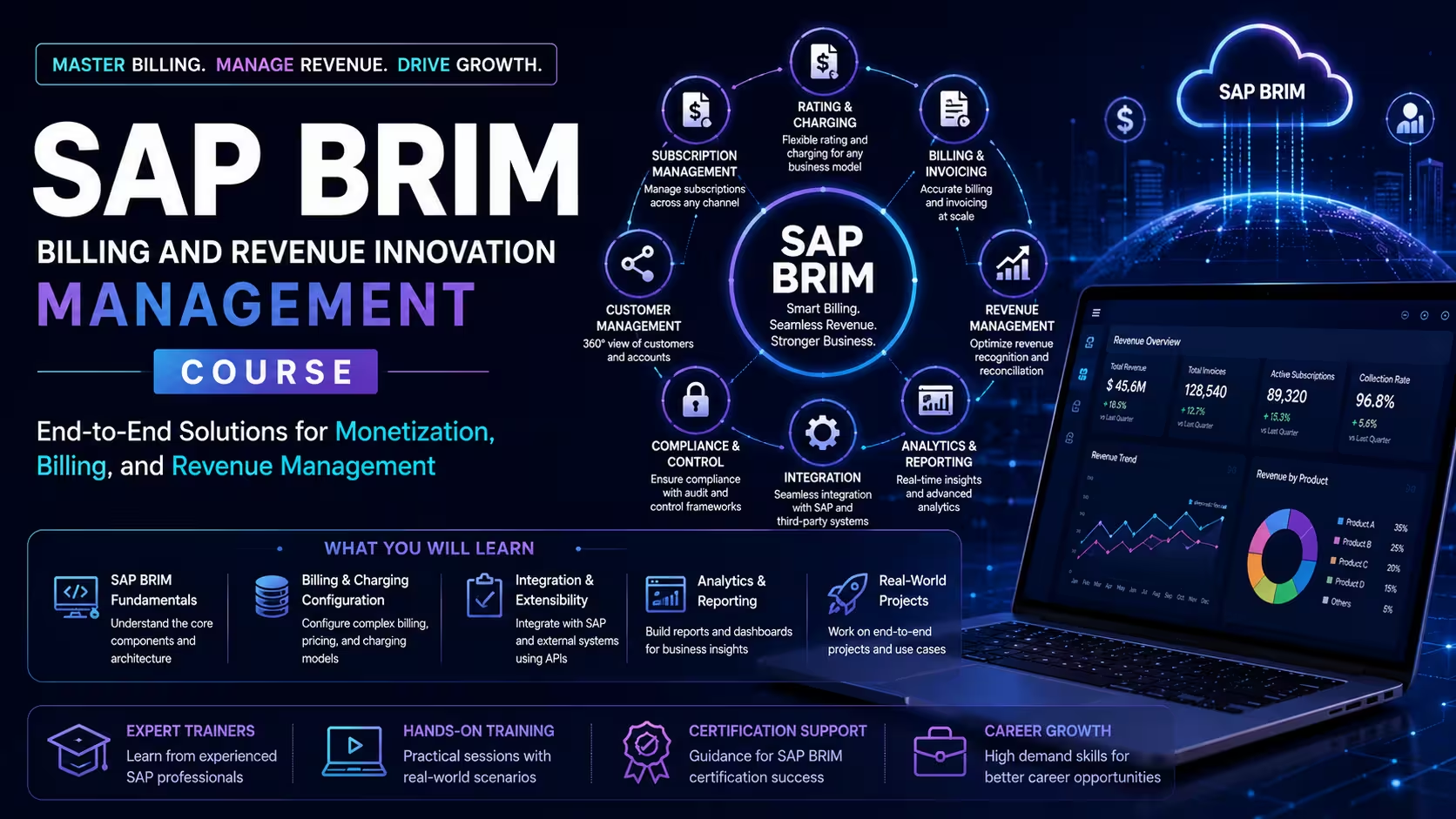
Course Objectives
Q1. What will I learn from SAP BRIM Training?
You will learn how SAP BRIM supports subscription-based, usage-based, and recurring revenue business models. The training covers subscription management, charging, mediation, invoicing, contract accounts, payment processes, and integration with SAP financial systems.
Q2. Will I gain practical experience with SAP BRIM?
Yes. The training includes practical exercises covering subscription orders, product configuration, usage data processing, charging, billing, invoice generation, and FI-CA integration. Learners also work on business scenarios and a real-time implementation project.
Q3. How can SAP BRIM skills support my career?
SAP BRIM skills can help you understand complex billing and revenue processes used by organizations offering digital, subscription, communication, utility, and usage-based services. The knowledge can support career paths in SAP BRIM consulting, billing implementation, functional support, business analysis, and revenue management.
Q4. Is SAP BRIM suitable for beginners?
The course can be suitable for beginners who have an interest in SAP and enterprise business processes. Basic knowledge of ERP concepts, billing, finance, subscriptions, or business process management can be helpful, but the training introduces the major SAP BRIM concepts progressively.
Q5. What practical skills will I gain after completing the course?
You will develop skills in subscription order management, charging, mediation, convergent invoicing, FI-CA processes, billing operations, integration, testing, troubleshooting, and revenue workflows. You will also gain experience understanding an end-to-end BRIM business process through practical exercises and project work.
Popular Techniques Covered in This Course
SAP BRIM Fundamentals
BRIM Architecture
Subscription Management
Product Configuration
Subscription Order Processing
Convergent Charging
Usage-Based Charging
Convergent Mediation
Convergent Invoicing
SAP FI-CA
Contract Account Management
Billing Process Management
BRIM Integration
BRIM Testing
Revenue Process Management
Get Hands-on Knowledge about Real-Time Projects
Project 1
Subscription Billing Management Project
Develop an end-to-end subscription billing workflow covering customer and product setup, subscription orders, recurring charges, billing cycles, invoice generation, payment processing, and financial integration.
Project 2
Usage-Based Charging Project
Create a usage-based charging scenario using SAP BRIM concepts. The project covers usage data, chargeable items, pricing logic, rating, charging plans, simulations, and downstream billing processes.
Project 3
Convergent Mediation & Usage Data Project
Build a practical usage-data processing workflow covering data collection, validation, transformation, enrichment, duplicate handling, error management, and integration with charging processes.
Project 4
Convergent Invoicing & FI-CA Integration Project
Develop a billing and invoicing process that connects billable items with invoice generation and SAP FI-CA processes. The project includes contract accounts, receivables, payments, clearing, and financial posting scenarios.
Project 5
End-to-End SAP BRIM Implementation Project
Work through a complete SAP BRIM business scenario from requirement analysis and solution design to subscription management, charging, mediation, invoicing, FI-CA integration, testing, troubleshooting, and project documentation.
Key Features
Edubrights offers SAP BRIM – Billing and Revenue Innovation Management Training in virtual mode with expert trainers. Here are the key features,
40 Hours Course Duration
100% Job Oriented Training
Industry Expert Faculties
Free Demo Class Available
Completed 500+ Batches
Certification Guidance
Curriculum
Module 1: Introduction to SAP BRIM & Digital Business Models
- Introduction to SAP BRIM
- Evolution of Billing and Revenue Management
- SAP BRIM Business Architecture
- Digital Business Models
- Subscription-Based Business Models
- Usage-Based Services
- Recurring Revenue Models
- SAP BRIM Components Overview
- End-to-End BRIM Business Process
- Industry Use Cases
Module 2: SAP BRIM Architecture & System Landscape
- SAP BRIM Solution Architecture
- Core BRIM Components
- System Landscape
- Component Integration
- Master Data Flow
- Transaction Data Flow
- Business Process Integration
- SAP ERP and SAP S/4HANA Integration
- SAP FI-CA Integration Overview
- BRIM Implementation Considerations
Module 3: Subscription Order Management
- Introduction to Subscription Order Management
- Customer and Contract Data
- Product and Subscription Management
- Subscription Product Configuration
- Order Capture
- Subscription Lifecycle
- Order Processing
- Contract Management
- Change and Cancellation Processes
- Subscription Order Integration
Module 4: SAP Convergent Charging
- Introduction to Convergent Charging
- Charging Architecture
- Charging Plans
- Chargeable Items
- Usage-Based Charging
- Recurring Charges
- One-Time Charges
- Rating Concepts
- Pricing Logic
- Charging Processes
- Simulation and Testing
Module 5: SAP Convergent Mediation
- Introduction to Convergent Mediation
- Usage Data Processing
- Data Collection
- Data Validation
- Data Transformation
- Usage Record Management
- Data Enrichment
- Duplicate Detection
- Error Handling
- Mediation Workflows
- Integration with Charging
Module 6: SAP Convergent Invoicing
- Introduction to Convergent Invoicing
- Billing Process Overview
- Billable Items
- Billing Documents
- Invoice Processing
- Invoice Aggregation
- Billing Cycles
- Invoice Consolidation
- Invoice Corrections
- Credit and Debit Processes
- Invoice Output Management
Module 7: SAP FI-CA & Contract Accounts
- Introduction to SAP FI-CA
- Contract Account Management
- Business Partner Integration
- Receivables Management
- Payment Processing
- Open Item Management
- Clearing Processes
- Dunning Management
- Collections Concepts
- FI-CA Integration with BRIM
- Financial Posting Processes
Module 8: Subscription Billing & Revenue Processes
- Subscription Billing Lifecycle
- Recurring Billing
- Usage-Based Billing
- Rating and Charging Integration
- Billing Data Management
- Invoice Generation
- Payment Processes
- Revenue Recognition Concepts
- Revenue Reporting
- Adjustments and Corrections
- End-to-End Revenue Flow
Module 9: SAP BRIM Integration & Data Exchange
- BRIM Integration Architecture
- API and Interface Concepts
- SAP Integration Technologies
- Master Data Synchronization
- Transaction Data Integration
- Charging Integration
- Invoicing Integration
- FI-CA Integration
- External System Integration
- Error Monitoring
- Integration Testing
Module 10: SAP BRIM Configuration & Testing
- BRIM Configuration Fundamentals
- Product Configuration
- Pricing Configuration
- Charging Configuration
- Billing Configuration
- Invoice Configuration
- Business Process Testing
- Integration Testing
- Test Case Development
- Defect Analysis
- Troubleshooting
Module 11: SAP BRIM Reporting, Monitoring & Operations
- BRIM Operational Monitoring
- Transaction Monitoring
- Billing Monitoring
- Charging Monitoring
- Invoice Monitoring
- Error Management
- Process Logs
- Reconciliation Concepts
- Billing and Revenue Reports
- Operational Support
- Performance Considerations
Module 12: Real-Time SAP BRIM Implementation Project
- Business Requirement Analysis
- BRIM Solution Design
- Product and Subscription Setup
- Charging Configuration
- Usage Data Processing
- Billing Configuration
- Invoice Generation
- FI-CA Integration
- Payment Processing
- End-to-End Testing
- Issue Resolution
- Project Documentation
- Final Business Process Demonstration
Receive Training From Our Skilled and Effective Trainers
About Our Instructors
Experience in the Industry
Learn from experienced SAP BRIM professionals who bring practical knowledge of billing, subscription management, charging, invoicing, revenue processes, and SAP financial integration from real-world enterprise projects.
Backgrounds at the Top
Our SAP BRIM trainers have hands-on experience with Subscription Order Management, SAP Convergent Charging, Convergent Mediation, Convergent Invoicing, SAP FI-CA, contract accounts, payment processing, and end-to-end billing workflows.
Clear & Effective Teaching
Complex SAP BRIM concepts are explained through practical business scenarios, subscription models, usage-based charging examples, billing workflows, invoice processing, and financial integration cases, making the concepts easier to understand and apply.
Hands-On Learning Focus
Students gain practical experience through guided SAP BRIM exercises, subscription and product configuration, charging scenarios, usage-data processing, invoicing workflows, FI-CA activities, integration testing, troubleshooting, and real-world project exercises.
Up-to-Date Knowledge
Our instructors continuously update the SAP BRIM curriculum with current billing practices, subscription business models, charging and invoicing concepts, FI-CA integration approaches, digital revenue processes, implementation practices, and relevant SAP industry developments.
About Our Course Certification*
SAP BRIM – Billing and Revenue Innovation Management training at Edubrights is designed for learners who want to develop practical knowledge of modern billing, subscription management, charging, invoicing, and revenue processes. The course introduces the key SAP BRIM components and explains how they work together to support complex digital and subscription-based business models. Learners gain practical exposure to Subscription Order Management, SAP Convergent Charging, SAP Convergent Mediation, SAP Convergent Invoicing, SAP FI-CA, billing processes, payment management, integration, testing, monitoring, and revenue workflows. Through guided exercises, business scenarios, implementation discussions, and a real-time project, learners understand how customer subscriptions, usage data, charging, billing, invoicing, and financial processes are connected across an SAP BRIM landscape.

Course FAQs
1. What is SAP BRIM, and how does it support digital business models?
SAP Billing and Revenue Innovation Management (BRIM) supports subscription-based, usage-based, and recurring-revenue business models. It connects subscription management, charging, mediation, invoicing, and financial processes in an integrated business workflow.
2. What are the core components of SAP BRIM?
The core components covered in SAP BRIM include Subscription Order Management (SOM), SAP Convergent Charging (CC), SAP Convergent Mediation, SAP Convergent Invoicing (CI), and SAP FI-CA. These components support the flow from customer subscriptions and usage records to billing and financial processing.
3. How does the SAP BRIM end-to-end process work?
The process typically starts with customer and product setup, followed by subscription order processing, usage-data collection, mediation, charging, billable-item creation, invoicing, and financial processing. The exact flow depends on the services offered and the implementation architecture.
4. What is Subscription Order Management (SOM)?
SOM manages subscription orders, product selection, contract creation, and subscription lifecycle activities. It supports changes, renewals, and cancellations that can affect downstream charging and billing.
5. How is customer and contract data managed in SAP BRIM?
Customer and contract data provides the foundation for subscription processing and financial transactions. Correct customer identifiers, contract attributes, product assignments, validity dates, and account relationships help ensure accurate billing.
6. What is subscription product configuration in SAP BRIM?
Subscription product configuration defines the products and services that customers can subscribe to. Product information can be associated with pricing, subscription conditions, charging requirements, and billing processes.
7. What is the subscription lifecycle in SAP BRIM?
The subscription lifecycle can include customer onboarding, subscription creation, activation, modification, suspension, renewal, and cancellation. Each lifecycle event can affect charging, billing, invoicing, and financial processing.
8. How are subscription orders processed in SAP BRIM?
Subscription orders capture customer requirements and the products or services being purchased. The order information is processed and integrated with downstream subscription, charging, billing, and financial processes.
9. How are subscription changes and cancellations handled?
Changes can involve product modifications, quantity changes, pricing updates, or contract-period changes. Cancellation processing ends or modifies the applicable subscription according to configured business rules and effective dates.
10. What is SAP Convergent Charging?
SAP Convergent Charging calculates charges for recurring, one-time, and usage-based services. It supports pricing, rating, charging plans, allowances, and other charging scenarios required for subscription and consumption-based businesses.
11. What is a charging plan in SAP Convergent Charging?
A charging plan defines the logic used to calculate charges for a particular service or product. It can determine how usage or other events are converted into chargeable values.
12. What are chargeable items in SAP BRIM?
Chargeable items represent the results generated from charging processes. They contain information that can subsequently be transferred into downstream billing and invoicing processes.
13. What is rating in SAP BRIM?
Rating determines the monetary or balance impact associated with a usage or business event. It applies configured pricing and charging rules to calculate the appropriate charge.
14. How does usage-based charging work in SAP BRIM?
Usage data is collected and prepared before being processed by the charging system. Convergent Charging applies the relevant pricing and rating logic and produces chargeable results for downstream processing.
15. What is recurring charging in SAP BRIM?
Recurring charging applies charges at predefined intervals for subscription services. The recurring charge can be associated with subscription terms, pricing conditions, billing cycles, and contract periods.
16. What are one-time charges in SAP BRIM?
One-time charges are applied for individual events or services rather than repeatedly over a recurring billing period. Examples can include activation fees, setup charges, or other configured one-time services.
17. What is Convergent Mediation in SAP BRIM?
Convergent Mediation processes usage or consumption data before it reaches charging. It can support data collection, validation, transformation, enrichment, duplicate handling, and error management.
18. How is usage data processed in Convergent Mediation?
Usage records can be collected from source systems and validated before further processing. The mediation process can transform, enrich, aggregate, or prepare usage information for charging.
19. How are duplicate usage records handled?
Duplicate detection helps prevent the same usage event from being processed more than once. Detection rules and error-handling processes should be designed according to the source-data structure and business requirements.
20. How are errors handled during usage-data processing?
Invalid or incomplete usage records can be identified during validation and routed for error handling. Corrective processing can then be performed before the data is passed to downstream charging processes.
21. What is SAP Convergent Invoicing?
SAP Convergent Invoicing manages billable items, billing, invoicing, and related invoice functions in the BRIM process. It can process information from different sources and combine eligible items into invoices.
22. What is a billable item in SAP Convergent Invoicing?
A billable item contains billing-relevant information that can be processed by Convergent Invoicing. Billable items can represent usage-based, recurring, or one-time transactions and can be aggregated during billing.
23. What is the difference between billing and invoicing in SAP BRIM?
Billing processes and aggregates eligible billable items to prepare information for invoicing. Invoicing creates the customer invoice and related financial documents from the billing results.
24. What is invoice aggregation in SAP BRIM?
Invoice aggregation combines eligible billing information according to configured criteria. This allows multiple transactions or services to be represented efficiently in the billing and invoicing process.
25. What is invoice consolidation in SAP BRIM?
Invoice consolidation combines relevant billing information from multiple services, subscriptions, or transactions into a consolidated customer invoice. This can simplify invoice presentation for customers with complex service portfolios.
26. What are billing cycles in SAP BRIM?
Billing cycles define when recurring or eligible billable items are processed for billing. They help establish consistent billing schedules for subscription and recurring-revenue services.
27. How are invoice corrections handled in SAP BRIM?
Invoice corrections are used when previously processed billing or invoice information requires adjustment. Depending on the scenario, correction processing can involve revised billing information, credit documents, debit documents, or other configured processes.
28. What are credit and debit processes in SAP BRIM?
Credit and debit processes adjust customer billing or financial values when corrections or additional charges are required. They help maintain accurate customer balances and billing records.
29. What is SAP FI-CA in the BRIM landscape?
SAP Contract Accounts Receivable and Payable (FI-CA) manages high-volume customer receivables and payables. Within BRIM, it supports contract accounts, open items, payments, clearing, dunning, collections, and financial postings.
30. What is contract account management in SAP FI-CA?
Contract account management organizes financial transactions associated with a business partner and contractual relationship. It provides the foundation for receivables, payments, clearing, dunning, and related financial processes.
31. How does business partner integration work in SAP BRIM?
Business partner information provides customer-related master data used across subscription and financial processes. The business partner can be associated with subscriptions, contract accounts, billing information, and financial transactions.
32. What is open item management in SAP FI-CA?
Open item management tracks outstanding financial transactions that have not yet been cleared. It supports processes such as payment matching, clearing, receivables monitoring, and collections.
33. What is clearing in SAP FI-CA?
Clearing matches payments or credits with the appropriate open receivable items. Successful clearing updates the financial status of customer transactions and helps maintain accurate account balances.
34. What is dunning management in SAP BRIM?
Dunning management supports the process of following up on overdue customer receivables. Configured rules can determine dunning levels, timing, and customer communication requirements.
35. How does payment processing work in SAP BRIM?
Payment processing handles incoming and outgoing payment transactions associated with customer financial accounts. Payment processes can be integrated with FI-CA and other financial components to support automated processing.
36. What is revenue recognition in SAP BRIM?
Revenue recognition determines when and how revenue should be recognized according to applicable accounting requirements. BRIM billing information can integrate with revenue accounting processes for appropriate financial treatment.
37. What is revenue reporting in SAP BRIM?
Revenue reporting provides information about billing and revenue-related transactions for analysis and financial monitoring. Reports can help organizations review revenue flows, billing results, adjustments, and operational performance.
38. How does SAP BRIM integrate with SAP ERP and SAP S/4HANA?
BRIM can exchange master and transaction data with SAP ERP and SAP S/4HANA systems. Integration can connect subscription, charging, billing, invoicing, receivables, and financial processes depending on the implementation architecture.
39. How does SAP BRIM integration architecture work?
The integration architecture defines how data moves between SOM, charging, mediation, invoicing, FI-CA, and external systems. It includes master-data synchronization, transaction-data exchange, interfaces, APIs, monitoring, and error handling.
40. What is master data synchronization in SAP BRIM?
Master data synchronization keeps common business information consistent between connected systems. Depending on the implementation, this may include customer, product, business partner, contract, and other relevant master data.
41. What is transaction data integration in SAP BRIM?
Transaction data integration transfers operational business events between BRIM components and connected systems. Examples include subscription orders, usage records, chargeable items, billing information, invoices, and financial transactions.
42. How is SAP BRIM integration tested?
Integration testing validates whether data and processes move correctly between connected BRIM components and external systems. Test scenarios should cover successful processing, invalid data, error handling, corrections, and end-to-end business flows.
43. What is business process testing in SAP BRIM?
Business process testing validates complete business scenarios rather than individual configuration settings. A test can follow a process from subscription creation through charging, billing, invoicing, payment, and financial posting.
44. How are SAP BRIM configuration errors troubleshot?
Troubleshooting typically involves reviewing configuration settings, master data, transaction data, process logs, and error messages. The affected component should first be identified before analyzing the relevant process or integration flow.
45. What is operational monitoring in SAP BRIM?
Operational monitoring tracks the status and processing of BRIM transactions and business processes. It can help identify failed charging, billing, invoicing, payment, or integration activities.
46. How are billing and charging processes monitored?
Monitoring can involve reviewing transaction statuses, process logs, failed records, and processing results. Regular monitoring helps identify exceptions before they affect downstream billing or financial processes.
47. What are reconciliation concepts in SAP BRIM?
Reconciliation compares related data or financial results between processing stages or systems. It can help identify missing transactions, mismatched amounts, duplicate records, and differences between billing and financial results.
48. How can SAP BRIM performance be improved?
Performance can be improved by reviewing high-volume transaction processing, charging and billing configurations, data volumes, integration flows, scheduled processes, and system resources. Monitoring processing times and bottlenecks helps identify areas requiring optimization.
49. What practical projects are covered in the SAP BRIM training?
The Edubrights course includes projects covering subscription billing management, usage-based charging, Convergent Mediation and usage-data processing, Convergent Invoicing with FI-CA integration, and an end-to-end SAP BRIM implementation. These projects cover product setup, subscription orders, charging, usage processing, billing, invoices, payments, financial integration, testing, troubleshooting, and documentation.
50. What technical skills can learners develop through SAP BRIM training?
Learners can develop skills in Subscription Order Management, product and subscription configuration, Convergent Charging, usage-based charging, Convergent Mediation, Convergent Invoicing, FI-CA, billing, payment processing, integration, testing, monitoring, troubleshooting, and revenue processes. The published curriculum also covers end-to-end BRIM implementation and operational support.
Get Training Quote for Free
Testimonials
Hear What Our Students Say
"Transform your life through Education, hear it from our Alumni"

6 LPA
Fathima
Student
Software Engineer
"Transform your life through Education, hear it from our Alumni"

8 LPA
Rahul
Student
Data Scientist
"Transform your life through Education, hear it from our Alumni"

8 LPA
Siddharth
NIELSON IQ
Data Analyst