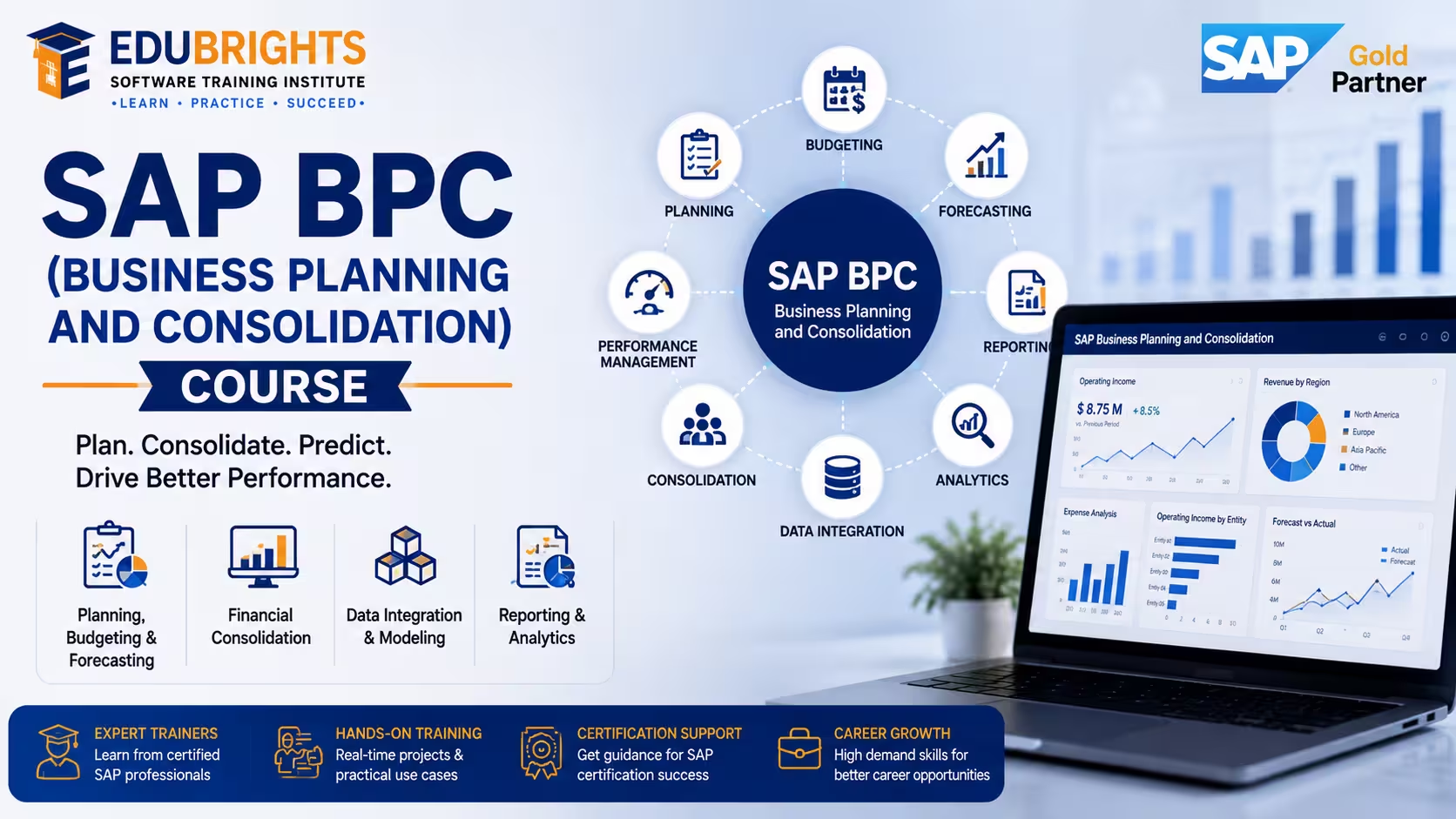
Course Objectives
1. Learn Financial Planning and Budgeting
Understand how organizations create budgets, plan expenses, and manage financial performance using SAP BPC.
2. Gain Practical Knowledge of Forecasting
Learn to build forecasts, analyze business trends, and support better decision-making with accurate financial data.
3. Understand Financial Consolidation
Learn how companies combine financial data from multiple departments or business units into a single report.
4. Work on Real Business Scenarios
Get hands-on experience with SAP BPC tools through practical exercises and real-world business projects.
Popular Techniques Covered in This Course
SAP BPC Fundamentals
Budget Planning
Financial Forecasting
Financial Consolidation
Business Performance Management
Data Modeling
Workflow Management
Business Rules Configuration
SAP BW & SAP Integration
SAP BPC Reporting
Get Hands-on Knowledge about Real-Time Projects
Project 1
Project 1: Annual Budget Planning System
Create a budgeting solution that helps departments prepare and manage yearly financial plans.
Project 2
Project 2: Sales Forecast Dashboard
Build a forecasting dashboard to predict future sales performance and business growth.
Project 3
Project 3: Financial Consolidation Process
Develop a solution to combine financial reports from multiple business units into one consolidated report.
Project 4
Project 4: Expense Tracking and Analysis
Create reports that help management monitor expenses and improve cost control.
Project 5
Project 5: Executive Financial Reporting Dashboard
Design a dashboard that displays KPIs, revenue, expenses, and financial performance in real time.
Key Features
Edubrights offers SAP BPC (Business Planning & Consolidation) in virtual mode with expert trainers. Here are the key features,
40 Hours Course Duration
100% Job Oriented Training
Industry Expert Faculties
Free Demo Class Available
Completed 500+ Batches
Certification Guidance
Curriculum
Module 1: Introduction to SAP BPC
- Overview of SAP Business Planning and Consolidation
- BPC Standard vs. BPC Embedded vs. BPC Optimized
- BPC for planning, budgeting, and financial consolidation
- Integration with BW, SAP ECC, and S/4HANA
- BPC implementation methodology
Module 2: BPC Architecture and Administration
- BPC environments and models
- Dimensions and dimension members
- Application set configuration
- BPC transport and lifecycle management
- User and team security
Module 3: BPC Dimensions and Models
- Standard dimensions: Time, entity, account, category
- Custom dimensions and properties
- Model configuration for planning and consolidation
- Dimension member hierarchies
- Transformation and conversion files
Module 4: Data Loading and Integration
- Data manager packages for loading
- Transformation files and conversion files
- Loading from BW InfoProviders
- Loading from flat files
- Delta loading and scheduling
Module 5: Business Rules for Consolidation
- Intercompany elimination rules
- Currency translation rules
- US elimination and automatic adjustments
- Minority interest calculations
- Ownership management
Module 6: Planning and Budgeting
- Budget model setup
- Planning input schedules
- Driver-based planning
- Allocation and distribution logic
- Top-down and bottom-up planning
Module 7: Script Logic
- BPC script logic syntax
- Default logic and package logic
- SCOPE and REC statements
- Nested logic and conditions
- Performance optimization in script logic
Module 8: BPC for Excel (EPM Add-in)
- EPM add-in for Microsoft Excel
- Report and input form design
- Context and dimension selection
- EPM functions and formulas
- Offline planning mode
Module 9: Web Reporting and Input
- BPC web client
- Web-based input forms
- Approval workflow in BPC
- Commentary management
- Work status and process control
Module 10: Financial Consolidation
- Legal consolidation process
- Consolidation monitor
- Journal entries in BPC
- Equity pickup method
- Consolidation reporting
Module 11: BPC Embedded and Optimized for S/4HANA
- BPC Embedded architecture
- Integration with aFin and S/4HANA Finance
- Optimized BPC for S/4HANA
- Real-time planning with HANA
- Migration from standard BPC
Module 12: Real-Time Projects and Case Studies
- Annual budgeting and rolling forecast
- Group financial consolidation implementation
- End-to-end BPC cycle
- Certification and interview preparation
Receive Training From Our Skilled and Effective Trainers
Learn from Experienced SAP BPC Professionals
Gain practical expertise from experienced SAP Business Planning & Consolidation (SAP BPC) consultants who have successfully delivered enterprise financial planning, budgeting, forecasting, consolidation, and performance management projects for organizations across banking, manufacturing, retail, healthcare, energy, telecommunications, and financial services. Learn real-world implementation methodologies and corporate finance best practices used by global enterprises.
Industry Exposure with Enterprise Financial Planning Projects
Our SAP BPC trainers have hands-on experience implementing SAP BPC Standard, SAP BPC Embedded, and SAP BPC Optimized for SAP S/4HANA solutions for enterprise budgeting, financial forecasting, statutory consolidation, management reporting, intercompany eliminations, currency translation, and group financial reporting. Learn industry best practices adopted by leading consulting firms and multinational organizations.
Simple, Practical & Business-Oriented Teaching Approach
Core SAP BPC concepts are explained through structured lessons, live demonstrations, real financial planning scenarios, budgeting exercises, consolidation workflows, reporting activities, and interactive business case studies. This practical approach enables both beginners and working professionals to confidently understand enterprise planning, financial consolidation, and SAP EPM implementation.
Hands-On Real-Time SAP BPC Projects
Develop job-ready expertise through guided labs and enterprise projects covering Budgeting, Forecasting, Financial Planning, Financial Consolidation, Business Process Flows (BPF), Data Manager, Dimension Modeling, Business Rules, Script Logic, Currency Translation, Intercompany Eliminations, Management Reporting, Variance Analysis, SAP BW Integration, SAP S/4HANA Integration, SAP Analytics Cloud (SAC) Integration, and end-to-end SAP BPC implementation projects.
Updated with the Latest SAP Planning Technologies
Our curriculum is continuously updated with the latest SAP BPC Embedded, SAP BPC Optimized for SAP S/4HANA, SAP Analytics Cloud (SAC) Planning, enterprise performance management innovations, financial planning best practices, group reporting enhancements, cloud-based planning solutions, and modern corporate finance methodologies. This ensures learners develop practical, certification-ready, and industry-relevant SAP BPC skills that are highly valued by global organizations.
About Our Course Certification*
The SAP BPC Professional Certification validates your skills in budgeting, forecasting, financial planning, and consolidation. It proves that you can use SAP BPC to support business reporting and performance management activities. This certification helps you qualify for finance and SAP consulting roles across various industries.

Course FAQs
1. What is SAP BPC?
SAP BPC stands for SAP Business Planning and Consolidation. It is used for financial planning, budgeting, forecasting, consolidation, reporting, and performance management.
2. What are the main capabilities of SAP BPC?
SAP BPC supports budgeting, financial planning, forecasting, consolidation, reporting, workflow management, and business performance management. It can also integrate with SAP BW and SAP S/4HANA environments.
3. What is SAP BPC Standard?
SAP BPC Standard is a planning and consolidation configuration that uses BPC-specific models, dimensions, business rules, and logic. It supports processes such as budgeting, forecasting, financial planning, and consolidation. SAP documentation distinguishes Standard and Embedded configurations in BPC 10.1.
4. What is SAP BPC Embedded?
SAP BPC Embedded is deeply integrated with SAP BW planning capabilities. It can use BW InfoProviders, aggregation levels, and planning functions for planning and consolidation scenarios.
5. What is SAP BPC Optimized for S/4HANA?
BPC Optimized is designed for planning scenarios closely integrated with SAP S/4HANA and SAP HANA. It supports planning processes that can take advantage of the underlying HANA-based architecture.
6. What is SAP BPC architecture?
SAP BPC architecture consists of components for planning, consolidation, data modeling, data integration, business rules, reporting, workflows, and administration. The exact architecture varies depending on whether Standard, Embedded, or an optimized configuration is used.
7. What are BPC environments?
An environment is a logical container used to organize BPC models, dimensions, applications, and related configuration. It provides a framework for managing planning and consolidation solutions.
8. What are BPC models?
BPC models define the structures used to store and process planning or consolidation data. In Standard BPC, models can be designed for purposes such as financial reporting, consolidation, or other planning requirements.
9. What are dimensions in SAP BPC?
Dimensions represent the business perspectives used to organize planning and consolidation data. Common dimensions include Account, Entity, Time, Category, and additional custom dimensions.
10. What is the Account dimension?
The Account dimension represents financial measures such as revenue, expenses, assets, liabilities, and profit. Its members can be organized into hierarchies for planning and financial reporting.
11. What is the Entity dimension?
The Entity dimension represents organizational units such as companies, subsidiaries, departments, or business units. It is particularly important in financial consolidation because entities may participate in group reporting structures.
12. What is the Time dimension in SAP BPC?
The Time dimension represents periods such as years, quarters, months, or other configured time members. It allows planning and reporting data to be analyzed across different financial periods.
13. What is the Category dimension?
The Category dimension can represent different planning or reporting scenarios, such as Actual, Budget, Forecast, or other business-defined versions. It helps separate different versions of financial data.
14. What are custom dimensions in SAP BPC?
Custom dimensions represent business-specific characteristics that are not covered by standard dimensions. Examples may include product, region, department, channel, or project.
15. What are dimension members?
Dimension members are individual values within a dimension. For example, a Region dimension could contain members such as North, South, East, and West.
16. What are dimension hierarchies?
Dimension hierarchies organize members into parent-child relationships. They allow users to analyze information at different levels, such as company, region, department, and business unit.
17. What are dimension properties?
Dimension properties provide additional attributes or metadata for dimension members. These properties can support reporting, calculations, transformations, and business rules.
18. What are transformation files in SAP BPC?
Transformation files define mappings and transformation rules used when loading data into BPC. They help convert source-system structures into the dimensions and members required by the BPC model.
19. What are conversion files in SAP BPC?
Conversion files map source values to corresponding BPC dimension members. They are useful when source-system codes or descriptions do not directly match the values maintained in BPC.
20. What is Data Manager in SAP BPC?
Data Manager is used to load, export, transform, and manage data within BPC processes. It works with packages and transformation/conversion logic to support controlled data movement.
21. What are Data Manager packages?
Data Manager packages define tasks or processes for activities such as data loading, exporting, transformation, and other data-management operations. They can be used to standardize recurring data processes.
22. How can data be loaded into SAP BPC?
Data can be loaded from sources such as BW InfoProviders and flat files, depending on the BPC configuration. Transformation and conversion logic can be applied during the loading process. The Edubrights curriculum specifically covers BW InfoProvider loading, flat-file loading, delta loading, and scheduling.
23. What is delta loading in SAP BPC?
Delta loading transfers only newly changed or incremental data instead of repeatedly loading the complete dataset. This can reduce processing requirements for recurring data-load processes.
24. What is data integration between SAP BPC and SAP BW?
SAP BPC can use SAP BW data structures and capabilities, particularly in Embedded scenarios. BW InfoProviders can provide data for BPC planning and consolidation models.
25. What is business rule configuration in SAP BPC?
Business rules define automated calculations and processes used in planning and consolidation. They can support functions such as currency translation, intercompany elimination, ownership calculations, and adjustments.
26. What are intercompany elimination rules?
Intercompany elimination rules remove qualifying transactions or balances between entities within the same corporate group. They help prevent double counting when consolidated financial statements are prepared.
27. What is currency translation in SAP BPC?
Currency translation converts financial values from one currency to another according to configured exchange-rate and business rules. It is important when entities report in different currencies and consolidated reporting requires a common currency.
28. What is minority interest calculation?
Minority interest calculations determine the portion of an entity's results or equity that belongs to shareholders outside the controlling group. These calculations can form part of group consolidation processes.
29. What is ownership management in SAP BPC?
Ownership management maintains information about relationships between entities and their ownership structures. It can support consolidation calculations involving ownership percentages and control relationships.
30. What is financial consolidation in SAP BPC?
Financial consolidation combines financial information from multiple entities into consolidated group-level results. SAP BPC supports activities such as currency translation, intercompany eliminations, adjustments, journals, and consolidation reporting.
31. What is the Consolidation Monitor?
The Consolidation Monitor helps users execute and monitor consolidation activities. It provides visibility into the status of consolidation processes and collected data.
32. What are journal entries in SAP BPC?
Journal entries allow users to record adjustments to planning or consolidation data. In consolidation scenarios, journals can be used to correct or adjust collected and consolidated financial information.
33. What is planning in SAP BPC?
Planning in BPC involves entering, calculating, analyzing, and managing financial or operational plans. It can include budgets, forecasts, targets, allocations, and scenario-based planning.
34. What is driver-based planning?
Driver-based planning uses business drivers to calculate planning values. For example, revenue planning may use drivers such as volume, price, headcount, or growth assumptions.
35. What is top-down planning?
Top-down planning begins with targets defined at higher organizational levels and distributes those values to lower-level members. BPC supports disaggregation approaches for distributing target values to base levels in applicable configurations.
36. What is bottom-up planning?
Bottom-up planning collects planning inputs from lower organizational levels and aggregates them to higher-level totals. It is commonly used when departments or business units create their own detailed budgets.
37. What is allocation and distribution logic?
Allocation logic distributes values from one level or set of members to other members according to defined rules. Distribution can use factors, percentages, drivers, or other business-specific calculations.
38. What is BPC Script Logic?
BPC Script Logic is used to implement customized calculation and data-processing logic in applicable BPC Standard scenarios. It can support conditional calculations, data transformations, allocations, and other planning requirements.
39. What are SCOPE and REC statements in BPC Script Logic?
SCOPE is used to define the data region on which logic should operate, while REC statements are used for recording or calculating data within the defined scope. Correct use of these statements is important for controlled script execution.
40. What is default logic in SAP BPC?
Default logic defines calculations or processing that can occur automatically when planning data is entered or processed. It can help automate recurring business calculations.
41. What is the EPM Add-in for SAP BPC?
The EPM Add-in provides an Excel-based interface for interacting with supported SAP planning and reporting data. The Edubrights curriculum covers report design, input forms, dimension selection, EPM functions, formulas, and offline planning.
42. What are BPC input forms?
BPC input forms provide structured layouts through which users can enter or modify planning data. They can be designed around dimensions, measures, periods, and business requirements.
43. What is the BPC web client?
The BPC web client provides browser-based access to planning, reporting, administration, and related BPC functionality. The available features depend on the BPC configuration and application scenario.
44. What is approval workflow in SAP BPC?
Approval workflow controls how planning data or business processes move through defined review and approval stages. It can help organizations establish structured processes for submitting, reviewing, and approving planning information.
45. What is work status in SAP BPC?
Work status controls the state of data within a planning process. It can be used to restrict or manage changes as information moves through different stages of review and approval.
46. What is process control in SAP BPC?
Process control provides mechanisms for managing the status and progression of business planning activities. It helps organizations coordinate planning tasks and maintain controlled workflows.
47. How does SAP BPC integrate with SAP S/4HANA?
SAP BPC can integrate with SAP S/4HANA in supported planning and consolidation architectures. The Edubrights curriculum covers BPC Embedded, BPC Optimized for S/4HANA, S/4HANA Finance integration, HANA-based real-time planning, and migration from Standard BPC.
48. What is real-time planning with SAP HANA?
Real-time planning uses HANA's in-memory processing capabilities to support faster access to planning data and calculations in suitable SAP architectures. BPC Embedded planning can leverage BW planning capabilities and HANA-optimized scenarios.
49. What practical projects can be covered in SAP BPC training in Chennai?
The Edubrights course lists projects covering annual budget planning, sales forecasting, financial consolidation, expense tracking and analysis, and executive financial reporting dashboards. The curriculum also includes end-to-end BPC cycles and group financial consolidation case studies.
50. What technical skills can I gain from SAP BPC training in Chennai?
You can develop skills in BPC architecture, dimensions and models, Data Manager, data loading, transformation and conversion files, consolidation rules, planning and budgeting, Script Logic, EPM Add-in, workflows, financial consolidation, BW integration, S/4HANA integration, and BPC reporting. These areas closely follow the technical curriculum published on the Edubrights SAP BPC course page.
Get Training Quote for Free
Testimonials
Hear What our Students say
"Transform your life through Education, hear it from our Alumni"

6 LPA
Fathima
Student
Software Engineer
"Transform your life through Education, hear it from our Alumni"

8 LPA
Rahul
Student
Data Scientist
"Transform your life through Education, hear it from our Alumni"

8 LPA
Siddharth
NIELSON IQ
Data Analyst