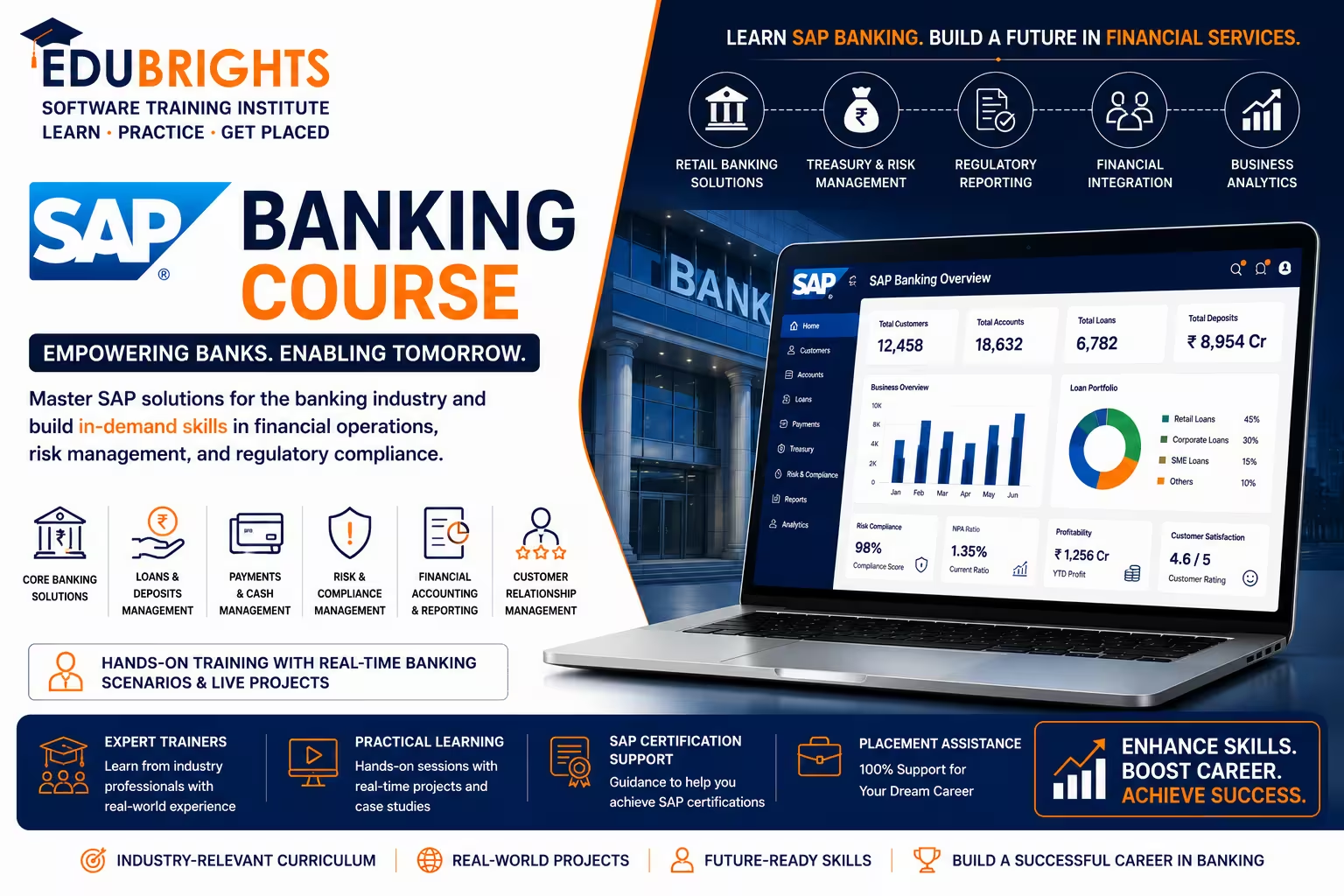
Course Objectives
1. Understand SAP Banking Solutions and Financial Services
Learn how SAP Banking supports core banking operations, lending, deposits, payments, treasury, risk management, and customer services.
2. Master Banking Business Processes
Gain expertise in retail banking, corporate banking, account management, loan processing, transaction management, and regulatory compliance.
3. Configure and Manage SAP Banking Applications
Develop practical skills in SAP Banking modules, integration, data management, workflow configuration, and financial operations.
4. Prepare for Real-World Banking Implementations
Work on industry-focused projects involving banking operations, digital transformation, customer management, and financial services automation.
Popular Techniques Covered in This Course
SAP Banking Fundamentals
Core Banking Operations Management
Loan and Deposit Management
Banking Product Configuration
Payment Processing Systems
Financial Risk Management
Regulatory Compliance and Reporting
Customer Account Management
SAP Banking Integration
Financial Services Process Automation
Get Hands-on Knowledge about Real-Time Projects
Project 1
Project 1: Retail Banking Management System
Implement SAP Banking solutions to manage customer accounts, deposits, transactions, and banking services efficiently.
Project 2
Project 2: Loan Processing and Approval Workflow
Design and configure an automated loan origination and approval system with credit assessment and compliance validation.
Project 3
Project 3: Banking Payment Processing Platform
Develop a payment processing solution for domestic and international transactions with real-time monitoring and reconciliation.
Project 4
Project 4: Customer Relationship and Account Management
Create a centralized customer information management system to improve customer service and account administration.
Project 5
Project 5: Regulatory Reporting and Compliance Solution
Implement automated compliance reporting processes to meet banking regulations and financial reporting requirements.
Key Features
Edubrights offers SAP Banking in virtual mode with expert trainers. Here are the key features,
40 Hours Course Duration
100% Job Oriented Training
Industry Expert Faculties
Free Demo Class Available
Completed 500+ Batches
Certification Guidance
Curriculum
Module 1: Introduction to SAP Banking
- Overview of SAP for Banking industry
- SAP Banking components: SAP Bank Analyzer, FSCM, BCM
- SAP Banking integration with FI, CO, and TR
- Banking industry challenges and SAP solutions
- SAP Banking implementation methodology
Module 2: SAP Bank Analyzer
- Bank Analyzer architecture
- Source data layer and results data layer
- Financial instruments management
- Risk and finance integration
- Accounting derivation engine
Module 3: Loans Management
- Loan origination and processing
- Loan disbursement and repayment
- Amortization schedule management
- Variable rate loans
- Non-performing loan management
Module 4: Deposits Management
- Deposit product configuration
- Current and savings account management
- Fixed deposit and term deposits
- Interest calculation and posting
- Account statement generation
Module 5: Treasury Management in Banking
- Money market instruments
- Foreign exchange transactions
- Derivatives management
- Position management
- Integration with SAP Market Risk
Module 6: Risk Management for Banks
- Credit risk management
- Market risk and VaR calculation
- Liquidity risk monitoring
- Regulatory capital calculation (Basel III)
- Stress testing scenarios
Module 7: Regulatory Reporting
- FINREP and COREP reporting
- Basel III/IV compliance
- IFRS 9 expected credit loss
- AnaCredit reporting
- Integration with regulatory reporting engines
Module 8: Payment Processing
- SAP Payment Engine
- SEPA and SWIFT payment processing
- Real-time payment (ISO 20022)
- Anti-money laundering (AML) checks
- Payment fraud detection
Module 9: SAP FSCM for Banking
- Collections management for banking
- Dispute management
- Credit management for corporate clients
- Electronic bank statement processing
- Biller direct for payment portals
Module 10: Banking Analytics
- Profitability analytics by product and customer
- Risk exposure dashboards
- Regulatory analytics
- Customer lifetime value analysis
- SAC integration for banking KPIs
Module 11: Digital Banking and Open Banking
- API banking and open banking (PSD2)
- SAP BTP for banking innovations
- Mobile banking integration
- AI-driven credit scoring
- Digital onboarding for banking customers
Module 12: Real-Time Projects and Case Studies
- Retail bank SAP implementation
- Risk and regulatory reporting rollout
- End-to-end SAP Banking cycle
- Certification and interview preparation
Receive Training From Our Skilled and Effective Trainers
Learn from Experienced SAP Banking Consultants
Gain practical expertise from experienced SAP Banking consultants who have successfully delivered enterprise SAP Banking, SAP for Banking, core banking, digital banking, payments, lending, treasury, risk management, regulatory compliance, and financial transformation projects across retail banking, corporate banking, investment banking, financial institutions, and global banking organizations. Their real-world implementation experience brings valuable industry knowledge into every SAP Banking training session.
Industry Exposure with Enterprise Banking & Financial Services Projects
Our SAP Banking trainers have worked on real-world implementations across commercial banks, private banks, financial institutions, insurance companies, fintech organizations, and multinational consulting firms. Learn industry best practices in Core Banking, Loans Management, Deposits Management, Payments Processing, Treasury Operations, Risk Management, Regulatory Reporting, Financial Accounting, Customer Account Management, and end-to-end banking operations using SAP solutions.
Simple, Practical & Business-Oriented Teaching Approach
Core SAP Banking concepts are taught through structured lessons, live demonstrations, banking workflows, customer lifecycle scenarios, lending processes, treasury operations, payment processing, financial reporting, compliance management, and interactive business case studies. This practical approach enables both beginners and working professionals to confidently understand enterprise banking operations and SAP Banking implementation.
Hands-On Real-Time SAP Banking Projects
Develop job-ready expertise through guided labs, practical assignments, and enterprise projects covering SAP Banking configuration, customer onboarding, account management, loan processing, deposit management, payment processing, treasury management, risk assessment, Basel compliance, IFRS reporting, regulatory reporting, SAP Bank Analyzer, analytics, dashboards, and end-to-end SAP Banking implementation projects.
Updated with the Latest SAP Banking Technologies
Our curriculum is continuously updated with the latest SAP Banking, SAP Bank Analyzer, SAP S/4HANA Finance, digital banking innovations, Basel III and Basel IV compliance, IFRS 9, AI-powered financial analytics, open banking, cloud banking technologies, regulatory reporting standards, and enterprise best practices. This ensures learners develop practical, certification-ready, and industry-relevant SAP Banking skills that are highly valued by banks, financial institutions, and consulting organizations worldwide.
You will succeed with our recognized certification
The Certified SAP Banking Solutions Professional certification validates expertise in banking operations, financial services management, payment processing, loan administration, and regulatory compliance using SAP solutions. It demonstrates the ability to implement and manage SAP Banking applications that support modern banking institutions. This certification enhances career opportunities in banking technology, financial consulting, and enterprise banking operations.

Course FAQs
1. What is SAP Banking?
SAP Banking is a collection of SAP capabilities designed to support banking and financial-services processes. It can cover areas such as customer accounts, deposits, loans, payments, treasury, risk management, regulatory reporting, analytics, and digital banking.
2. What are the main components covered in SAP Banking?
The SAP Banking curriculum covers areas including SAP Bank Analyzer, FSCM, Banking Customer Account Management, Loans Management, Deposits Management, Treasury Management, Risk Management, Payment Processing, Banking Analytics, and Digital Banking. These components support transactional, financial, risk, compliance, and customer-related banking processes.
3. What is SAP Bank Analyzer?
SAP Bank Analyzer provides capabilities for processing and analyzing financial information used by banks. It can support financial instruments, accounting-related processes, risk integration, source data processing, and results analysis.
4. What is the architecture of SAP Bank Analyzer?
SAP Bank Analyzer uses structured processing and data layers to manage banking information and generate financial results. The Edubrights curriculum covers the Source Data Layer, Results Data Layer, financial instruments management, risk and finance integration, and Accounting Derivation Engine.
5. What is the Source Data Layer in SAP Bank Analyzer?
The Source Data Layer provides source information required for banking analysis and financial processing. It forms part of the architecture through which relevant banking data is prepared for subsequent calculations and result generation.
6. What is the Results Data Layer in SAP Bank Analyzer?
The Results Data Layer contains processed results generated from banking calculations and analytical processes. These results can be used for financial analysis, reporting, risk-related processing, and downstream banking activities.
7. What is the Accounting Derivation Engine in SAP Bank Analyzer?
The Accounting Derivation Engine determines accounting-relevant information from financial transactions and instruments using configured rules. It helps connect banking transactions with accounting requirements and financial reporting processes.
8. What is Bank Customer Accounts (BCA) in SAP Banking?
Bank Customer Accounts (BCA) supports current-account and account-management processes in SAP Banking. SAP documentation describes account creation around products, account master data, account holders, business partners, and related account-management functions.
9. What is customer account management in SAP Banking?
Customer account management handles account master data, account holders, transactions, balances, and related account activities. It can support account lifecycle processes and integration with other banking and financial functions.
10. What is deposit management in SAP Banking?
Deposit Management supports the creation and administration of deposits and current accounts throughout their lifecycle. SAP documentation includes contract management, business partners, conditions, interest and charge calculation, incoming payments, settlement, and bank statements.
11. What types of deposit products can SAP Banking support?
SAP Banking can support deposit scenarios such as current accounts, savings accounts, fixed deposits, and term deposits, depending on the implemented solution and configuration. Product definitions determine applicable conditions, interest rules, charges, and operational processes.
12. What is deposit product configuration?
Deposit product configuration defines the characteristics and business rules of a deposit product. These rules can include contract conditions, interest calculation, charges, payment processing, settlement, and account lifecycle activities.
13. How is interest calculated for deposits?
Interest calculation uses configured financial conditions associated with the relevant product or contract. SAP financial conditions can represent standard or individual conditions and serve as a basis for calculating interest and charges.
14. What is account statement generation in SAP Banking?
Account statement generation provides transaction and balance information for banking accounts. Deposit-processing capabilities can include periodic settlement and bank statement processing as part of the account lifecycle.
15. What is SAP Loans Management?
SAP Loans Management supports the management of different types of loans throughout their servicing lifecycle. SAP documentation includes loan account creation, conditioning, disbursement, repayment, billing, payment processing, payoff, and account closure.
16. What is loan origination in SAP Banking?
Loan origination covers the processes involved in creating and initiating a loan for a customer. It can include customer information, product selection, credit assessment, approval, account creation, and preparation for disbursement.
17. What is loan disbursement?
Loan disbursement is the process of releasing approved loan funds to the borrower or designated recipient. SAP Loans Management includes disbursement as one of the operations in the loan servicing lifecycle.
18. What is an amortization schedule?
An amortization schedule defines how principal, interest, and repayments are distributed over scheduled payment periods. SAP Banking implementations can use configured loan conditions and calculation rules to support different repayment structures.
19. How are variable-rate loans managed?
Variable-rate loans use financial conditions that can change based on configured rules or reference rates. SAP loan processing can apply loan-specific conditioning and calculation rules to support changing interest conditions.
20. What is non-performing loan management?
Non-performing loan management deals with loans where repayment performance has deteriorated according to defined banking criteria. Processes can involve monitoring, overdue-item management, collections, provisioning, and risk analysis.
21. What is Treasury Management in SAP Banking?
Treasury Management supports financial-market, liquidity, and treasury-related banking processes. The Edubrights curriculum covers money market instruments, foreign exchange transactions, derivatives management, position management, and integration with SAP Market Risk.
22. What are money market instruments?
Money market instruments are short-term financial instruments used for liquidity, funding, and investment activities. Treasury systems can support transaction processing, valuation, position management, settlement, and related accounting activities.
23. What is foreign exchange transaction management?
Foreign exchange transaction management handles financial transactions involving different currencies. It can include trade capture, currency positions, valuation, settlement, and integration with financial risk processes.
24. What is derivatives management in SAP Banking?
Derivatives management involves financial contracts whose values depend on underlying assets, rates, currencies, or other variables. SAP Treasury capabilities can support transaction processing, valuation, position management, accounting, and risk integration.
25. What is position management?
Position management tracks financial positions generated by treasury transactions and financial instruments. It provides information about holdings, exposures, balances, and market-related positions for further analysis and risk processing.
26. What is banking risk management?
Banking risk management involves identifying, measuring, monitoring, and managing financial risks. The Edubrights curriculum covers credit risk, market risk, Value at Risk, liquidity risk, regulatory capital, and stress testing.
27. What is credit risk management in SAP Banking?
Credit risk management evaluates potential losses resulting from customers or counterparties failing to meet financial obligations. Banking systems can use customer, exposure, collateral, transaction, and repayment information to support credit-risk processes.
28. What is Value at Risk (VaR)?
Value at Risk (VaR) is a quantitative measure used to estimate potential losses for a defined portfolio, confidence level, and time horizon. It can be used as part of market-risk measurement and monitoring.
29. What is liquidity risk monitoring?
Liquidity risk monitoring evaluates whether a financial institution can meet its financial obligations when they become due. Treasury and banking analytics can be used to monitor cash positions, funding requirements, liquidity gaps, and related exposures.
30. What is Basel III/IV compliance in SAP Banking?
Basel III/IV refers to international banking regulatory frameworks covering areas such as capital, risk, and regulatory reporting. SAP Banking implementations can support the calculation, analysis, and reporting of relevant regulatory information according to the applicable requirements.
31. What is stress testing in banking risk management?
Stress testing evaluates the potential effect of defined adverse scenarios on financial positions or portfolios. Banks can use stress scenarios to assess potential effects on credit risk, market risk, liquidity, capital, and other financial measures.
32. What is regulatory reporting in SAP Banking?
Regulatory reporting involves preparing financial and risk information required by banking regulators. The Edubrights curriculum includes FINREP, COREP, Basel III/IV, IFRS 9 expected credit loss, AnaCredit, and regulatory reporting engine integration.
33. What are FINREP and COREP?
FINREP is associated with financial reporting, while COREP covers regulatory reporting related to prudential and capital requirements within the applicable framework. SAP Banking implementations can prepare and process the required data for supported regulatory reporting scenarios.
34. What is IFRS 9 expected credit loss (ECL)?
IFRS 9 expected credit loss is an accounting approach for recognizing expected credit losses on applicable financial assets. Banking systems can use exposure, financial instrument, risk, and calculation data to support ECL-related processing and reporting.
35. What is AnaCredit reporting?
AnaCredit is a European Central Bank framework for collecting detailed credit and credit-risk information. SAP Banking implementations can support the preparation and processing of relevant data for applicable regulatory reporting requirements.
36. What is SAP Payment Engine?
SAP Payment Engine supports payment-related processing in banking scenarios. It can be used for payment and collection processes and can integrate with other banking components for external and internal payment processing. SAP documentation also describes Payment Engine integration as an option for loans and deposits scenarios.
37. What is ISO 20022 in banking payments?
ISO 20022 is an international standard for structuring financial messages. SAP payment processes can use applicable ISO 20022 message formats to support standardized payment information exchange.
38. What are SEPA and SWIFT payment processes?
SEPA supports standardized euro payment transactions within the applicable European payment framework, while SWIFT provides financial messaging infrastructure used by financial institutions. SAP Banking payment processes can be configured for relevant payment and messaging requirements.
39. How are anti-money laundering (AML) checks used in payment processing?
AML checks help identify transactions or customer activities that may require investigation under applicable anti-money-laundering controls. Payment workflows can incorporate validation and monitoring steps to support compliance processes.
40. What is payment fraud detection?
Payment fraud detection involves identifying unusual or potentially fraudulent payment activity using rules, analytics, risk indicators, or external detection mechanisms. It can be incorporated into payment-processing and transaction-monitoring workflows.
41. What is SAP FSCM in banking?
SAP Financial Supply Chain Management (FSCM) provides capabilities for financial processes such as collections, dispute management, credit management, and payment-related activities. The Edubrights curriculum covers collections, disputes, corporate credit management, electronic bank statements, and Biller Direct.
42. What is collections management for banking?
Collections management supports the monitoring and handling of outstanding financial obligations. It can help organizations manage collection activities, customer interactions, payment status, and follow-up processes.
43. What is dispute management in SAP FSCM?
Dispute management provides structured processes for recording, investigating, and resolving financial disputes. It can connect dispute cases with relevant customer, transaction, and accounting information.
44. What is electronic bank statement processing?
Electronic bank statement processing brings bank transaction information into SAP for reconciliation and accounting activities. SAP also provides bank subaccount functionality to help reconcile bank balances with corresponding G/L accounts when statements are received.
45. What is banking analytics?
Banking analytics uses customer, transaction, financial, risk, and operational data to generate business insights. The Edubrights curriculum includes product and customer profitability, risk exposure dashboards, regulatory analytics, customer lifetime value, and SAP Analytics Cloud integration.
46. How can SAP Analytics Cloud support banking KPIs?
Banking analytics uses customer, transaction, financial, risk, and operational data to generate business insights. The Edubrights curriculum includes product and customer profitability, risk exposure dashboards, regulatory analytics, customer lifetime value, and SAP Analytics Cloud integration.
47. What is digital banking in SAP?
Digital banking involves delivering banking services through digital channels and connected enterprise systems. The Chennai curriculum covers API banking, open banking, PSD2, SAP BTP, mobile banking integration, AI-driven credit scoring, and digital onboarding.
48. What is open banking and API banking?
Open banking enables authorized financial data or services to be accessed through defined interfaces and consent-based processes. API banking uses application programming interfaces to connect banking services with applications, digital channels, partners, and other systems.
49. What practical projects can be covered in SAP Banking training in Chennai?
The Edubrights course lists projects such as Retail Banking Management System, Loan Processing and Approval Workflow, Banking Payment Processing Platform, Customer Relationship and Account Management, and Regulatory Reporting and Compliance Solution. These projects cover customer accounts, lending, payments, customer information, compliance, and banking workflows.
50. What technical skills can I gain from SAP Banking training in Chennai?
SAP Banking training can help develop skills in SAP Bank Analyzer, customer account management, deposits, loans, loan servicing, treasury, foreign exchange, derivatives, banking risk management, Basel reporting, IFRS 9, regulatory reporting, payment processing, ISO 20022, SAP FSCM, banking analytics, SAP Analytics Cloud, digital banking, APIs, open banking, and SAP BTP integration. These areas align with the technical curriculum published on the Edubrights SAP Banking course page.
Get Training Quote for Free
Testimonials
Hear What our Students say
"Transform your life through Education, hear it from our Alumni"

8 LPA
Rahul
Student
Data Scientist
"Transform your life through Education, hear it from our Alumni"

6 LPA
Fathima
Student
Software Engineer
"Transform your life through Education, hear it from our Alumni"

8 LPA
Siddharth
NIELSON IQ
Data Analyst