Course Objectives
1. What will you learn in the Hardware Design – Digital Electronics & PCB course?
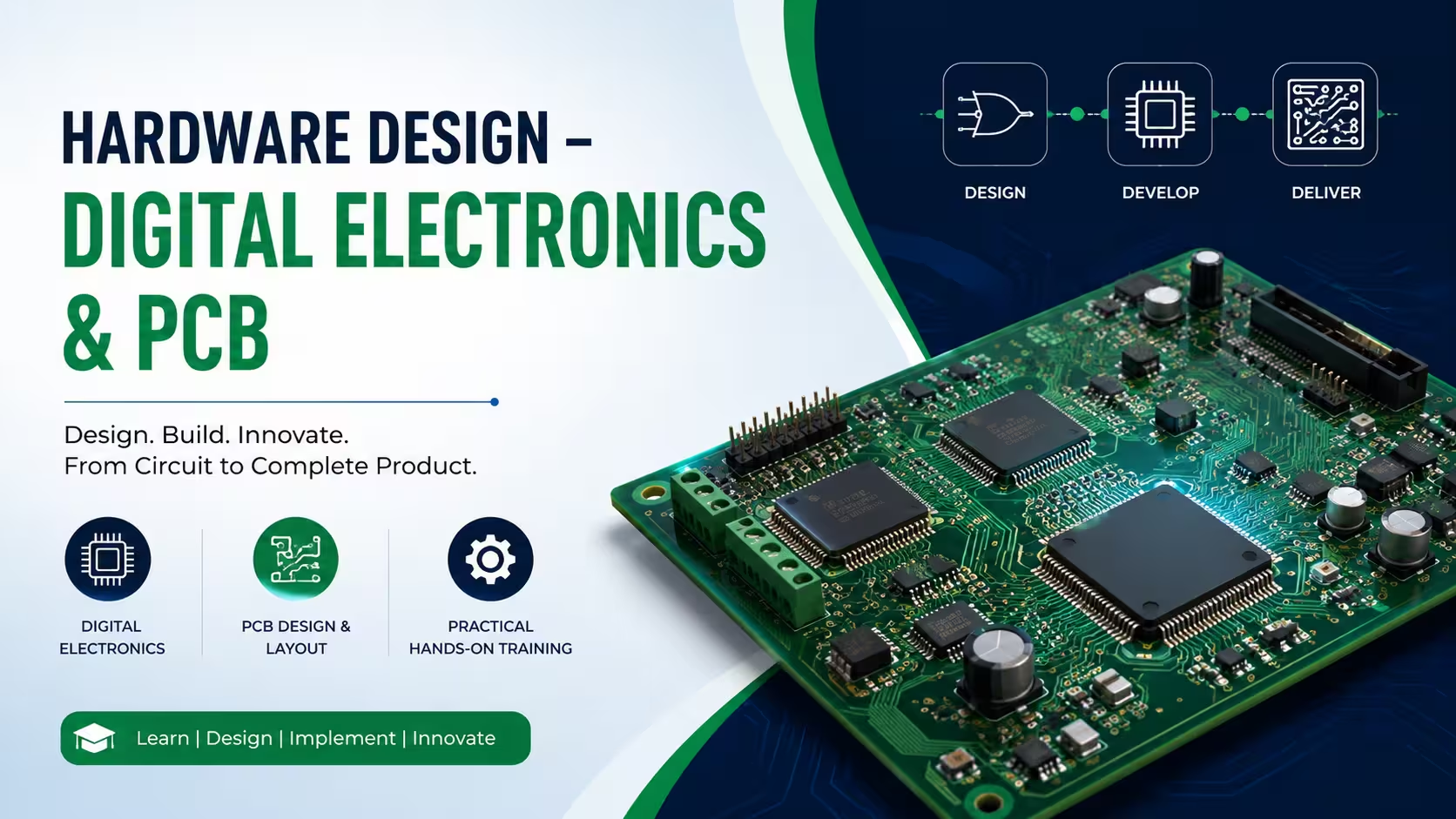
You will learn how to design, simulate, and develop electronic hardware systems using digital electronics principles and PCB design tools. The course covers digital logic, electronic components, schematic design, PCB layout, circuit simulation, microcontroller interfacing, signal integrity, testing, and manufacturing fundamentals.
2. How does this course prepare you for real-world hardware design projects?
The course provides hands-on experience in designing electronic circuits, creating PCB layouts, selecting components, performing simulations, debugging hardware, and preparing manufacturing-ready PCB designs used in consumer electronics, automotive, IoT, industrial automation, and embedded systems.
3. What practical skills will you develop during the training?
You will gain expertise in digital electronics, logic gates, combinational and sequential circuits, schematic capture, PCB layout, multilayer board design, component placement, routing, design rule checks (DRC), circuit simulation, soldering basics, and hardware testing.
4. How will real-time projects improve your hardware design skills?
You will work on practical projects involving embedded system boards, power supply circuits, IoT controller boards, sensor interface circuits, digital control systems, and custom PCB development to gain real-world engineering experience.
5. What career opportunities can you pursue after learning Hardware Design – Digital Electronics & PCB?
This course prepares you for roles such as Hardware Design Engineer, PCB Design Engineer, Electronics Design Engineer, Embedded Hardware Engineer, R&D Engineer, Product Design Engineer, Electronics Testing Engineer, and PCB Layout Engineer.
Popular Techniques Covered in This Course
Digital Electronics Fundamentals
Logic Gates, Flip-Flops, Counters, and Registers
Electronic Components and Circuit Design
Schematic Capture and Circuit Simulation
PCB Layout Design and Routing
Hardware Design Best Practices and Documentation
Multilayer PCB Design and Design Rule Checks (DRC)
Signal Integrity and Power Distribution
Microcontroller and Embedded Hardware Interfacing
PCB Manufacturing, Assembly, and Testing
Get Hands-on Knowledge about Real-Time Projects
Project 1
Project 1: Digital Counter PCB Design
Design a digital counter circuit, create the schematic, simulate the design, and develop a PCB layout ready for manufacturing.
Project 2
Project 2: IoT Sensor Interface Board
Develop a PCB for an IoT-based sensor monitoring system with microcontroller integration and communication interfaces.
Project 3
Project 3: Regulated Power Supply Circuit
Design and test a regulated power supply PCB with voltage regulation, protection circuits, and PCB routing.
Project 4
Project 4: Embedded Controller Development Board
Create a custom embedded controller board with microcontroller, communication modules, connectors, and peripheral interfaces.
Project 5
Project 5: Smart Home Automation PCB
Build a PCB for a smart home automation system integrating sensors, relays, wireless communication, and embedded control.
Key Features
Edubrights offers HARDWARE DESIGN – DIGITAL ELECTRONICS & PCB Training in virtual mode with expert trainers. Here are the key features,
40 Hours Course Duration
100% Job Oriented Training
Industry Expert Faculties
Free Demo Class Available
Completed 500+ Batches
Certification Guidance
Curriculum
Module 1: Introduction to Digital Electronics
- Digital electronics fundamentals: binary, hexadecimal, and BCD number systems
- Logic gates: AND, OR, NOT, NAND, NOR, XOR, and XNOR
- Boolean algebra: simplification, De Morgan's theorems, and Karnaugh maps
- Combinational circuits: adders, multiplexers, decoders, and encoders
Module 2: Sequential Circuits
- Flip-flops: SR, D, JK, and T flip-flop operation and truth tables
- Registers: shift registers and parallel load register design
- Counters: synchronous, asynchronous, and modulo counters
- Finite State Machines: Mealy and Moore machine design
Module 3: Electronic Components
- Passive components: resistors, capacitors, inductors, and transformers
- Active components: diodes, BJTs, MOSFETs, and op-amps
- Integrated circuits: logic families TTL and CMOS characteristics
- Power supplies: linear regulators, switching regulators, and voltage references
Module 4: Schematic Design
- Schematic capture fundamentals: symbols, nets, and hierarchy
- KiCad or Altium Designer: schematic editor introduction
- Component libraries: using and creating schematic symbols
- Netlist generation: exporting schematic for PCB layout
Module 5: PCB Layout Design
- PCB design rules: trace width, clearance, and via sizing
- Layer stack-up: single, double, and multilayer PCB design
- Component placement: placement for signal integrity and thermal management
- Routing: manual and auto-routing strategies for PCB traces
Module 6: Signal Integrity and EMC
- Signal integrity fundamentals: reflections, crosstalk, and ground bounce
- Impedance matching: controlled impedance traces for high-speed signals
- Decoupling capacitors: placement and value selection strategy
- EMC design: grounding, shielding, and filtering for compliance
Module 7: Simulation and Verification
- SPICE simulation: circuit simulation with LTspice
- Digital simulation: logic simulation with ModelSim or Vivado
- Design Rule Check (DRC): automated PCB design validation
- Gerber files: generating manufacturing files for PCB fabrication
Module 8: Capstone Project and Assessment
- Combinational and sequential circuit design: schematic and simulation
- PCB layout: complete two-layer PCB with routing and DRC
- Gerber output and PCB fabrication file generation project
- Final assessment and course certification
Receive Training From Our Skilled and Effective Trainers
Experience in the Industry Learn from electronics engineers and PCB designers who have designed digital circuits, embedded system hardware, and PCB layouts for consumer electronics, industrial control, and IoT product development.
Backgrounds at the Top Our hardware design trainers have worked at electronics product companies, PCB design houses, and embedded systems engineering teams delivering hardware designs from schematic to manufactured PCB.
Clear & Effective Teaching Digital logic, combinational and sequential circuits, electronic components, schematic capture, PCB layout, signal integrity, EMC design, SPICE simulation, and Gerber file generation are explained with real hardware design examples.
Hands-On Learning Focus Students design digital circuits, draw schematics in KiCad, lay out PCBs, run DRC checks, simulate with LTspice, and generate Gerber fabrication files through structured hands-on hardware design lab exercises.
Up-to-Date Knowledge Trainers keep content current with the latest KiCad and Altium Designer releases, high-speed PCB design techniques, and evolving digital electronics and PCB design best practices.
Professional Hardware Design – Digital Electronics & PCB Certification
The Professional Hardware Design – Digital Electronics & PCB Certification validates your expertise in digital electronics, schematic design, PCB layout, circuit simulation, embedded hardware, and electronics manufacturing.

Course FAQs
1. What is PCB Design?
Answer: PCB (Printed Circuit Board) design is the process of creating the physical layout that connects electronic components to build functional electronic devices.
2. What is Digital Electronics?
Answer: Digital electronics deals with electronic circuits that operate using binary signals (0 and 1) to process and control digital systems.
3. What is Schematic Design?
Answer: Schematic design is the process of creating a logical representation of an electronic circuit before developing the PCB layout.
4. Why is PCB layout important?
Answer: A well-designed PCB layout improves electrical performance, minimizes interference, ensures manufacturability, and increases product reliability.
5. Which software tools are commonly used for PCB design?
Answer: Popular PCB design tools include Altium Designer, KiCad, Autodesk Eagle, OrCAD, Cadence Allegro, and EasyEDA.
6. Which industries use PCB and hardware design?
Answer: Consumer electronics, automotive, aerospace, healthcare, industrial automation, IoT, telecommunications, robotics, defense, and semiconductor industries use PCB design.
7. Is Hardware Design suitable for beginners?
Answer: Yes. The course starts with digital electronics fundamentals before progressing to advanced PCB design and hardware development.
8. Does the course include practical hardware projects?
Answer: Yes. The course includes hands-on projects involving digital circuits, PCB layouts, embedded systems, IoT boards, and electronic product development.
9. Is Hardware Design in demand?
Answer: Yes. Skilled hardware and PCB design engineers are highly sought after in electronics manufacturing, embedded systems, automotive, and IoT industries.
10. Why should professionals learn Hardware Design?
Answer: Hardware design skills enable professionals to build innovative electronic products, embedded systems, and PCB-based solutions for modern technology industries.
Get Training Quote for Free
Testimonials
Hear What Our Students Say
"Transform your life through Education, hear it from our Alumni"

8 LPA
Rahul
Student
Data Scientist
"Transform your life through Education, hear it from our Alumni"

6 LPA
Fathima
Student
Software Engineer
"Transform your life through Education, hear it from our Alumni"

8 LPA
Siddharth
NIELSON IQ
Data Analyst