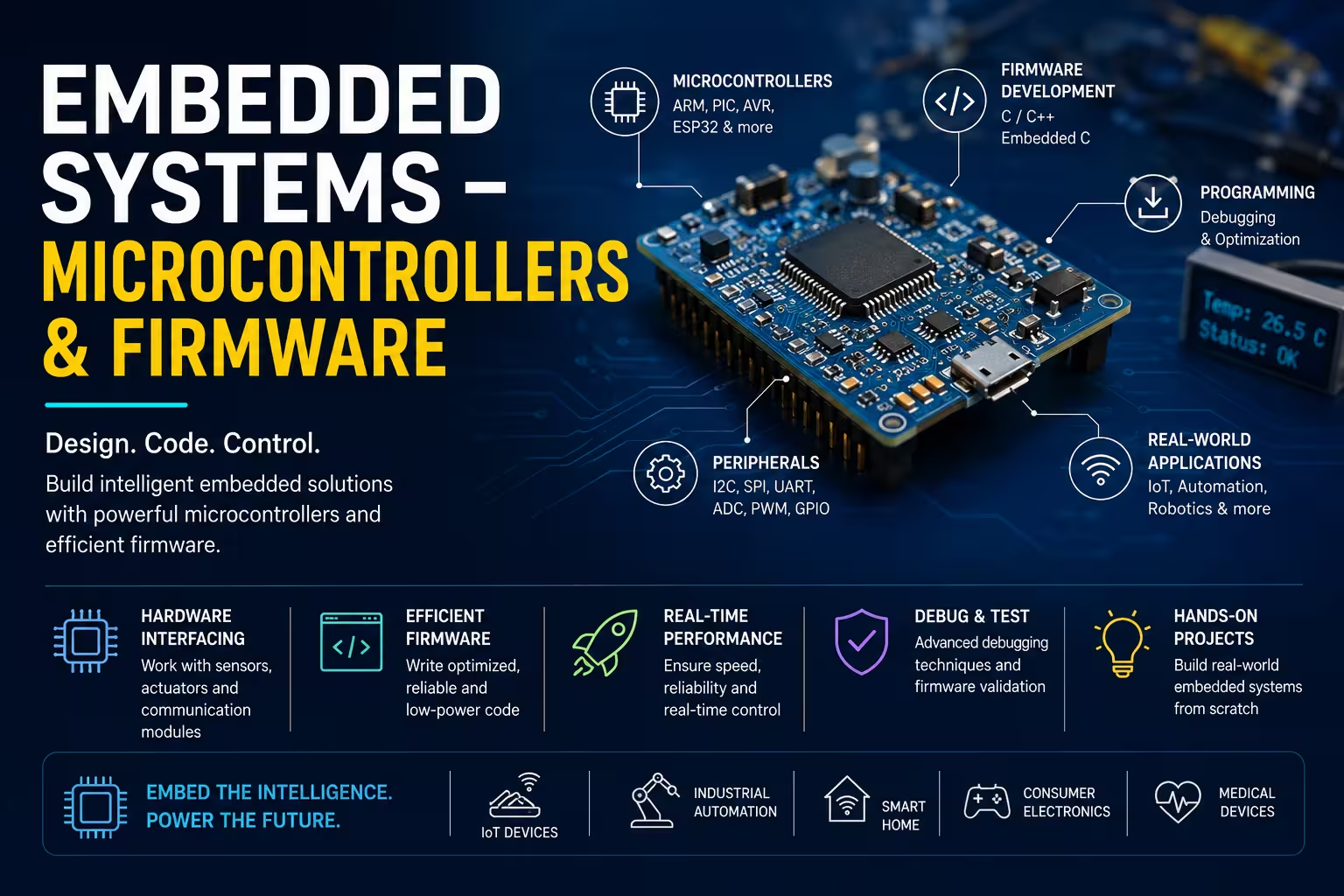
Course Objectives
1. What are Embedded Systems and why are they important in modern technology?
Learn how embedded systems control electronic devices, automate processes, and power smart products across various industries.
2. Why do organizations use microcontrollers and firmware in product development?
A basic understanding of C programming, digital electronics, microcontrollers, and electrical fundamentals will help you learn more effectively.
3. Which technologies are used in Embedded Systems development?
Explore embedded C, ARM Cortex-M, Arduino, STM32, AVR, PIC microcontrollers, communication protocols, and real-time embedded programming.
4. How do Embedded Systems improve industrial and consumer products?
Learn how embedded technologies enable automation, energy efficiency, real-time control, and intelligent decision-making in electronic devices.
5. What skills are required to become an Embedded Systems Engineer?
Develop practical skills in embedded programming, firmware development, hardware interfacing, debugging, communication protocols, and microcontroller programming.
Popular Techniques Covered in This Course
Embedded systems fundamentals
Embedded C programming
Firmware development
Microcontroller architecture
ARM Cortex-M programming
STM32 programming
Arduino development
GPIO programming
ADC and DAC interfacing
Timers and interrupts
Get Hands-on Knowledge about Real-Time Projects
Project 1
1. Smart Home Automation Project
Develop a microcontroller-based home automation system to control lighting and appliances using sensors and embedded firmware. Improve automation and energy efficiency.
Project 2
2. Digital Temperature Monitoring Project
Build an embedded system that reads temperature sensor data and displays real-time values on an LCD or OLED display. Ensure accurate environmental monitoring.
Project 3
3. Industrial Motor Control Project
Design firmware to control motor speed and direction using PWM and microcontroller peripherals. Improve automation for industrial equipment.
Project 4
4. IoT Environmental Monitoring Project
Create an embedded solution that collects sensor data and transmits it to a cloud platform for real-time monitoring. Enable smart environmental data analysis.
Project 5
5. Smart Access Control System Project
Develop a secure access control system using RFID or keypad authentication with embedded firmware. Enhance security through reliable hardware and software integration.
Key Features
Edubrights offers EMBEDDED SYSTEMS – MICROCONTROLLERS & FIRMWARE Training in virtual mode with expert trainers. Here are the key features,
40 Hours Course Duration
100% Job Oriented Training
Industry Expert Faculties
Free Demo Class Available
Completed 500+ Batches
Certification Guidance
Curriculum
Module 1: Introduction to Embedded Systems
- Embedded systems overview: definition, characteristics, and applications
- Microcontroller vs microprocessor: architecture and use case differences
- Popular microcontrollers: Arduino, PIC, STM32, and ESP32
- Development environment setup: IDE, compiler, and programmer/debugger
Module 2: Microcontroller Architecture
- CPU core: ALU, registers, program counter, and stack pointer
- Memory types: Flash, SRAM, EEPROM, and memory mapping
- Clock system: internal oscillators, external crystals, and PLL
- Reset and power management: power modes and reset sources
Module 3: GPIO and Peripheral Interfacing
- GPIO configuration: input, output, pull-up, and pull-down modes
- LED and button interfacing: digital I/O control and debouncing
- Timers: timer modes, PWM generation, and input capture
- Interrupts: external interrupts, NVIC, and interrupt service routines
Module 4: Communication Protocols
- UART: serial communication for debug output and device communication
- SPI: high-speed synchronous communication with sensors and displays
- I2C: multi-device bus communication with addressing
- CAN bus: automotive and industrial embedded communication protocol
Module 5: Analog and Sensor Interfacing
- ADC: analogue-to-digital conversion for sensor reading
- DAC: digital-to-analogue conversion for signal generation
- Temperature, humidity, and pressure sensor interfacing
- Display interfacing: LCD, OLED, and TFT displays
Module 6: Embedded C Programming
- Embedded C fundamentals: bit manipulation, pointers, and memory
- Register-level programming: direct hardware register access
- Hardware abstraction layer (HAL): using vendor HAL libraries
- Interrupt-driven vs polling: choosing the right programming model
Module 7: Real-Time Operating Systems
- RTOS fundamentals: tasks, scheduling, and context switching
- FreeRTOS: task creation, semaphores, queues, and mutexes
- RTOS for embedded systems: when to use and when not to use
- Debugging embedded systems: JTAG, SWD, and logic analyser
Module 8: Capstone Project and Assessment
- Embedded system project: sensor data acquisition and UART reporting
- Communication protocol: I2C or SPI peripheral integration project
- FreeRTOS application: multi-task embedded system with semaphores
- Final assessment and course certification
Receive Training From Our Skilled and Effective Trainers
Experience in the Industry Learn from embedded systems engineers who have developed firmware for industrial automation, consumer electronics, automotive ECUs, and IoT devices using ARM Cortex-M, PIC, and ESP32 microcontrollers.
Backgrounds at the Top Our embedded systems trainers have worked at electronics product companies, automotive Tier 1 suppliers, and IoT startups designing and programming microcontroller-based hardware products.
Clear & Effective Teaching Microcontroller architecture, GPIO, timers, interrupts, UART/SPI/I2C/CAN protocols, ADC, embedded C programming, HAL libraries, FreeRTOS, and debugging are explained with real embedded hardware project examples.
Hands-On Learning Focus Students configure microcontroller peripherals, interface sensors and displays, implement communication protocols, write embedded C firmware, and build FreeRTOS applications through structured hands-on hardware lab exercises.
Up-to-Date Knowledge Trainers keep content current with the latest STM32, ESP32, and Arduino platform releases, RTOS advances, and evolving embedded systems development and IoT firmware best practices.
Succeed Our Resourceful Certification
Our institution offers a recognized Embedded Systems – Microcontrollers & Firmware certification. This certification enhances your portfolio and prepares you for collaborative projects in real-world environments. Gain practical skills through hands-on training and assessments.

Course FAQs
1. What is an Embedded System?
An Embedded System is a specialized computer system designed to perform specific functions within electronic devices or machines.
2. Who should learn Embedded Systems?
Electronics engineers, electrical engineers, computer science students, IoT developers, robotics enthusiasts, and firmware developers.
3. What is firmware?
Firmware is software programmed into a microcontroller or embedded device that controls its hardware functions and operations.
4. Which programming language is commonly used for Embedded Systems?
Embedded C is the most widely used programming language for firmware and microcontroller development.
5. What are microcontrollers?
Microcontrollers are compact integrated circuits that combine a processor, memory, and input/output peripherals on a single chip.
6. Which communication protocols are covered in this course?
The course covers UART, SPI, I2C, PWM, and other commonly used embedded communication interfaces.
7. Is prior electronics knowledge required?
Basic electronics knowledge is helpful, but the course introduces essential concepts before moving to advanced topics.
8. Does this course include hardware programming?
Yes. Learners work with microcontrollers, sensors, peripherals, and firmware through practical embedded projects.
9. What jobs can I pursue after completing this course?
You can work as an Embedded Systems Engineer, Firmware Engineer, Embedded Software Developer, IoT Developer, or Hardware Engineer.
10. Does this course include practical projects?
Yes. The course includes projects on home automation, motor control, IoT monitoring, embedded security, and sensor interfacing.
11. Are Embedded Systems used in IoT applications?
Yes. Embedded systems are the foundation of IoT devices, enabling sensing, processing, communication, and automation.
12. How do Embedded Systems improve product development?
They provide efficient hardware control, real-time processing, lower power consumption, and reliable device operation.
13. Can I build my own embedded projects after completing this course?
Yes. The practical training equips you to design, program, debug, and deploy embedded applications for academic, industrial, and commercial projects.
Get Training Quote for Free
Testimonials
Hear What Our Students Say
"Transform your life through Education, hear it from our Alumni"

8 LPA
Rahul
Student
Data Scientist
"Transform your life through Education, hear it from our Alumni"

8 LPA
Siddharth
NIELSON IQ
Data Analyst
"Transform your life through Education, hear it from our Alumni"

6 LPA
Fathima
Student
Software Engineer