Course Objectives
1. Understand Generative AI Concepts and Large Language Models
Learn the fundamentals of Generative AI, Large Language Models (LLMs), transformer architecture, prompt engineering, and modern AI application development using Databricks.
2. Build Retrieval-Augmented Generation (RAG) Applications
Develop practical skills in creating knowledge-based AI applications using Vector Search, embeddings, retrieval pipelines, and RAG architectures for accurate and context-aware responses.
3. Develop and Manage GenAI Solutions on Databricks
Gain hands-on experience with Databricks AI tools, AI Playground, Model Serving, MLflow, Vector Search, and other technologies used to build production-ready Generative AI applications.
4. Fine-Tune and Optimize Foundation Models
Learn how to customize large language models using LoRA, QLoRA, instruction tuning, and evaluation techniques to improve performance for specific business domains and use cases.
5. Prepare for Databricks Generative AI Engineer Certification
Build the knowledge and practical experience required to confidently prepare for the Databricks Generative AI Engineer Certification through projects, mock exams, and real-world implementation scenarios.
Popular Techniques Covered in This Course
Generative AI Fundamentals
Large Language Models (LLMs)
Prompt Engineering
Retrieval-Augmented Generation (RAG)
Databricks Vector Search
LangChain Development
LlamaIndex Integration
MLflow for GenAI
LLM Fine-Tuning Techniques
Responsible AI and Model Governance
Get Hands-on Knowledge about Real-Time Projects
Project 1
1. Legal Document Question Answering System
In this project, learners will build a Generative AI solution that allows users to ask questions about legal documents and receive context-aware responses. Using Vector Search, embeddings, and RAG architecture, the application will retrieve relevant information before generating answers.
Project 2
2. Intelligent Customer Support Chatbot
Students will develop an AI-powered customer support assistant capable of answering frequently asked questions using company knowledge bases. The chatbot will leverage Databricks Vector Search, LangChain, and large language models to provide accurate responses while maintaining conversational context.
Project 3
3. Financial Report Summarization Platform
This project focuses on building a Generative AI application that automatically summarizes lengthy financial reports and business documents. Learners will use foundation models, prompt engineering techniques, and MLflow tracking to generate concise summaries and improve information accessibility for business users.
Project 4
4. Healthcare Knowledge Assistant
Learners will create an AI-powered knowledge retrieval system for healthcare professionals. The solution will search medical documents, retrieve relevant information, and generate helpful responses using Retrieval-Augmented Generation.
Project 5
5. Multilingual Enterprise Knowledge Bot
In this capstone project, students will build a multilingual AI assistant capable of answering questions in multiple languages using enterprise documentation. The project includes Vector Search, LangChain integration, model evaluation, prompt management, and deployment using Databricks Model Serving.
Key Features
Edubrights offers Databricks Generative AI Engineer Certification Training in virtual mode with expert trainers. Here are the key features,
40 Hours Course Duration
100% Job Oriented Training
Industry Expert Faculties
Free Demo Class Available
Completed 500+ Batches
Certification Guidance
Curriculum
Module 1: GenAI on Databricks Overview
- Databricks Generative AI Engineer exam: format, domains, and target audience
- GenAI landscape: foundation models, fine-tuning, and RAG -- when to use which
- Databricks AI tooling: Model Serving, Vector Search, AI Playground, and DBRX
- Indian GenAI use cases: legal document summarisation, regional language Q&A, and more
Module 2: Large Language Model Fundamentals
- Transformer architecture: attention mechanisms and tokenisation for engineers
- Open-source vs proprietary LLMs: trade-offs for Indian enterprise deployments
- Prompt engineering: system prompts, few-shot examples, and chain-of-thought
- LLM evaluation metrics: BLEU, ROUGE, and human preference scoring explained
Module 3: Retrieval-Augmented Generation (RAG)
- RAG architecture: retriever + generator design for knowledge-grounded responses
- Databricks Vector Search: creating and querying vector indexes on Delta tables
- Embedding models: choosing the right model for Hindi and English multilingual RAG
- RAG evaluation: context precision, recall, and faithfulness metrics for exam
Module 4: Building GenAI Applications
- LangChain on Databricks: chains, agents, and memory for production applications
- LlamaIndex integration: document indexing and retrieval pipeline construction
- AI Playground: rapid prototyping and model comparison for application developers
- Capstone mini-project: building a GST regulation Q&A chatbot on Databricks
Module 5: MLflow for GenAI
- MLflow LLM tracking: logging prompts, responses, and evaluation metrics
- MLflow AI Gateway: managing multiple LLM providers with unified API interface
- Prompt versioning: tracking prompt changes alongside model versions in registry
- Practice: 20 MLflow GenAI questions aligned to certification exam domains
Module 6: Fine-Tuning & Model Customisation
- When to fine-tune: domain adaptation for Indian legal, medical, and financial text
- LoRA and QLoRA: efficient fine-tuning techniques on Databricks GPU clusters
- Instruction tuning: creating supervised fine-tuning datasets from Indian sources
- Evaluation and safety: testing fine-tuned models for hallucination and bias
Module 7: Production GenAI & Responsible AI
- Serving LLMs: Databricks Model Serving for real-time GenAI API endpoints
- Guardrails: implementing content filtering and toxicity detection in pipelines
- Cost management: token budgeting and caching strategies for high-traffic apps
- Responsible AI in India: bias, transparency, and DPDP Act implications for GenAI
Module 8: Mock Exam & Certification Readiness
- Full 45-question timed mock at Generative AI Engineer certification difficulty
- Answer review: covering RAG, MLflow, fine-tuning, and responsible AI domains
- Exam-day reference card: key concepts, APIs, and architectural patterns
- Career guide: GenAI Engineer roles, salaries, and growth outlook in Indian tech
Receive Training From Our Skilled and Effective Trainers
Experience in the Industry Learn from Databricks-certified data engineers and ML engineers who have built production lakehouse platforms, Delta Live Tables pipelines, and ML workflows on Databricks for data-driven enterprises.
Backgrounds at the Top Our Databricks trainers have delivered data platform projects at technology companies, financial services firms, and healthcare organisations where Databricks is the central platform for data engineering and machine learning.
Clear & Effective Teaching Databricks architecture, Spark DataFrames, Delta Lake, Databricks SQL, MLflow, Delta Live Tables, Unity Catalog, and governance are explained clearly with real lakehouse data platform examples.
Hands-On Learning Focus Students build end-to-end lakehouse pipelines, work with Delta tables, create DLT pipelines, track ML experiments with MLflow, and configure Unity Catalog governance through structured lab exercises.
Up-to-Date Knowledge Trainers keep content current with the latest Databricks platform releases, Databricks AI and GenAI capabilities, Unity Catalog enhancements, and evolving lakehouse architecture best practices.
Databricks Generative AI Engineer Professional Certification
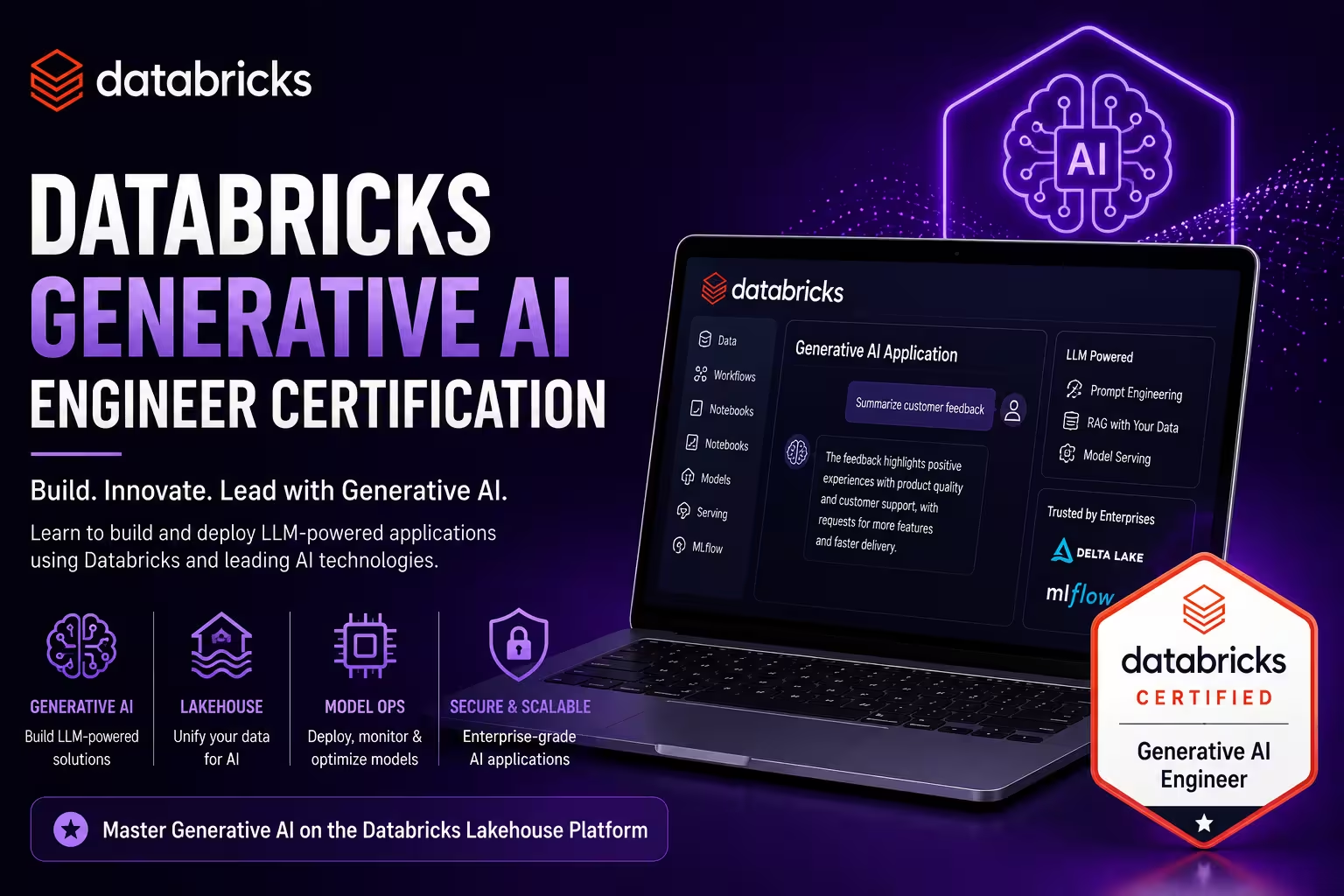
Edubrights Offers the Databricks Generative AI Engineer Professional Certification validates your ability to design, build, deploy, and manage Generative AI applications using the Databricks Lakehouse Platform. This certification demonstrates expertise in Large Language Models (LLMs), Retrieval-Augmented Generation (RAG), Vector Search, Prompt Engineering, MLflow, LangChain, Model Serving, Fine-Tuning, and Responsible AI practices.
Course FAQs
1. What is the Databricks Generative AI Engineer Certification?
The Databricks Generative AI Engineer Certification validates your ability to build, deploy, manage, and optimize Generative AI applications using Databricks tools and technologies.
2. Who should enroll in this Databricks Generative AI course?
This course is ideal for Data Scientists, Machine Learning Engineers, AI Engineers, Data Engineers, Software Developers, and professionals interested in Generative AI technologies.
3. Do I need prior AI experience to learn Generative AI on Databricks?
Basic knowledge of Python and machine learning concepts is helpful, but the course introduces key Generative AI concepts and practical implementation techniques in a structured manner.
4. What is Retrieval-Augmented Generation (RAG)?
RAG is a technique that combines information retrieval with language generation to provide more accurate, context-aware, and reliable responses from AI applications.
5. What tools are covered in this course?
The course covers Databricks AI Playground, MLflow, Vector Search, LangChain, LlamaIndex, Model Serving, Foundation Models, and Fine-Tuning techniques.
6. Why is Generative AI important for modern businesses?
Generative AI helps organizations automate content creation, customer support, document analysis, knowledge management, and intelligent decision-making processes.
7. Will I learn how to build AI chatbots?
Yes. Learners will build practical Generative AI applications, including question-answering systems, document assistants, and chatbot solutions using modern frameworks.
8. What is MLflow's role in Generative AI projects?
MLflow helps manage experiments, track prompts, monitor model performance, version AI workflows, and maintain reproducible Generative AI development processes.
9. What career opportunities are available after completing this course?
Learners can pursue roles such as Generative AI Engineer, AI Engineer, Machine Learning Engineer, LLM Engineer, AI Application Developer, and Data Scientist.
10. Is Generative AI a high-demand career skill?
Yes. Organizations across industries are actively investing in Generative AI solutions, creating strong demand for professionals with practical AI development and deployment skills.
11. What industries are adopting Generative AI?
Industries such as banking, healthcare, retail, education, insurance, manufacturing, legal services, and technology are rapidly adopting Generative AI solutions.
12. What is LLMOps?
Industries such as banking, healthcare, retail, education, insurance, manufacturing, legal services, and technology are rapidly adopting Generative AI solutions.
13. What job roles can I pursue after completing this course?
Career opportunities include Generative AI Engineer, AI Engineer, Machine Learning Engineer, LLM Developer, AI Solutions Architect, and Applied AI Specialist.
14. How long does it take to complete the training?
Most learners can develop strong practical skills in Generative AI within a few weeks to a few months, depending on their background and learning pace.
15. Why is Generative AI important for businesses?
Generative AI improves productivity, automates repetitive tasks, enhances customer experiences, accelerates content creation, and supports intelligent decision-making.
Get Training Quote for Free
Testimonials
Hear What Our Students Say
"Transform your life through Education, hear it from our Alumni"

8 LPA
Rahul
Student
Data Scientist
"Transform your life through Education, hear it from our Alumni"

8 LPA
Siddharth
NIELSON IQ
Data Analyst
"Transform your life through Education, hear it from our Alumni"

6 LPA
Fathima
Student
Software Engineer