Course Objectives
1. Understand Data Science Fundamentals
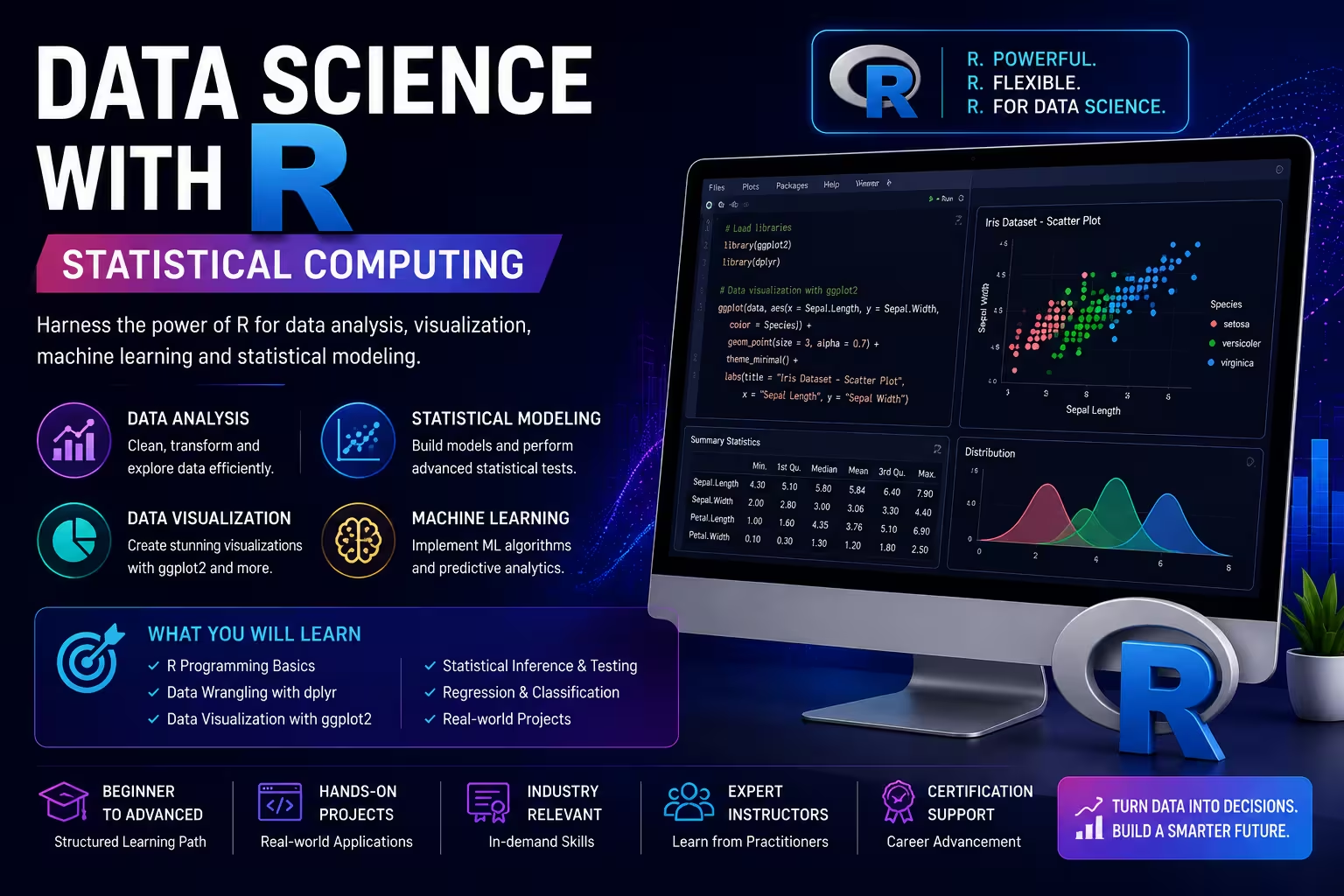
Learn the core concepts of Data Science, statistical computing, data analysis, and predictive modeling using R programming. Understand how organizations use data-driven insights to support business decisions.
2. Master R Programming for Data Analysis
Develop practical skills in R programming, including data manipulation, statistical analysis, visualization, and automation of analytical tasks.
3. Apply Statistical Methods to Real-World Data
Learn how to use descriptive statistics, probability distributions, hypothesis testing, and regression techniques to analyze business and research data.
4. Build Data Visualization and Reporting Solutions
Understand how to create charts, graphs, dashboards, and reports that communicate analytical findings effectively.
5. Develop Predictive Analytics Models
Gain expertise in building machine learning and predictive models using R to forecast trends and support decision-making.
Popular Techniques Covered in This Course
1. R Programming
2. Data Manipulation
3. Statistical Analysis
4. Data Visualization
5. Exploratory Data Analysis (EDA)
6. Regression Analysis
7. Machine Learning with Rv
8. Time Series Analysis
9. Data Reporting and Dashboarding
10. Statistical Computing
Get Hands-on Knowledge about Real-Time Projects
Project 1
1. Customer Purchase Behavior Analysis
Description: Analyze customer transaction data to identify purchasing patterns, customer preferences, and product demand trends. Generate insights that help businesses improve marketing strategies and customer retention.
Project 2
2. Sales Forecasting System
Description: Develop a predictive model using historical sales data to forecast future sales performance. Help organizations optimize inventory planning and resource allocation.
Project 3
3. Healthcare Data Analytics Project
Description: Analyze patient and healthcare datasets to identify trends, predict risks, and improve healthcare decision-making through statistical analysis and visualization.
Project 4
4. Financial Market Trend Prediction
Description: Build statistical models to analyze stock market data and forecast potential market movements using historical trends and predictive analytics techniques.
Project 5
5. Social Media Sentiment Analysis
Description: Collect and analyze social media data to determine customer sentiment, brand perception, and public opinion using text analytics and statistical methods.
Key Features
Edubrights offers DATA SCIENCE WITH R – STATISTICAL COMPUTING Training in virtual mode with expert trainers. Here are the key features,
40 Hours Course Duration
100% Job Oriented Training
Industry Expert Faculties
Free Demo Class Available
Completed 500+ Batches
Certification Guidance
Curriculum
Module 1: Introduction to R and RStudio
- R overview: statistical computing language and its ecosystem
- RStudio IDE: console, script editor, environment, and plots panels
- R data types: vectors, matrices, lists, and data frames
- Installing and loading packages: CRAN and tidyverse ecosystem
Module 2: Data Manipulation with tidyverse
- dplyr: filter, select, mutate, summarise, and group_by
- tidyr: pivot_longer, pivot_wider, separate, and unite
- Joining datasets: inner_join, left_join, and anti_join
- Pipe operator: chaining dplyr operations with %>%
Module 3: Data Visualisation with ggplot2
- ggplot2 grammar of graphics: data, aesthetics, and geoms
- Chart types: geom_point, geom_bar, geom_line, and geom_boxplot
- Faceting: small multiples with facet_wrap and facet_grid
- Themes and scales: customising colours, labels, and axes
Module 4: Statistical Analysis in R
- Descriptive statistics: mean, median, variance, and standard deviation
- Hypothesis testing: t-test, chi-square, and ANOVA in R
- Correlation and regression: lm() and interpreting model output
- Probability distributions: normal, binomial, and Poisson in R
Module 5: Machine Learning with R
- caret package: unified interface for ML model training and evaluation
- Supervised learning: linear regression, logistic regression, and decision trees
- Model evaluation: confusion matrix, ROC curve, and cross-validation
- Unsupervised learning: k-means clustering and hierarchical clustering
Module 6: Text Mining and NLP in R
- tidytext package: tokenisation, stop word removal, and word frequency
- Sentiment analysis: AFINN, Bing, and NRC lexicons in R
- TF-IDF: term frequency-inverse document frequency with tidytext
- Topic modelling: LDA with the topicmodels package
Module 7: R Markdown and Shiny
- R Markdown: creating reproducible reports combining code and narrative
- Output formats: HTML, PDF, and Word from R Markdown documents
- Shiny: building interactive web applications with R
- Shiny dashboard: reactivity, input widgets, and output renders
Module 8: Capstone Project and Assessment
- Exploratory data analysis: tidyverse data wrangling and ggplot2 visualisation
- Machine learning model: classification or regression with caret
- Shiny app or R Markdown report presenting analytical findings
- Final assessment and course certification
Receive Training From Our Skilled and Effective Trainers
Experience in the Industry Learn from data scientists and statisticians who have used R for statistical modelling, exploratory data analysis, machine learning, and data visualisation in healthcare, finance, and research organisations.
Backgrounds at the Top Our R programming trainers have worked at universities, research institutions, and analytics consultancies where R is the primary tool for advanced statistical analysis and reproducible research.
Clear & Effective Teaching R fundamentals, tidyverse data manipulation, ggplot2 visualisation, statistical analysis, machine learning with caret, text mining, R Markdown, and Shiny are explained with real data science project examples.
Hands-On Learning Focus Students wrangle datasets with dplyr, visualise data with ggplot2, build ML models with caret, perform statistical tests, analyse text, and create Shiny apps through structured hands-on R lab exercises.
Up-to-Date Knowledge Trainers keep content current with the latest tidyverse and tidymodels releases, Quarto as a next-generation R Markdown, and evolving R-based data science and statistical computing best practices.
Certified Data Science with R Professional
Our institution offers a recognized DATA SCIENCE WITH R – STATISTICAL COMPUTING certification. This certification enhances your portfolio and prepares you for collaborative projects in real-world environments. Gain practical skills through hands-on training and assessments.
Course FAQs
1. What is Data Science with R?
Description: Data Science with R is the process of analyzing, visualizing, and modeling data using the R programming language to generate meaningful insights and predictions.
2. Who should enroll in this course?
Description: Students, data analysts, software professionals, researchers, statisticians, and business professionals interested in data analytics can benefit from this course.
3. Is prior programming knowledge required?
Description: No. Beginners can learn R programming from scratch as part of the course curriculum.
4. What is R programming used for?
Description: R is widely used for statistical computing, data visualization, predictive analytics, machine learning, and research applications.
5. What are the career opportunities after this course?
Description: Learners can pursue roles such as Data Scientist, Data Analyst, Business Analyst, Statistical Analyst, and Machine Learning Analyst.
6. How important is statistics in Data Science?
Description: Statistics is a core component of data science and helps in analyzing data, identifying patterns, and making accurate predictions.
7. Will I learn machine learning in this course?
Description: Yes. The course covers essential machine learning algorithms and predictive modeling techniques using R.
8. What datasets will be used for practice?
Description: Learners work with business, finance, healthcare, marketing, and publicly available datasets to gain practical experience.
9. Can R handle large datasets?
Description: Yes. R provides multiple libraries and techniques to process and analyze large datasets efficiently.
10. What tools are commonly used with R?
Description: Popular tools include RStudio, Shiny, ggplot2, dplyr, caret, and various machine learning libraries.
11. Is Data Science with R suitable for research professionals?
Description: Yes. R is one of the most preferred tools in academic research, scientific studies, and statistical analysis.
12. How long does it take to learn Data Science with R?
Description: The learning duration depends on the training program, but most learners gain practical proficiency within a few months.
13. Does the course include real-world projects?
Description: Yes. Hands-on projects are included to help learners apply concepts in practical business scenarios.
14. Is R better than Excel for data analysis?
Description: R offers advanced statistical capabilities, automation, and machine learning features that go far beyond traditional spreadsheet analysis.
15. Can I become a Data Scientist after completing this course?
Description: This course provides a strong foundation for data science careers, especially when combined with practical project experience and continuous learning.
Get Training Quote for Free
Testimonials
Hear What Our Students Say
"Transform your life through Education, hear it from our Alumni"

8 LPA
Rahul
Student
Data Scientist
"Transform your life through Education, hear it from our Alumni"

8 LPA
Siddharth
NIELSON IQ
Data Analyst
"Transform your life through Education, hear it from our Alumni"

6 LPA
Fathima
Student
Software Engineer