Course Objectives
1. Orchestrate Distributed Data Processing
Master the Spark execution hierarchy, understanding how the driver node divides complex tasks into partitions across multiple worker executors to bypass single-machine bottlenecks
2. Transform Massive Datasets with PySpark
Utilize the powerful PySpark DataFrame API and Spark SQL to filter, join, aggregate, and reshape petabyte-scale unformatted data lakes natively.
3. Build Fault-Tolerant Streaming Applications
Design continuous ingestion pipelines using Structured Streaming, managing late-arriving data, stateful aggregations, and high-throughput micro-batching
4. Diagnose and Refactor Execution Plans
Read Directed Acyclic Graphs (DAGs) in the Spark UI to identify memory spilling, resolve data skew, optimize shuffle operations, and drop unnecessary cloud cluster costs.
Popular Techniques Covered in This Course
Spark Architecture (Driver, Executors, Core Allocation)
PySpark DataFrame API & Catalyst Optimizer Mechanics
Distributed Data Modeling (Parquet, Avro, and Delta Lake)
Advanced Partitioning & Data Skew Resolution
Spark SQL Temporary Views & Query Execution
Structured Streaming & Event-Time Checkpointing
Broadcast Joins vs. Shuffle Hash Joins
Resilient Distributed Datasets (RDDs) and Lazy Evaluation
Databricks Workspace & Notebook Orchestration
Spark UI Profiling & Memory Out-of-Memory (OOM) Debugging
Get Hands-on Knowledge about Real-Time Projects
Project 1
Project 1: Multi-Terabyte Telecom Call Detail Record (CDR) Aggregation
Build a high-performance aggregation engine. You will ingest massive directories of raw telecom log files, apply PySpark transformations to isolate dropped call metrics across specific network towers, and write the compressed results back into optimized Parquet files.
Project 2
Project 2: Real-Time E-Commerce Fraud Detection Stream
Develop an active event-tracking pipeline using Structured Streaming. You will hook into a live data feed mimicking global credit card transactions, establish watermark thresholds to handle late-arriving network packets, and trigger conditional logic to flag rapid, repetitive purchases instantly.
Project 3
Project 3: Automated Financial Log ETL Pipeline
Construct a multi-stage Extract-Load-Transform (ELT) architecture. You will clean dirty, semi-structured JSON financial data, handle missing array values, execute complex inner and outer joins across isolated client databases, and save the verified schema into a central Delta Lake.
Project 4
Project 4: Healthcare Data Masking & Deduplication Matrix
Design a strictly governed data-cleansing module. You will write custom User-Defined Functions (UDFs) in Python to scramble sensitive patient identification numbers, apply distinct filtering to eliminate duplicate hospital admissions, and enforce strict schema validations.
Project 5
Project 5: High-Performance Spark UI Bottleneck Diagnosis
Execute a triage mission on an intentionally broken, slow-running query. You will open the Spark UI, trace the execution DAG, identify severe data skew causing a single node to freeze, and rewrite the pipeline using salting techniques and broadcast joins to cut execution time by 80%
Key Features
Edubrights offers Apache Spark – Big Data Processing Training in virtual mode with expert trainers. Here are the key features
40 Hours Course Duration
100% Job Oriented Training
Industry Expert Faculties
Free Demo Class Available
Completed 500+ batches
Certification Guidance
Curriculum
Module 1: Spark Architecture & Setup
- Spark vs MapReduce: speed and programming model
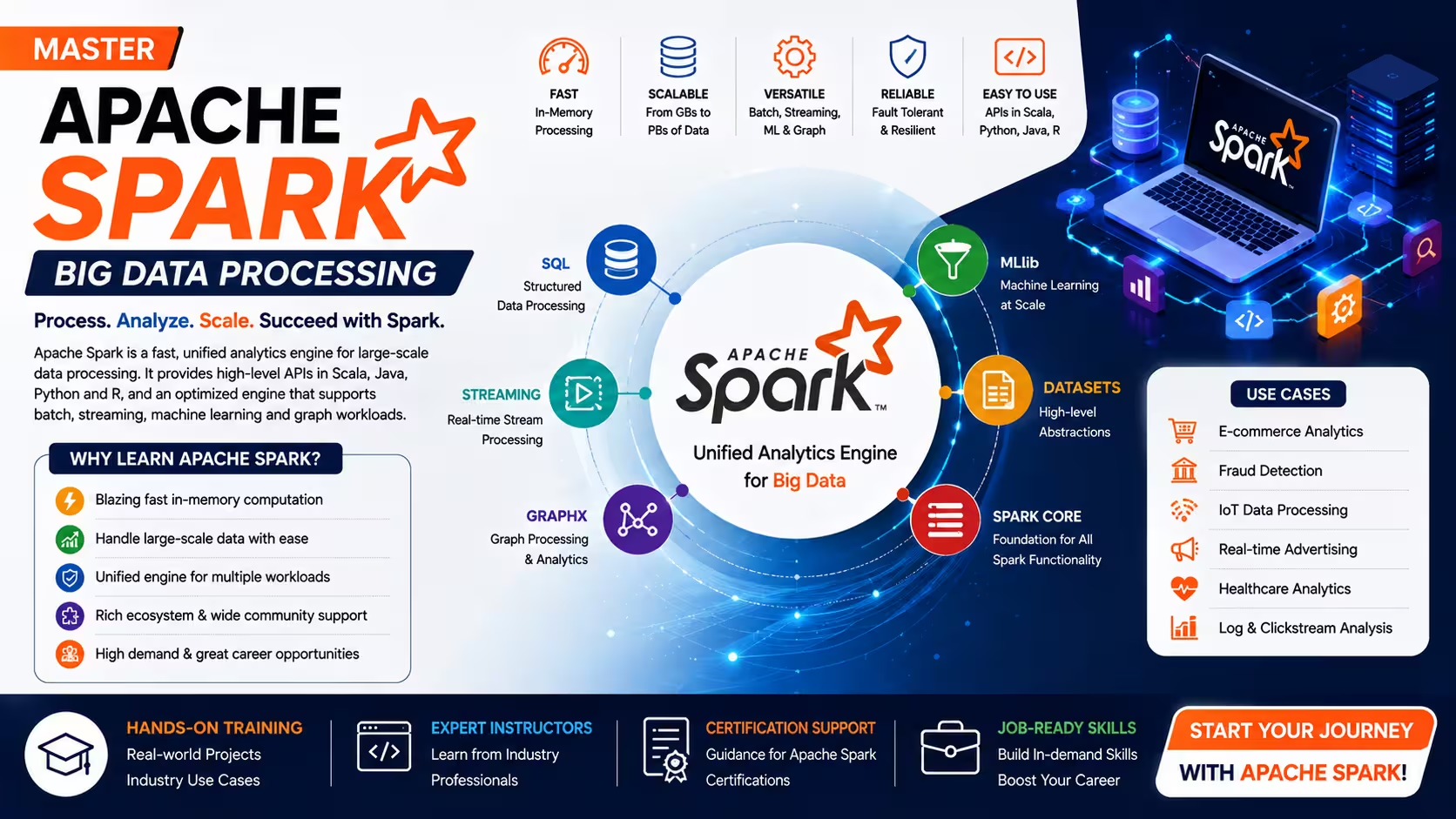
- Spark components: Core, SQL, Streaming, MLlib, GraphX
- Cluster managers: YARN, Mesos, Standalone, Kubernetes
- Spark driver, executor, task, and stage
- PySpark setup: local mode and Jupyter notebooks
- Databricks Community Edition for practice
Module 2: RDDs – Resilient Distributed Datasets
- RDD creation: parallelize and textFile
- Transformations: map, filter, flatMap, reduceByKey
- Actions: collect, count, take, saveAsTextFile
- Lazy evaluation and DAG execution
- Partitioning and data locality
- Caching and persistence strategies
Module 3: Spark DataFrames & SQL
- DataFrame creation: JSON, CSV, Parquet, ORC
- DataFrame transformations: select, filter, groupBy, join
- Spark SQL: CREATE TABLE, SELECT, subqueries
- Schema inference vs explicit schema
- Window functions: rank, lag, lead, rolling
- Handling null values and duplicates
Module 4: PySpark Advanced
- User Defined Functions (UDFs): Python and Pandas UDFs
- Column functions: when, lit, col, expr
- Aggregations: agg, pivot, crosstab
- Complex types: arrays, maps, structs
- Explode and nested data handling
- SparkContext and SparkSession management
Module 5: Spark Streaming & Structured Streaming
- DStream vs Structured Streaming
- ReadStream from Kafka, File, and Socket
- Output modes: append, update, complete
- Watermarks for late data handling
- Stateful streaming: groupBy and mapGroupsWithState
- Checkpointing for fault tolerance
Module 6: Performance Tuning
- Query plan: physical and logical plan inspection
- Broadcast join for small table optimisation
- Partitioning: repartition vs coalesce
- Caching: cache vs persist with storage levels
- Serialisation: Kryo vs Java
- Memory management: executor memory tuning
Module 7: Data Formats & Storage
- Parquet: columnar storage and predicate pushdown
- Delta Lake: ACID transactions on data lakes
- ORC, Avro, and JSON format comparison
- Reading and writing to S3, HDFS, ADLS
- Partition pruning strategies
- Data lake architecture with Spark
Module 8: Production & Cloud
- Submitting Spark jobs: spark-submit options
- YARN cluster mode: resource allocation
- Databricks: managed Spark platform
- EMR and Azure HDInsight: cloud Spark
- Monitoring: Spark UI and event logs
- CI/CD for Spark data pipelines
Receive Training From Our Skilled and Effective Trainers
Our Apache streaming instructors are senior data engineers and platform architects who have built production Kafka and Spark pipelines processing billions of events daily for e-commerce, fintech, and media streaming companies. They teach real-world fault-tolerant design patterns, operational best practices, and performance tuning from live cluster experience.
Succeed Our Resourceful Certification
Our institution offers a recognized Apache Spark – Big Data Processing certification that validates your ability to design and prototype professional user interfaces efficiently. This certification enhances your design portfolio and prepares you for collaborative projects in real-world environments. Gain practical skills through hands-on training and assessments.

Course FAQs
1. What are the exact prerequisites for this Apache Spark course?
You should have a comfortable, working knowledge of Python programming (writing functions, understanding lists/dictionaries) and foundational SQL query logic. You do not need prior experience configuring distributed hardware or maintaining Linux clusters.
2. Why use Apache Spark instead of legacy Hadoop MapReduce?
MapReduce forces data to be read from and written back to physical disk drives between every single processing step, which is incredibly slow. Spark processes data completely in-memory (RAM), making it up to 100 times faster for complex analytics and iterative machine learning workloads.
3. Will we use Python or Scala for writing our Spark code?
We strictly use Python (PySpark). While Spark is natively written in Scala, Python has overwhelmingly dominated the modern data engineering and AI ecosystem. Databricks and corporate engineering teams natively rely on PySpark for its readability and massive open-source library support.
4. Will I need to build a custom computer or buy a server to run Spark locally?
No. Setting up a local Spark cluster is a massive headache that wastes learning time. EduBrights handles the infrastructure completely. We provide pre-funded, cloud-based Databricks sandbox environments so you can spin up distributed compute clusters directly from your web browser.
5. How long is the total duration of this EduBrights training track?
The course spans a structured 12-week interactive learning timeline. This layout ensures an optimal balance between technical weekend theory lectures, hands-on cloud lab practices, portfolio project debugging, and mock technical interview rounds.
6. Can I successfully balance this course with a full-time engineering job?
Yes. EduBrights hosts flexible weekend and evening cohort schedules tailored specifically for working professionals. Every live classroom feed is recorded in high-definition and instantly archived in your student portal dashboard within 3 hours
7. What is "Lazy Evaluation" in the context of Apache Spark?
When you write code to filter or join a DataFrame, Spark does not actually execute the math right away. Instead, it "lazily" builds a logical map of what you want to do. It only physically executes the code when you call an Action (like .show() or .write()). This allows Spark’s internal optimizer to completely rewrite your code for maximum efficiency before it touches the data.
8. What causes Out-Of-Memory (OOM) errors, and how do we fix them?
OOM errors occur when a single executor node is handed more data than its physical RAM can hold, usually due to a massive, unoptimized JOIN or GROUP BY operation. We teach you how to resolve this by increasing partition counts, filtering data earlier in the pipeline, or utilizing Broadcast variables.
9. What dataset scales will we manage during our practical exercises?
You will move far past clean, basic textbook CSV files. Our cloud environments provide access to messy, multi-gigabyte open-source event streams, massive unformatted server logs, and nested JSON matrices to accurately replicate the pressure of real workplace data conditions
10. How does the technical support desk assist when my cluster pipeline crashes?
Every student gains direct entry to our engineering assistance desk. If a PySpark DataFrame transformation fails, a streaming checkpoint corrupts, or a cluster refuses to spin up, you can post your error logs to get step-by-step resolution help from active data engineers.
11. What is "Data Skew," and why does it slow down Spark applications?
Data skew happens when your data is unevenly distributed across your cluster. For example, if 90% of your customer traffic comes from one specific city, the single worker node assigned to process that city will choke and freeze, while the other worker nodes sit totally idle. We teach you how to "salt" your data to force it to spread evenly.
12. Structured Streaming vs. Batch Processing: What is the difference?
Batch processing wakes up on a schedule (e.g., every night at 2:00 AM), processes all the data collected that day, and goes back to sleep. Structured Streaming keeps the cluster awake constantly, processing micro-batches of new data the exact second it hits your cloud storage buckets.
Get Training Quote for Free
Testimonials
Hear What Our Students Say
"Transform your life through Education, hear it from our Alumni"

8 LPA
Siddharth
NIELSON IQ
Data Analyst
"Transform your life through Education, hear it from our Alumni"

6 LPA
Fathima
Student
Software Engineer
"Transform your life through Education, hear it from our Alumni"

8 LPA
Rahul
Student
Data Scientist