Course Objectives
1. What exactly Amazon EKS training cover?
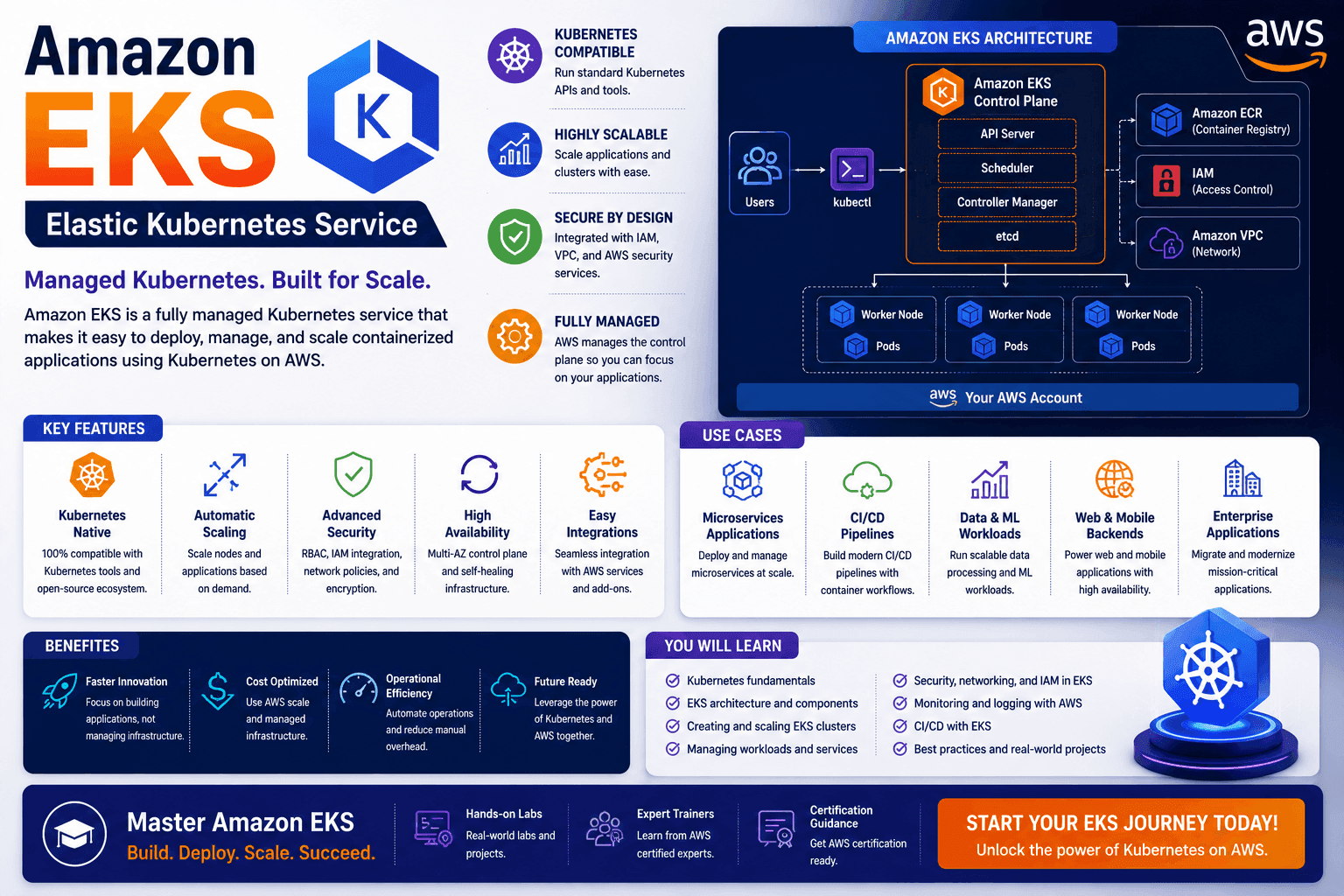
Amazon EKS training teaches you how to deploy, manage, and scale containerized applications using Kubernetes on AWS. It covers cluster setup, application deployment, networking, security, observability, and best practices for production workloads.
2. What are the main objectives of the Amazon EKS course for your development skills?
This course aims to help you build and maintain EKS clusters, deploy containerized apps efficiently, secure environments, and implement monitoring and scaling to master Kubernetes in AWS cloud.
3. How do you manage workloads on EKS?
You will deploy, scale, and monitor applications using Kubernetes on AWS.
4. How do you secure and operate EKS clusters?
You will implement security, networking, and observability best practices.
Popular Techniques Covered in This Course
1.Kubernetes architecture and concepts
2.Amazon EKS cluster creation and management
3.Container image management with Amazon ECR
4.Application deployment using Helm and kubectl
5.AWS networking and security in EKS
6.Monitoring and logging (CloudWatch, X-Ray)
7.Persistent storage on Kubernetes
8.IAM and Kubernetes RBAC for security
9.Auto scaling and load balancing
10.CI/CD pipelines and GitOps integrations
Get Hands-on Knowledge about Real-Time Projects
Project 1
1: Production EKS Cluster Setup
Deploy a highly available EKS cluster with node groups and networking.
Project 2
2: Microservices Deployment
Deploy and manage a complete microservices application on EKS.
Project 3
3: EKS with Fargate
Run serverless Kubernetes workloads using AWS Fargate.
Project 4
4: Secure EKS Environment
Implement security policies, RBAC, and network restrictions.
Project 5
5: Monitoring and Observability
Set up monitoring, logging, and alerting for EKS clusters.
Key Features
Edubrights offers Amazon EKS Training in virtual mode with expert trainers. Here are the key features,
40 Hours Course Duration
100% Job Oriented Training
Industry Expert Faculties
Free Demo Class Available
Completed 500+ Batches
Certification Guidance
Curriculum
Module 1: Kubernetes Fundamentals
- Benefits of containers and orchestration
- Kubernetes architecture and core components
- Pod scheduling and Kubernetes objects
Module 2: Amazon EKS Fundamentals
- Introduction to Amazon EKS and control/data planes
- EKS APIs and security basics
- Hands-on: Deploying Kubernetes Pods in EKS
Module 3: Building and Maintaining EKS Clusters
- Creating EKS clusters
- Node deployment and management
- Planning and performing cluster upgrades
Module 4: Deploying Applications
- Application deployment methods
- Amazon ECR for container images
- Helm charts and deployments
- Hands-on: Deploying applications on EKS
Module 5: Managing Applications at Scale
- Scaling workloads in EKS
- Continuous deployment and GitOps with WeaveFlux
- Hands-on: Continuous deployment workflows
Module 6: Networking in EKS
- AWS networking review
- Pod communication, security, and load balancing
- Service mesh basics
Module 7: Observability and Monitoring
- Collecting metrics and logs
- Application tracing with AWS X-Ray
- Hands-on: Monitoring EKS clusters
Module 8: Storage Management in EKS
- Storage design patterns
- Persistent storage with AWS services
- Secrets management
- Hands-on: Managing storage in EKS
Module 9: Security and Authentication
- Cloud security fundamentals
- IAM and Kubernetes RBAC integration
- Pod permissions and service accounts
- Hands-on: Securing EKS environments
Module 10: Upgrades and Maintenance
- Planning EKS version upgrades
- Platform and cluster maintenance
- Cost, efficiency, and resiliency best practices
Capstone Project:
- Design, deploy, and manage a secure, scalable Kubernetes application on Amazon EKS
Receive Training From Our Skilled and Effective Trainers
Experience in the Industry Gain knowledge from experts with practical Amazon EKS project experience in a variety of sectors.
Backgrounds at the Top Prominent corporations such as hcl, tcs , accenture and cognizant employ trainers.
Clear & Effective Teaching Excellent communication and real-world examples simplify complex subjects.
Hands-On Learning Focus Students can apply their abilities in real-world situations with the use of case studies and real-time projects.
Up-to-Date Knowledge Trainers stay current with the latest tools, techniques and best practices.
Succeed Our Resourceful Certification
Our institution offers a globally recognized Amazon EKS certification that validates your expertise in deploying, managing, and scaling Kubernetes applications in AWS. The course equips you with hands-on skills to leverage cloud-native architectures for modern enterprise workloads.

Course FAQs
1. What is Amazon EKS?
Amazon Elastic Kubernetes Service (EKS) is a managed Kubernetes service to run containerized applications on AWS.
2. Can I run both Linux and Windows containers on EKS?
Yes, Amazon EKS supports both Linux and Windows-based containers.
3. How does EKS handle the Kubernetes control plane?
AWS manages the control plane for you, ensuring high availability and scalability.
4. What deployment strategies does EKS support?
EKS supports rolling updates, blue/green deployments, and can be integrated with Helm and GitOps workflows.
5. Is EKS secure?
Yes, EKS integrates tightly with AWS IAM, supports Kubernetes RBAC, and allows network policies for pod-level security.
6. How do I scale my applications in EKS?
You can use Horizontal Pod Autoscaler and Cluster Autoscaler to automatically scale apps and nodes.
7. Can I monitor applications running on EKS?
Yes, EKS integrates with CloudWatch, AWS X-Ray, and third-party monitoring tools for observability.
8. How do I manage persistent storage on EKS?
EKS supports multiple storage options like EBS volumes, EFS, and S3-backed data for pods.
9. What is the difference between Amazon EKS and self-managed Kubernetes?
EKS removes the operational overhead of managing the control plane, automates updates, and integrates with AWS services.
10. Can EKS be used in hybrid cloud environments?
Yes, with AWS Outposts and other tooling, EKS can run in hybrid and multi-cloud setups.
11. Do you cover Fargate and EC2?
Yes. Both EKS launch types are included.
12. How is EKS used in real companies?
EKS is widely used for running large-scale production workloads on AWS.
Get Training Quote for Free
Testimonials
Hear What Our Students Say
"Transform your life through Education, hear it from our Alumni"

6 LPA
Fathima
Student
Software Engineer
"Transform your life through Education, hear it from our Alumni"

8 LPA
Rahul
Student
Data Scientist
"Transform your life through Education, hear it from our Alumni"

8 LPA
Siddharth
NIELSON IQ
Data Analyst