Popular
What's the Real Cost of SAP MDG Certification?
Mohamed Akram
July 2, 2026
10 min read
What does SAP MDG certification really cost? This guide breaks down training fees, official exam costs, and how to evaluate value before you enroll.
Introduction
Before enrolling in any specialised SAP track, most learners want a clear picture of what they're actually paying for. SAP MDG certification costs can vary widely depending on the training format, the provider, and whether you're pursuing official SAP certification or a training-institute completion certificate. This guide breaks down what typically makes up that cost so you can budget realistically.
What "SAP MDG Certification Cost" Actually Includes
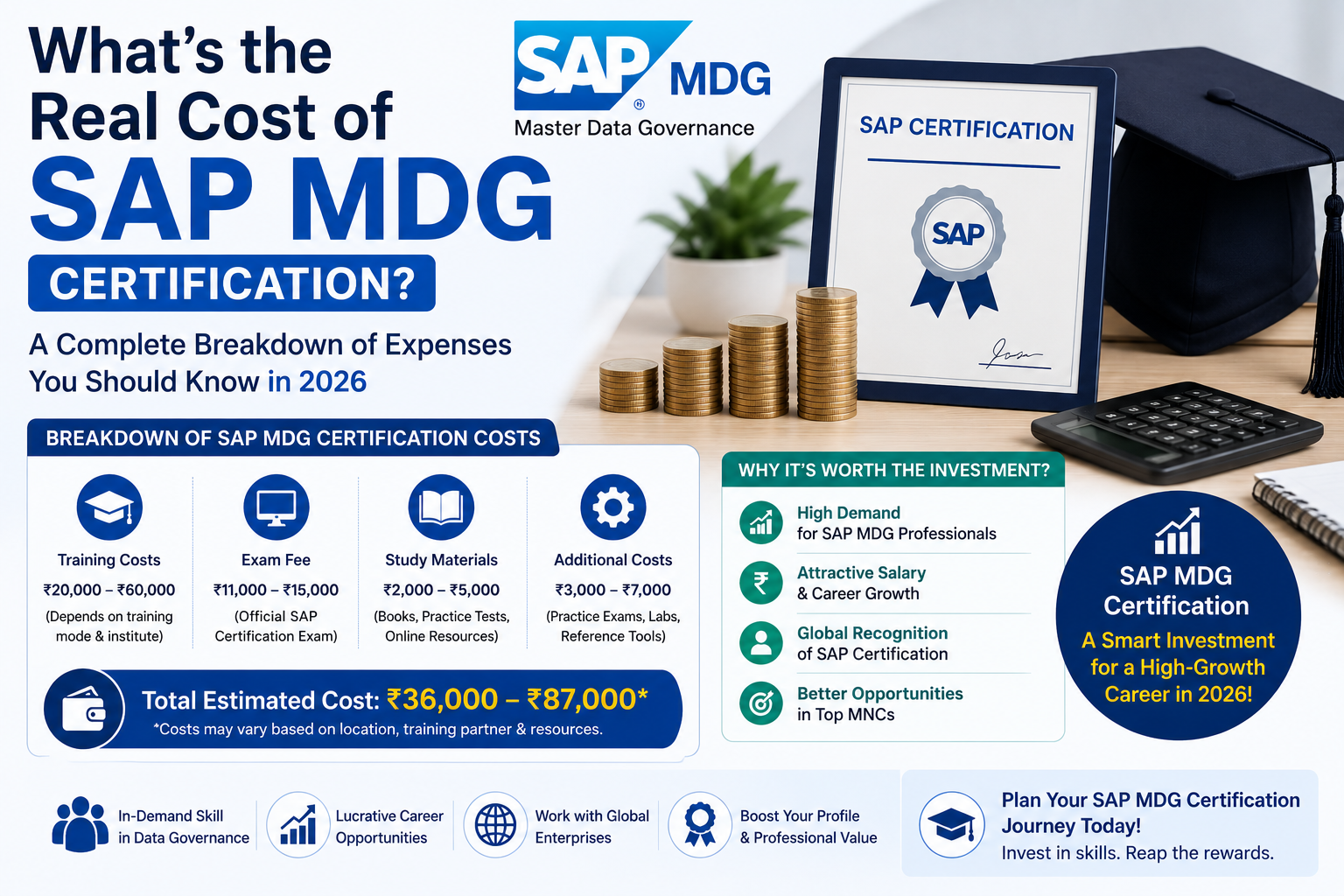
When people ask about certification cost, they're usually bundling together a few separate expenses:
- Training program fees — instructor-led classroom or online course fees
- Official SAP certification exam fees — charged separately by SAP if you pursue the formal SAP certification (not required for every job, but valuable for credibility)
- Study material and practice access — some providers include this, others charge extra
- Retake fees, if applicable, for the official exam
It's worth asking any training provider to break these out separately rather than quoting one bundled number, so you know exactly what you're paying for.
Factors That Influence the Cost
- Training mode: Classroom training in a city like Chennai is often priced differently from self-paced online courses
- Provider reputation and trainer experience: Institutes with SAP-experienced trainers and real project case studies typically price higher than generic online bundles
- Course depth: A course that includes SAP MDG-M and SAP MDG-S alongside core MDG will naturally cost more than a narrow, single-topic course
- Whether official SAP certification is included or is a separate, optional add-on
Because pricing changes over time and varies by provider, the most reliable way to get an accurate number is to request a direct quote — for example, from EduBrights' SAP MDG course page — rather than relying on outdated figures found online.
Is Official SAP Certification Necessary?
Not always. Many professionals build successful MDG careers on the strength of practical project experience and a strong resume, without holding the official SAP certification. That said, certification can help in specific situations:
- When you're early in your career and need a credential to stand out
- When applying to consulting firms that explicitly require certified SAP resources
- When you want a structured way to validate your knowledge before job hunting
If your goal is a corporate implementation role rather than consulting, practical skills and project exposure often matter more to hiring managers than the certificate itself.
How to Get the Best Value From Your Training Spend
- Compare what's actually included: live projects, mock interviews, doubt-clearing sessions, placement support
- Ask whether the syllabus covers SAP MDG-M and SAP MDG-S, not just the core module
- Check if the training pairs well with a foundational module like SAP MM if you're new to SAP
- Ask about batch size and trainer availability for one-on-one doubt resolution
Frequently Asked Questions (FAQs)
Q1. Is SAP MDG certification expensive compared to other SAP modules?
Costs are generally comparable to other functional module trainings; the bigger cost driver is usually training quality and whether official SAP certification is bundled in.
Q2. Do I need official SAP certification to get an MDG job?
Not necessarily — many professionals get hired based on practical training and project experience, though certification can help in certain consulting roles.
Q3. Are there hidden costs in SAP MDG training?
Sometimes, such as separate exam fees or paid retakes. Always ask for a full cost breakdown before enrolling.
Q4. How can I get an accurate, current price for SAP MDG training?
Contact a training provider directly for the latest fee structure, since prices change and vary by batch, mode, and inclusions.
Conclusion
The real cost of SAP MDG certification depends less on a single headline number and more on what's included — training depth, trainer quality, and whether official SAP certification is part of the package. Rather than chasing the cheapest option, evaluate the full value: practical project work, coverage of SAP MDG-M and SAP MDG-S, and support that actually prepares you for real MDG roles.
Contact us to know more about upcoming batches and get a free career counseling session.
Click Here to Join in Edubrights | SAP MDG Course
WhatsApp: +91-9498046428 | EduBrights Software Training Institute | Chennai
SAP MDG Certification Cost
SAP MDG Training Fees
SAP MDG Course
SAP Master Data Governance Certification
SAP MDG Price


