Popular
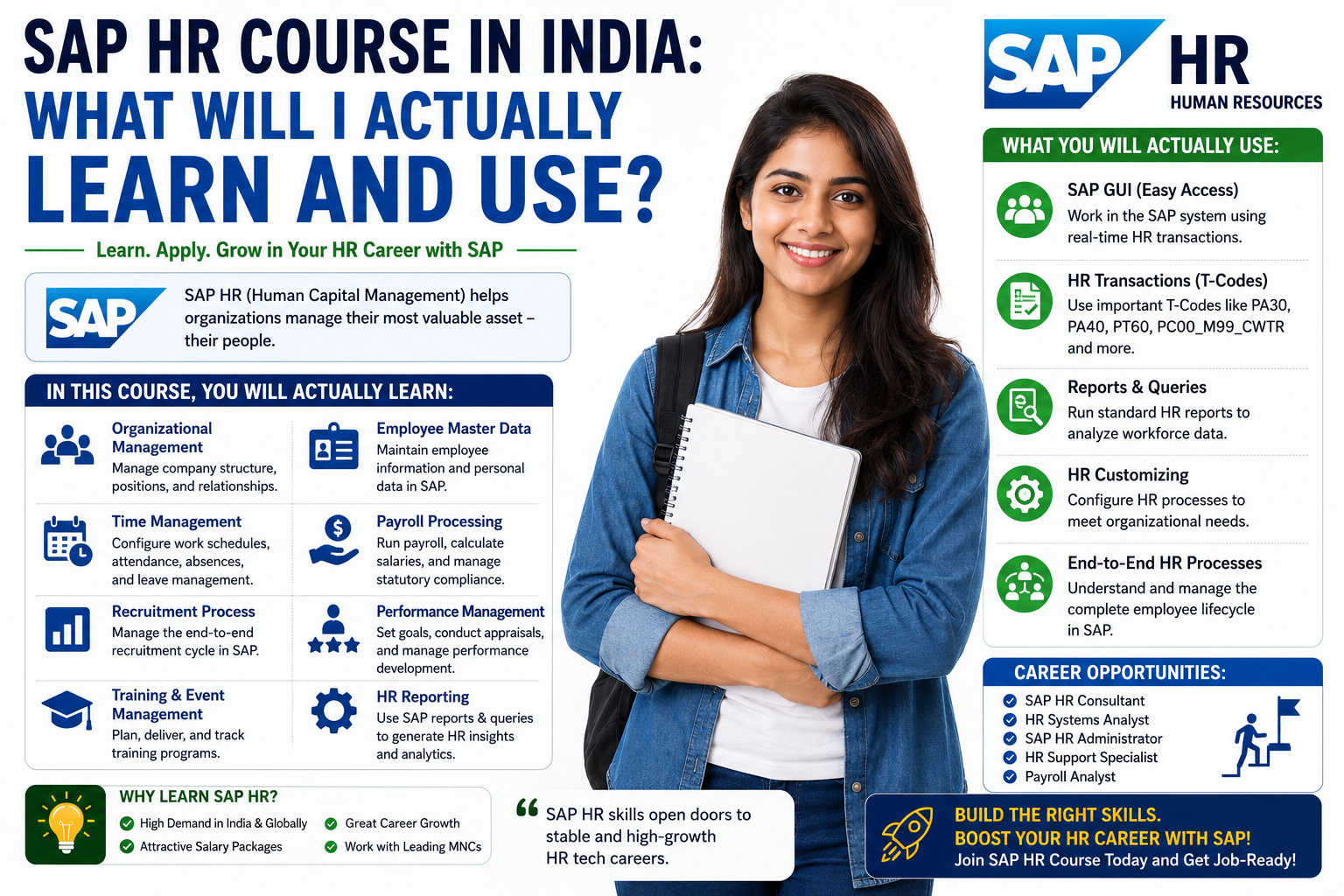
SAP HR Course in India: What Will I Actually Learn and Use?
Akram
June 30, 2026
5 min read
Learn what you will actually study in an SAP HR course in India. Explore SAP HCM topics, practical skills, career opportunities, job roles, and beginner guidance.
Introduction
Human resource management has evolved significantly with the growth of digital transformation. Organizations today use advanced HR technology to manage employee data, payroll, recruitment, performance, and workforce planning efficiently. SAP HR (SAP HCM) is one of the most widely used HR management solutions that helps businesses automate and optimize their human resource processes.
Many students and HR professionals in India consider learning SAP HR but often have questions like:
"What will I actually learn in an SAP HR course?"
"Will SAP HR skills help me build a career?"
This guide explains what you will learn in SAP HR training, practical skills you will gain, career opportunities, and how SAP HR is used in real business environments.
What Is SAP HR ?
SAP HR, also known as SAP Human Capital Management (SAP HCM), is an SAP module designed to manage employee-related processes within an organization.
It helps companies handle:
- Employee information management
- Payroll processing
- Recruitment
- Time management
- Organizational structure
- Employee benefits
- Performance management
SAP HR connects human resource operations with other SAP business processes, creating a centralized workforce management system.
What Will You Learn in an SAP HR Course?
A complete SAP HR course in India typically covers both basic and advanced HR processes.
1. SAP HR Fundamentals
You will learn the basics of SAP HR architecture and how it supports business operations.
Topics include:
- Introduction to SAP HCM
- SAP navigation
- HR organizational structure
- Personnel administration concepts
- Employee lifecycle management
This foundation helps beginners understand how SAP HR works in real organizations.
2. Personnel Administration (PA)
Personnel Administration is one of the core components of SAP HR.
You will learn how to manage:
- Employee master data
- Personal information
- Employee records
- Hiring processes
- Transfers and promotions
- Employee status changes
This module helps HR teams maintain accurate employee information.
3. Organizational Management (OM)
Organizational Management focuses on company structure and reporting relationships.
You will learn:
- Organizational units
- Positions
- Jobs
- Reporting hierarchy
- Organizational assignments
These concepts help companies manage workforce structures effectively.
4. Time Management
SAP HR helps organizations track employee attendance and working hours.
You will learn:
- Attendance management
- Leave management
- Work schedules
- Holiday calendars
- Time evaluation processes
5. SAP Payroll
Payroll is one of the most important areas of SAP HR.
You will understand:
- Payroll configuration basics
- Salary processing
- Wage types
- Deductions
- Payroll calculations
- Payroll reporting
Payroll knowledge is highly valuable for HR professionals.
6. Recruitment and Talent Management
Modern organizations use SAP solutions to manage hiring and employee development.
Topics include:
- Recruitment processes
- Candidate management
- Employee development
- Performance management
- Career planning
7. SAP SuccessFactors Overview
Many organizations are moving toward cloud-based HR solutions such as SAP SuccessFactors.
A modern SAP HR course may introduce:
- Employee Central
- Cloud HR processes
- Talent management
- Performance management
- Workforce analytics
Practical Skills You Will Gain
After completing SAP HR training, you will be able to:
- Manage employee data in SAP
- Understand HR business processes
- Configure basic HR functions
- Support payroll activities
- Handle organizational structures
- Generate HR reports
- Work with SAP HR transactions
Practical knowledge helps you become job-ready for SAP HR roles.
Who Should Learn SAP HR?
SAP HR is suitable for:
- HR Professionals
- MBA HR Graduates
- BBA Graduates
- Payroll Specialists
- HR Executives
- Recruitment Professionals
- Fresh Graduates interested in HR technology
- SAP professionals expanding their skills
Career Opportunities After SAP HR Training
SAP HR skills can help you pursue roles such as:
- SAP HR Consultant
- SAP HCM Consultant
- SAP SuccessFactors Consultant
- HR Systems Analyst
- SAP Payroll Consultant
- HR Technology Specialist
- SAP Support Consultant
Companies across IT services, manufacturing, healthcare, banking, retail, and consulting sectors hire SAP HR professionals.
Is SAP HR a Good Career Choice in India?
Yes. Organizations are increasingly adopting digital HR solutions to improve workforce management, automation, and employee experience.
SAP HR professionals with knowledge of SAP HCM, SAP SuccessFactors, and business processes can find opportunities in:
- Implementation projects
- HR technology consulting
- SAP support teams
- Enterprise transformation projects
Tips to Learn SAP HR Successfully
To build a strong SAP HR career:
- Understand basic HR concepts first.
- Learn SAP navigation thoroughly.
- Practice employee lifecycle scenarios.
- Work on real-time HR case studies.
- Learn SAP SuccessFactors basics.
- Improve communication and analytical skills.
- Prepare for SAP HR interviews.
Practical exposure is important because employers look for candidates who can apply SAP knowledge to real HR processes.
Frequently Asked Questions (FAQs)
Q1. What is SAP HR used for?
SAP HR is used to manage employee information, payroll, recruitment, attendance, organizational structures, and workforce processes.
Q2. Is SAP HR difficult to learn?
No. Beginners can learn SAP HR with basic HR knowledge and proper practical training.
Q3. Who can join SAP HR training?
HR professionals, MBA HR graduates, freshers, payroll specialists, and anyone interested in HR technology can learn SAP HR.
Q4. Is coding required for SAP HR?
No. SAP HR is mainly a functional module and does not require programming knowledge.
Q5. What jobs can I get after SAP HR training?
You can apply for roles such as SAP HR Consultant, SAP HCM Consultant, SAP SuccessFactors Consultant, HR Systems Analyst, and SAP Support Consultant.
Conclusion
SAP HR is a valuable skill for professionals who want to combine human resource management with enterprise technology. An SAP HR course helps you understand how organizations manage employees, payroll, recruitment, and workforce operations using SAP solutions.
With practical training, real-time project exposure, and knowledge of modern HR platforms like SAP SuccessFactors, you can build a strong career in SAP HR consulting and HR technology in India.
SAP HR Course in India
SAP HR Training
SAP HCM Course
SAP HR Certification
Learn SAP HR
SAP HR Career
SAP HR Consultant
SAP HCM Training
SAP Payroll Training
SAP SuccessFactors
SAP HR Jobs
SAP HR Module


