Popular
Is SAP FICO Difficult to Learn? Tips for Beginners
Akram
June 30, 2026
5 min read
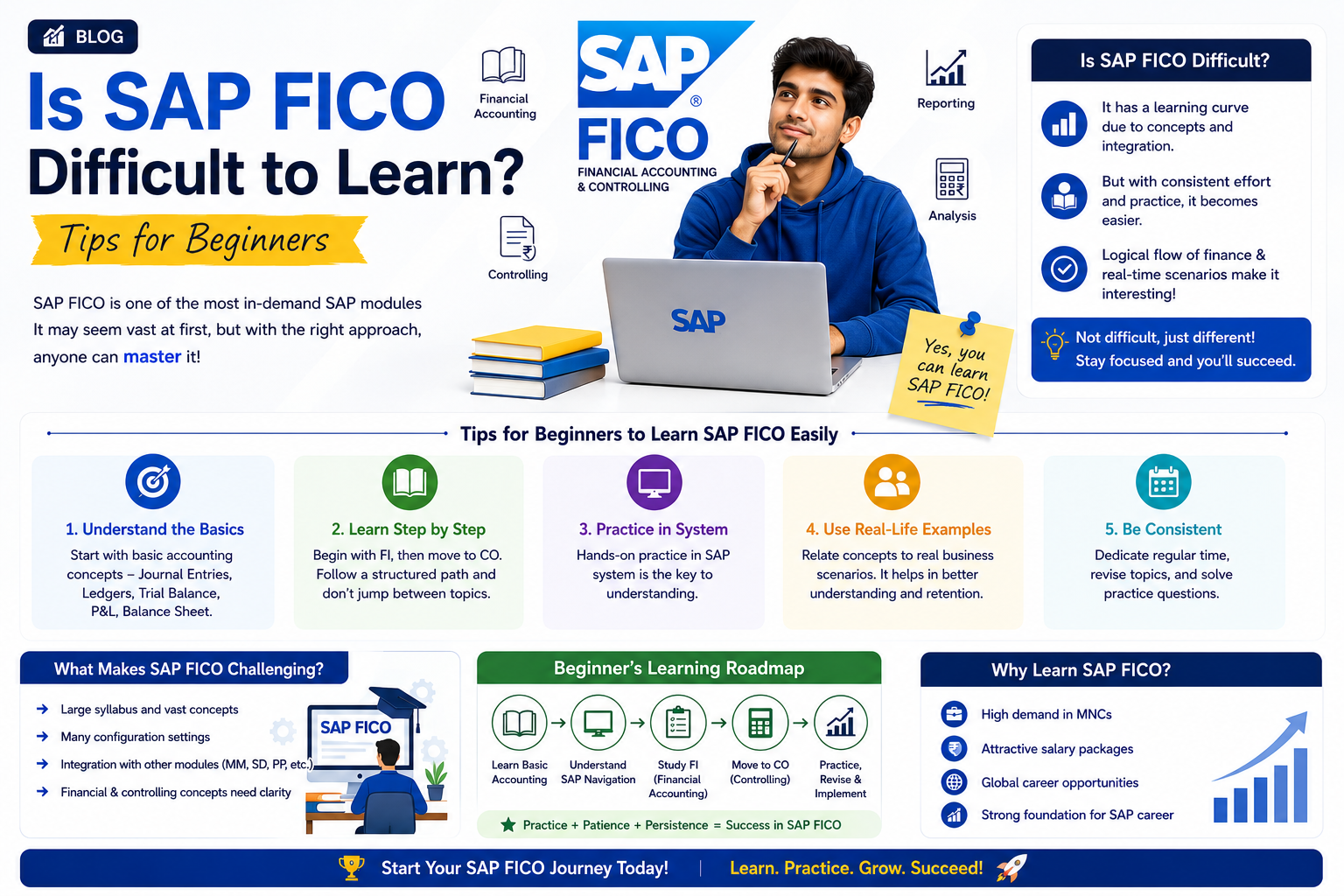
Wondering if SAP FICO is difficult to learn? Discover beginner-friendly tips, required skills, career opportunities, and how to master SAP FICO successfully.
Introduction
SAP FICO is one of the most popular SAP functional modules, widely used by organizations to manage financial accounting and controlling processes. Because of its strong demand across industries, many students, commerce graduates, and finance professionals consider learning SAP FICO to build a successful ERP career.
However, a common question among beginners is: "Is SAP FICO difficult to learn?" The answer depends on your educational background, willingness to practice, and understanding of finance concepts. With the right training and practical experience, SAP FICO can be learned by both freshers and working professionals.
What Is SAP FICO?
SAP FICO stands for Financial Accounting (FI) and Controlling (CO). It helps organizations manage financial transactions, budgeting, reporting, cost control, and internal accounting processes.
Key areas covered include:
- General Ledger Accounting
- Accounts Payable
- Accounts Receivable
- Asset Accounting
- Cost Center Accounting
- Profit Center Accounting
- Financial Reporting
It is one of the core modules in SAP ERP and SAP S/4HANA implementations.
Is SAP FICO Difficult for Beginners?
SAP FICO is not inherently difficult, but it does require an understanding of finance and accounting principles. Beginners without an accounting background may need extra time to understand concepts such as journal entries, ledgers, financial statements, and cost accounting.
Once these fundamentals are clear, learning SAP FICO becomes much easier through hands-on practice and real-world examples.
Factors That Affect the Learning Curve
Several factors influence how quickly you can learn SAP FICO:
Educational Background
Commerce graduates, MBA Finance students, accountants, and finance professionals usually learn SAP FICO faster because they are already familiar with accounting concepts.
Practical Training
Institutes that provide live projects, system access, and case studies help learners gain confidence much faster than theory-only courses.
Consistent Practice
Practicing transactions and understanding business processes regularly is essential for mastering SAP FICO.
Quality of Training
Experienced instructors who explain real-world business scenarios can significantly reduce the learning curve.
Tips for Learning SAP FICO Faster
If you're new to SAP FICO, these tips can help:
- Learn basic accounting concepts first.
- Understand business processes before SAP transactions.
- Practice using real-time scenarios.
- Work on hands-on assignments.
- Learn SAP navigation and reporting.
- Revise important financial concepts regularly.
- Take mock interviews and practical assessments.
Building a strong foundation makes advanced topics much easier to understand.
Skills You'll Gain
A comprehensive SAP FICO course helps you develop skills in:
- Financial Accounting
- Cost Accounting
- Business Process Management
- SAP Navigation
- Financial Reporting
- Asset Management
- Budgeting and Cost Control
- ERP Fundamentals
These skills are valuable across industries using SAP ERP.
Career Opportunities After Learning SAP FICO
SAP FICO professionals are employed in organizations of all sizes.
Common job roles include:
- SAP FICO Consultant
- Financial Analyst
- ERP Consultant
- SAP Support Consultant
- Accounts Executive
- Finance Business Analyst
- Implementation Consultant
- SAP Functional Consultant
Industries hiring SAP FICO professionals include banking, manufacturing, healthcare, retail, IT services, consulting, and telecommunications.
Is SAP FICO Worth Learning?
Yes. SAP FICO remains one of the most in-demand SAP modules because every organization needs effective financial management and reporting. Professionals with SAP FICO expertise enjoy strong career opportunities, competitive salaries, and the flexibility to work across multiple industries.
For candidates interested in finance and ERP systems, SAP FICO offers excellent long-term career growth.
Frequently Asked Questions (FAQs)
Q1. Is SAP FICO difficult for freshers?
No. Freshers can learn SAP FICO successfully with proper training, regular practice, and a good understanding of accounting fundamentals.
Q2. Do I need an accounting background?
While an accounting background is helpful, it is not mandatory. Beginners can learn accounting basics before moving to SAP FICO.
Q3. How long does it take to learn SAP FICO?
Most learners complete SAP FICO training in 2–4 months, depending on the course structure and learning pace.
Q4. Is coding required for SAP FICO?
No. SAP FICO is a functional module and generally does not require programming knowledge.
Q5. Can I get a job after learning SAP FICO?
Yes. Candidates with practical training, project experience, and a solid understanding of finance processes have good opportunities in SAP consulting and ERP support roles.
Conclusion
SAP FICO may seem challenging initially, especially for beginners without a finance background, but it becomes much easier with structured learning and consistent practice. Understanding accounting principles, working on practical projects, and learning from experienced trainers can help you master the module efficiently.
If you're looking for a stable and rewarding career in finance and ERP, SAP FICO is an excellent choice. With the right training and hands-on experience, you can develop valuable skills that are in demand across industries in India and around the world.
SAP FICO
SAP FICO Training
Learn SAP FICO
SAP FICO Course
SAP Certification
SAP Finance
SAP ERP
SAP Consultant
SAP Career
SAP Jobs


