Learn Databricks in 5 Minutes
Learn Databricks for beginners in this easy tutorial. Discover its architecture, key features like Delta Lake and MLflow, and step-by-step setup with free community edition. Boost your data engineering career with Edubrights Chennai training—enroll for hands-on certification and placements!
Learn Databricks in 5 Minutes: The Beginner's Quick-Start Guide
Wait, what? Can you really learn Databricks in 5 minutes? Nope—that's just the hook. But in these first 5 minutes of reading, you'll get a crystal-clear beginner's roadmap: exactly what Databricks is, why it powers companies like Netflix, and where to start your hands-on journey today. No fluff, just actionable steps to kickstart your data engineering career.
In today's data-driven world, giants like Amazon, Uber, and Netflix handle petabytes of data in real-time to power your shopping, rides, and recommendations. But for most teams, managing this data chaos is tough. If you're a beginner in data engineering or AI, learning Databricks is your fastest path to mastering it all.
Databricks isn't just a tool—it's a game-changer. In this Databricks for beginners guide, we'll break it down simply: what it is, why it solves real problems, its architecture, key features, and how to start today. No jargon overload—just clear steps to get you building.
The Big Problem: Why Data Teams Struggle (And How Databricks Fixes It)
Back in 2015, data work was a mess. Data engineers coded in Apache Spark, data scientists used Jupyter Notebooks, analysts stuck to SQL, and ML teams had separate deployment tools. Result? Data silos that wasted everyone's time.
Here's what went wrong:
- Wasted Time: Moving a machine learning model from test to production took weeks due to incompatible tools.
- Failed Projects: Studies show 87% of ML projects fail to reach production because tools don't collaborate.
- Infra Nightmares: Teams spent more time fixing servers than uncovering insights.
Databricks changes everything. Founded by Apache Spark's creators, it's a unified analytics platform where engineers, scientists, and analysts work in one seamless space. Do ingestion, transformation, ML, and reporting without tool-hopping. It scales Spark's power with beginner-friendly ease.
What is Databricks? A Simple Breakdown for Beginners
Think of Databricks as your all-in-one data playground. Built on Spark, it handles massive data processing while letting teams collaborate like never before.
Why choose Databricks for beginners?
- One platform for everything: ETL, analytics, ML.
- Handles petabytes effortlessly with auto-scaling.
- Free community edition to practice without cost.
Companies like Adobe and Mastercard use it to fuel their data magic. Ready to join them?
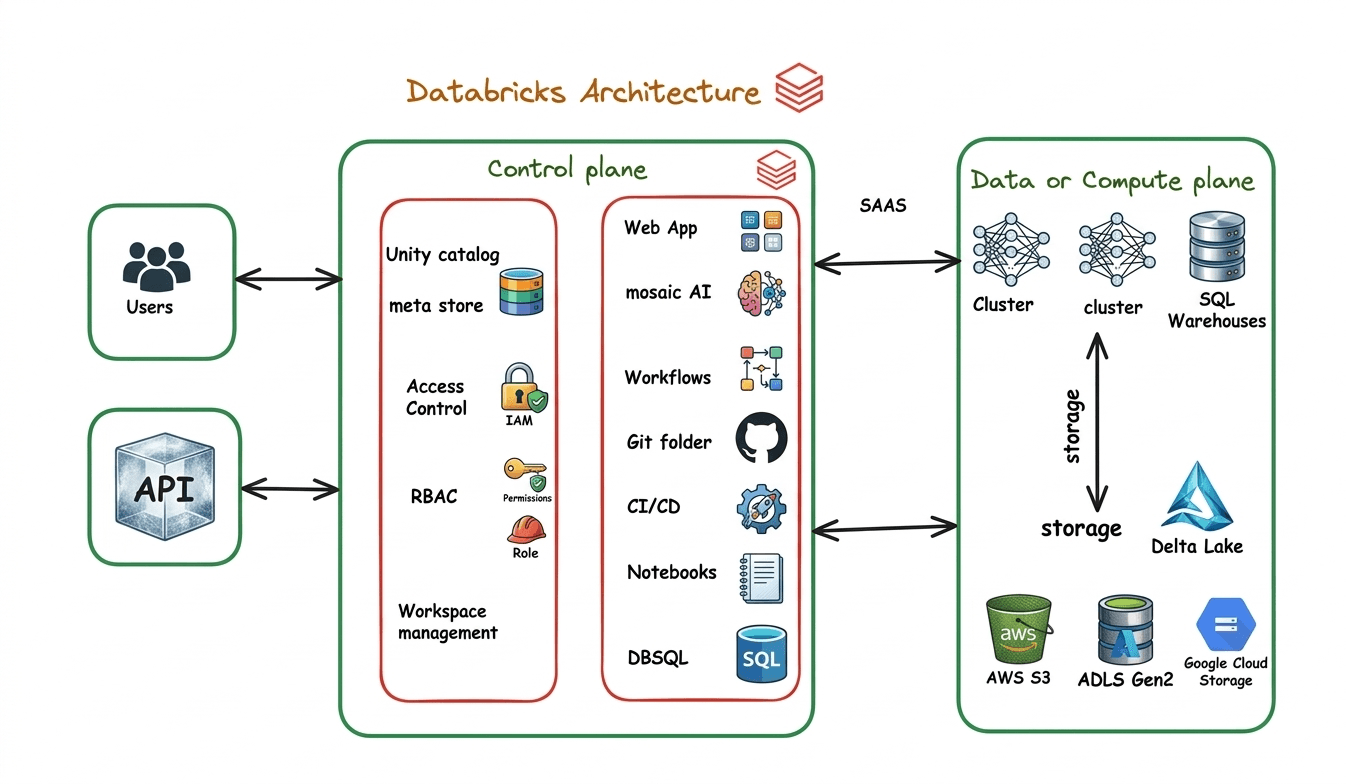
Databricks Architecture Explained: Brain, Muscle, and Storage
Grasp the basics with this Databricks tutorial breakdown. Databricks has three core parts—like a smart brain, powerful muscles, and organized storage.
1. Control Plane (The Brain)
- Fully managed by Databricks.
- Handles user logins, job scheduling, and the web UI.
- You focus on data; they handle the ops.
2. Compute Plane (The Muscle)
- Where data processing happens.
- Serverless: Databricks auto-manages scaling—no setup needed.
- Classic: Runs in your AWS/Azure account for custom control.
3. Workspace Storage
- Stores your files in DBFS (Databricks File System).
- Unity Catalog keeps data secure and organized.
Key Databricks Components Every Beginner Needs
Databricks packs powerful tools. Here's what you'll use most:
- Databricks Workspace: Your collaborative hub for notebooks, code, and dashboards.
- Clusters: Auto-scaling groups of machines. Start small, scale to petabytes automatically.
- Databricks SQL: SQL queries and drag-and-drop dashboards for analysts.
- MLflow: Tracks ML experiments, versions models, and deploys them smoothly.
- Delta Lake: Adds "ACID" reliability to data lakes—your data stays consistent, even with big changes.
Pro Tip: ACID means Atomicity, Consistency, Isolation, Durability—like a bank transaction that never fails halfway.
How to Get Started with Databricks: Step-by-Step for Beginners
Stop reading—start doing! This learn Databricks guide takes 10 minutes.
- Sign Up Free: Go to databricks.com/try-databricks. Choose Community Edition (free forever).
- Create a Workspace: Log in, set up your workspace.
- Launch a Cluster: Pick serverless, start small (e.g., 1 worker).
- Make Your First Notebook: Write simple code like:
df = spark.read.csv("your-file.csv", header=True) display(df) - Run a Query: Use Databricks SQL for instant viz.
- Experiment with MLflow: Track a simple model.
Boom—you're processing data like a pro! Practice daily to build skills.
Why Learn Databricks Now? Career Boost for Data Beginners
Demand for Databricks skills is exploding:
- Data Engineer roles: ₹8-15 LPA starting in Chennai.
- AI/ML jobs: Top companies seek Spark + Databricks experts.
- Future-proof: Powers lakehouse architecture (data lake + warehouse).
Research shows Databricks users deploy ML 5x faster.
Level Up with Edubrights: Hands-On Databricks Training in Chennai
Reading is great, but real mastery comes from guided practice. At Edubrights Software Training Institute in Chennai, our Databricks certification course is designed for beginners:
- 10-Day Bootcamp: 4 hours/day, hands-on projects.
- Covers Spark, Delta Lake, MLflow, Unity Catalog.
- Includes AWS integration, job-ready portfolio.
- Placement support: Mock interviews, aptitude training.
- Affordable, corporate-college tie-ups.
Over 500+ students placed at top firms. Enroll now for Databricks for beginners and land your dream data role!
Click Here to Join in Edubrights | Databricks Course
WhatsApp: +91-9498046428 / +91-9498055428 | EduBrights Software Training Institue | Chennai.
Get Training Quote for Free
Related Blogs

Top Interview Questions for Java Backend Developers
This blog covers top Java backend interview questions with clear answers, focusing on Spring Boot, REST APIs, Hibernate, security, and performance to help freshers and professionals prepare confidently.

How Can You Get Ready for a Data Science Interview After Finishing a Course?
Preparing for a data science interview is an important step after completing a data science course. While training helps you learn key concepts, interviews require you to demonstrate practical knowledge, problem-solving ability, and clear communication. This blog explains how reviewing core data science concepts, practicing real-world projects, strengthening programming skills, and preparing common interview questions can help candidates succeed. It also highlights the importance of building a strong portfolio, improving communication skills, and staying updated with industry trends to increase your chances of starting a successful career in data science.

What You Will Learn in a Professional MySQL Course – Curriculum Explained
In today’s data-driven world, databases play a critical role in almost every application, from small websites to large enterprise systems. Among all database technologies, MySQL continues to be one of the most widely used and trusted solutions across industries. If you are planning to build a career in database management, web development, or data-related roles, enrolling in professional mysql courses can be a smart and future-proof decision. This blog explains in detail what you will learn in a professional MySQL course, how the curriculum is structured, and why choosing the best mysql course can make a real difference in your career growth.

Java Courses: The Smart Way to Build a Strong Programming Career
This blog explains why Java remains a top programming language, highlights the benefits of Java courses and online training, and shows how certification and hands-on learning can boost career growth.